




























Views
Downloads

Printable Plate-Motion Scenario Worksheet | Grade 8 Science

Paste this activity's link or code into your existing LMS (Google Classroom, Canvas, Teams, Schoology, Moodle, etc.).
Students can open and work on the activity right away, with no student login required.
You'll still be able to track student progress and results from your teacher account.
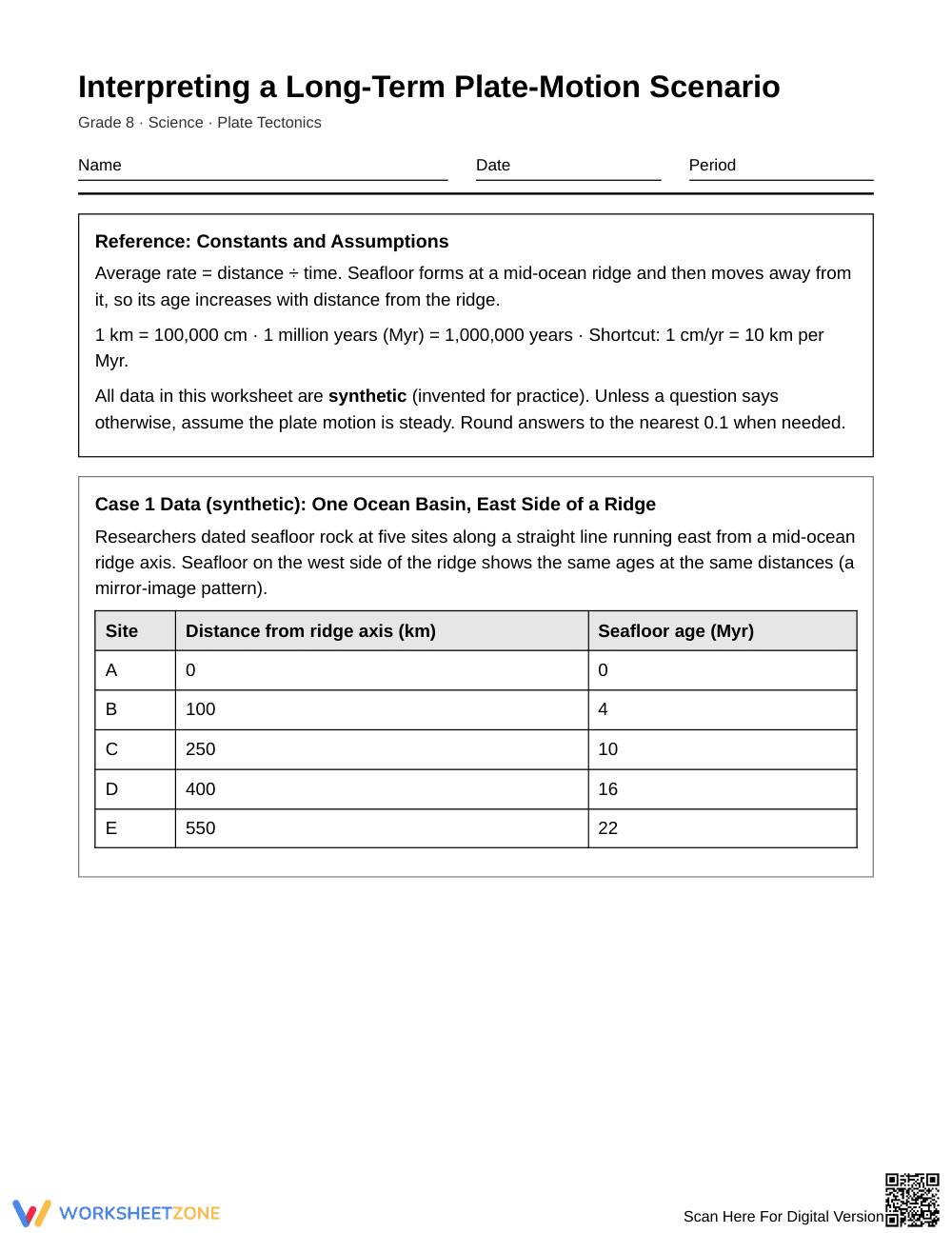
This Grade 8 Science worksheet teaches students to interpret a long-term plate-motion scenario by turning seafloor age and distance data into spreading rates, predictions, and evidence-based judgments. Students finish able to calculate a rate in cm/yr, use it to predict ages, and critique claims that go beyond the data.
At a Glance
- Grade: 8 · Subject: Science
- Standard: Plate tectonics data analysis — calculate rates from seafloor data and judge claims with evidence
- Skill Focus: Interpret a long-term plate-motion scenario
- Format: 5 pages · 10 problems · Answer key included · PDF
- Best For: Plate tectonics quantitative reasoning practice
- Time: 40–50 minutes
What's Inside
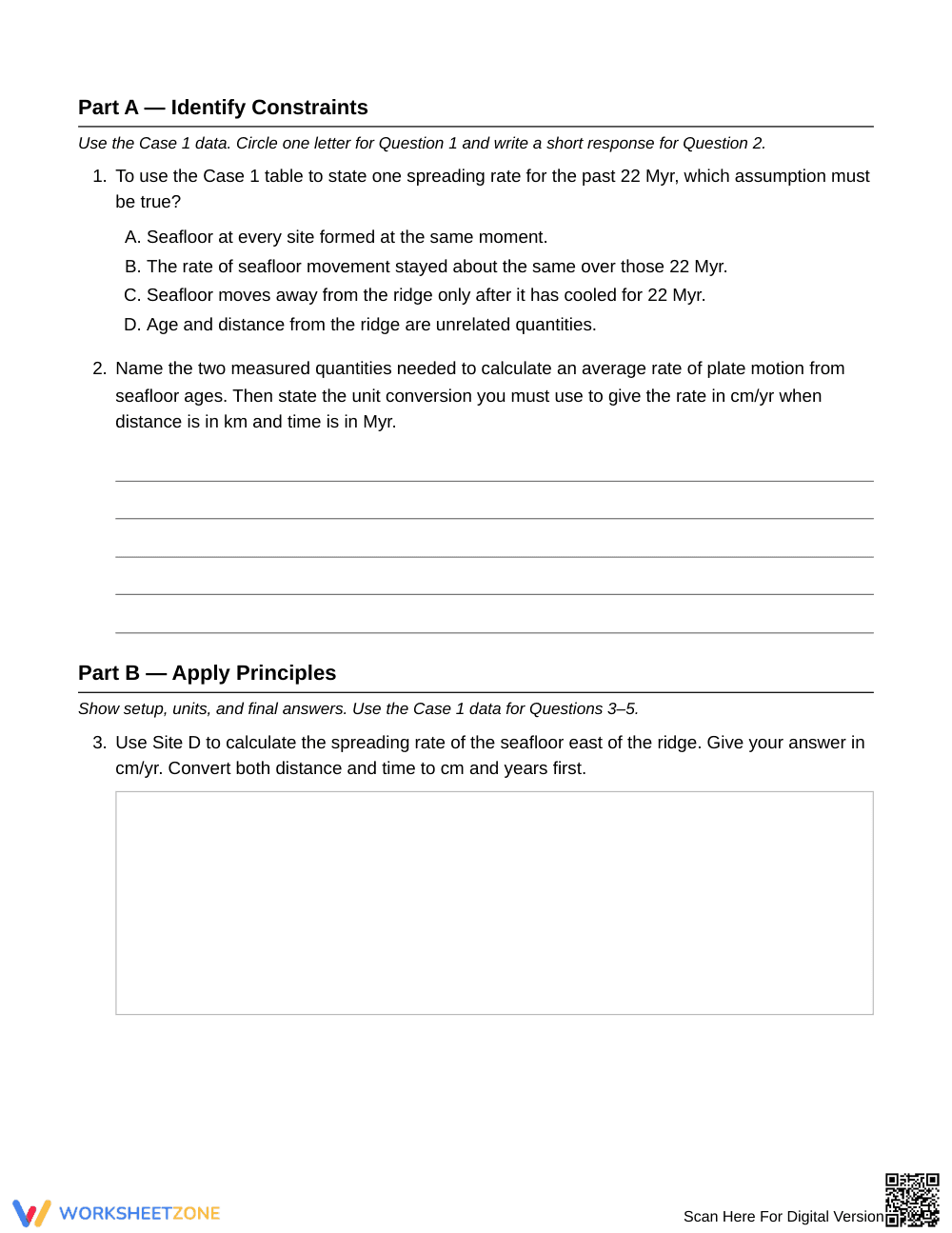
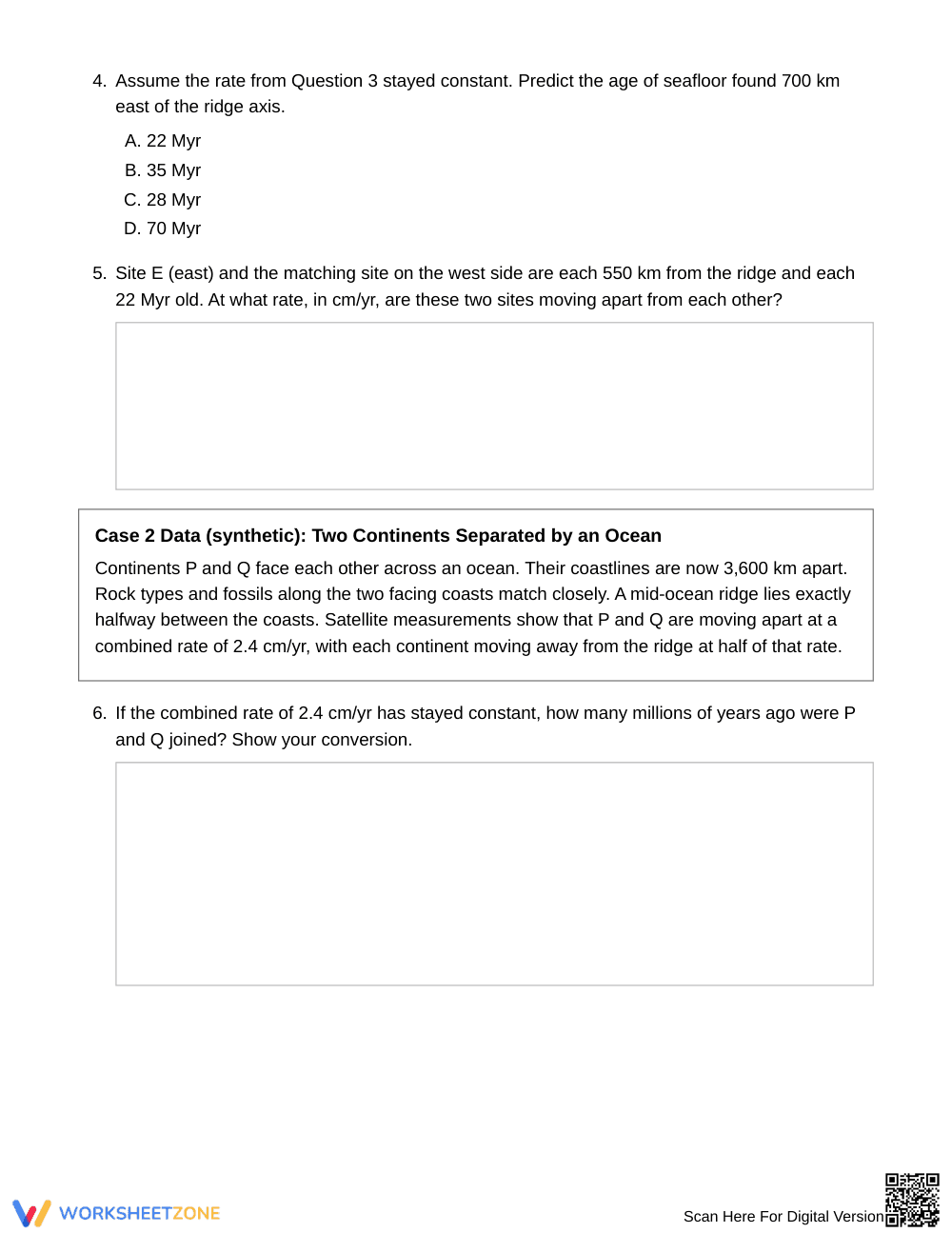
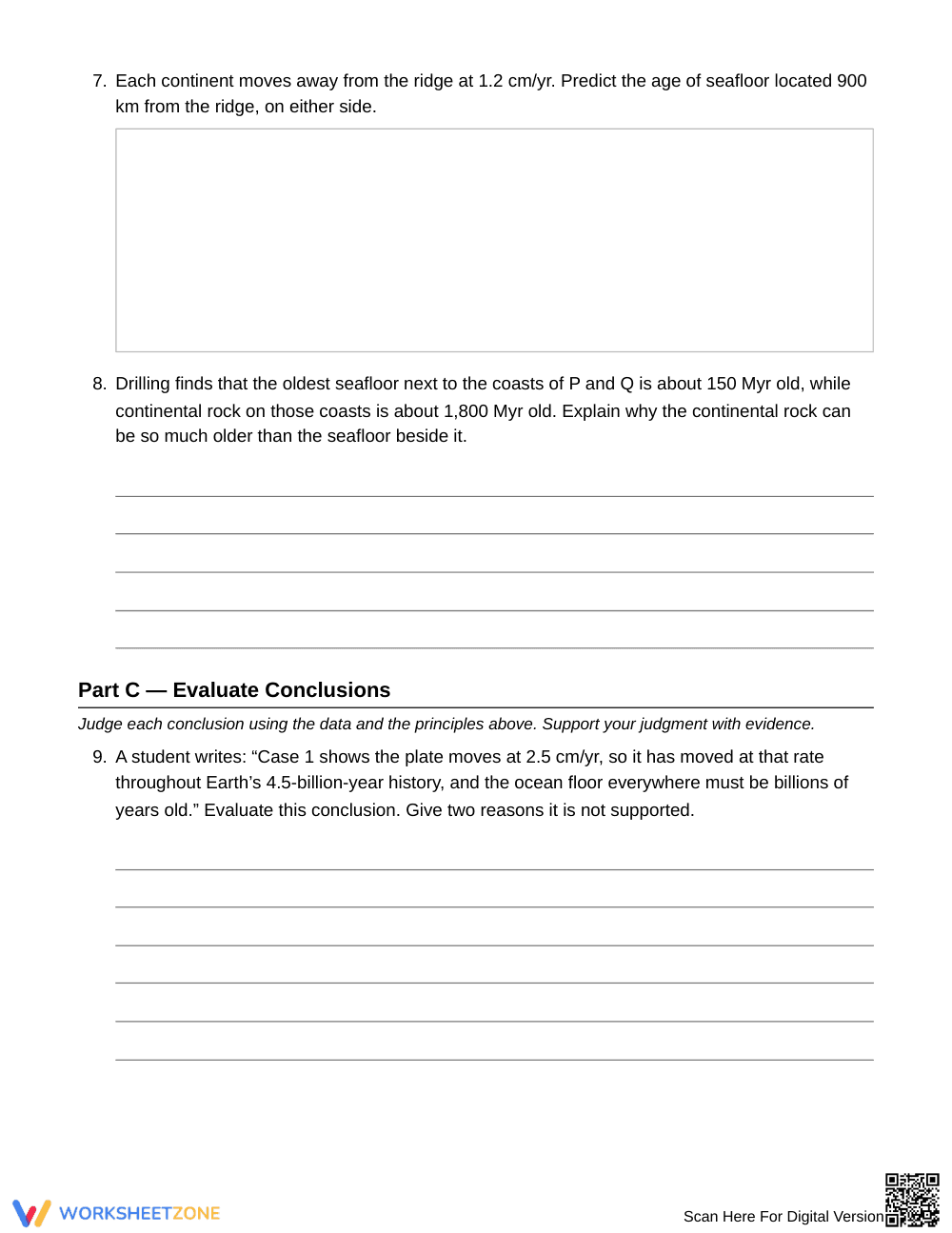
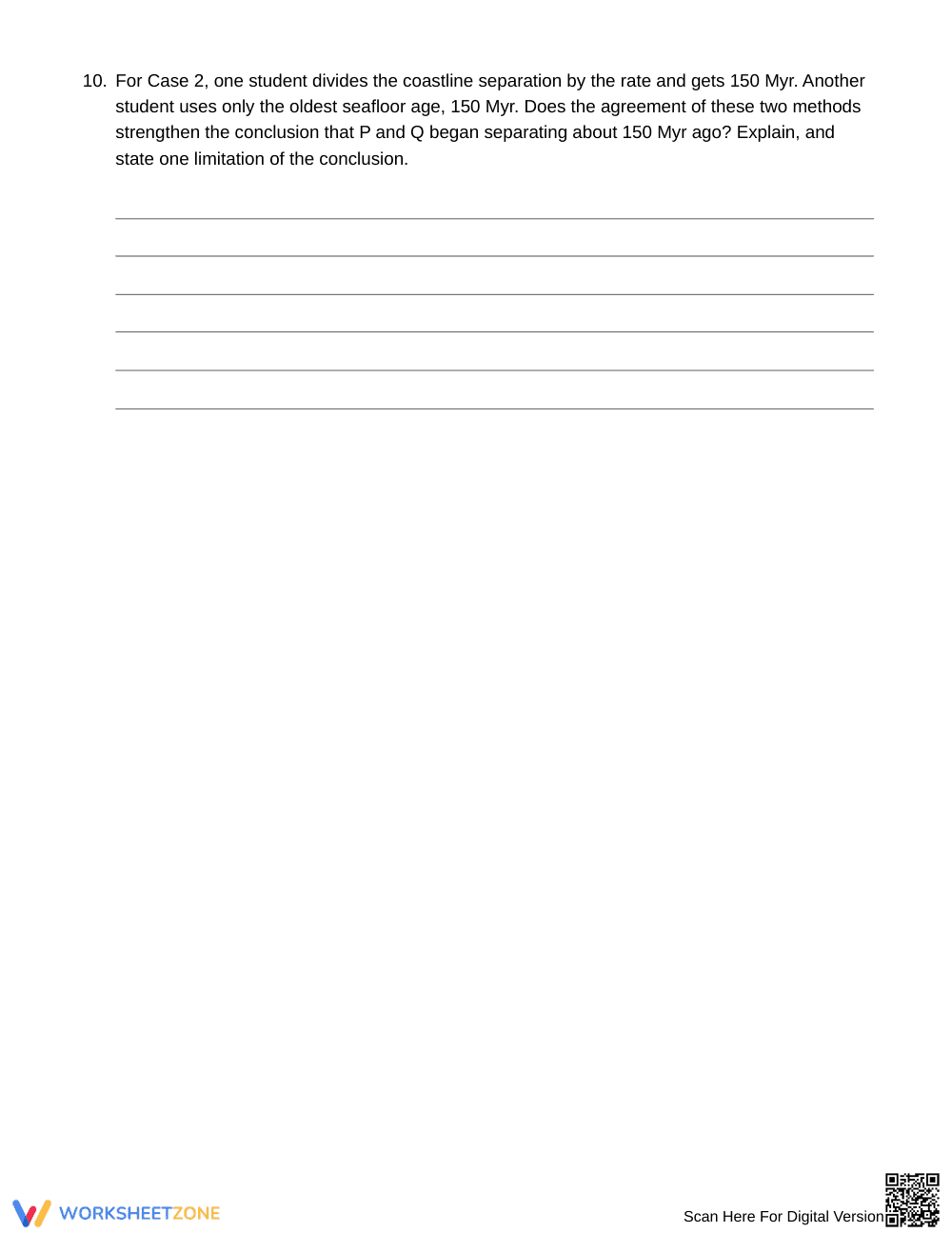
The packet has 5 pages: three student pages and a 2-page answer key. A reference box lists the rate formula, the km-to-cm and Myr-to-year conversions, and a shortcut (1 cm/yr = 10 km per Myr). Students work with two synthetic cases: a five-site seafloor-age table on one side of a mid-ocean ridge, and a scenario of two continents separated by an ocean. Task types include multiple choice, short response, multi-step calculation with units, prediction, and written evaluation of student claims.
Skill Progression
- Guided practice (Part A, 2 tasks): Students identify the assumptions and measured quantities needed to calculate a rate, with the reference box as support.
- Supported practice (Part B, 6 tasks): Students calculate spreading rates, convert units, and predict seafloor ages, showing setup and units.
- Independent practice (Part C, 2 tasks): Students judge claims, cite evidence, and state limitations without scaffolds.
The sequence follows a gradual-release model: I Do, We Do, You Do.
Standards Alignment
No standard code was supplied for this worksheet, so none is listed. The tasks address plate-motion evidence: using seafloor age and distance data, matching rock and fossil patterns, and the steady-rate assumption to reason about Earth's changing surface. Teachers can map the tasks to their own state or district plate-tectonics standards in lesson plans, IEP goals, or curriculum mapping tools.
How to Use It
- After direct instruction: Assign Parts A and B as independent practice once students have seen seafloor spreading. Circulate and check whether students convert km and Myr before dividing.
- Before a unit assessment: Use Part C as a review discussion. Have partners compare their evaluations of the student claims.
Formative tip: watch Question 3, where unit-conversion errors show up first. Expect 40–50 minutes for the full set, or about 25 minutes for Parts A and B alone.
Who It's For
Designed for Grade 8 Science students in a plate tectonics unit who are ready to combine ratio reasoning with earth science evidence. Students who need support can rely on the reference box; others can push into the critique tasks. It pairs well with a seafloor-age map or an anchor chart on continental drift evidence.
Interpreting a Long-Term Plate-Motion Scenario is a Grade 8 Science worksheet in which students use synthetic seafloor-age and continental-separation data to calculate spreading rates, convert kilometers per million years into cm/yr, predict seafloor ages, and evaluate student conclusions. Its 10 tasks move from identifying constraints, through applying rate principles, to judging claims against evidence. The structure reflects the gradual-release model described by Fisher & Frey (2014), in which responsibility shifts from modeling to guided work to independent application. The worksheet supports quantitative reasoning about plate tectonics by requiring setup, units, and justification for each calculation, and it asks students to name limits such as the steady-rate assumption. A 2-page answer key lets teachers check reasoning quickly, spot unit-conversion errors, and reteach before the next lesson.


