
































Printable Plate Motion Forces Worksheet | Grade 8 Science

Paste this activity's link or code into your existing LMS (Google Classroom, Canvas, Teams, Schoology, Moodle, etc.).
Students can open and work on the activity right away, with no student login required.
You'll still be able to track student progress and results from your teacher account.
This Grade 8 science worksheet helps students explain why plate motion has more than one cause. Learners use synthetic seafloor-age, plate-speed, and depth data to test mantle convection, ridge push, and slab pull, then defend a claim with numbers and reasoning.
At a Glance
- Grade: 8 · Subject: Science
- Standard: Plate Tectonics unit — use data to explain how several forces move plates
- Skill Focus: Explaining multiple causes of plate motion
- Format: 5 pages · 6 problems · Answer key included · PDF
- Best For: Data-based plate tectonics unit practice
- Time: 45–60 minutes
What's Inside
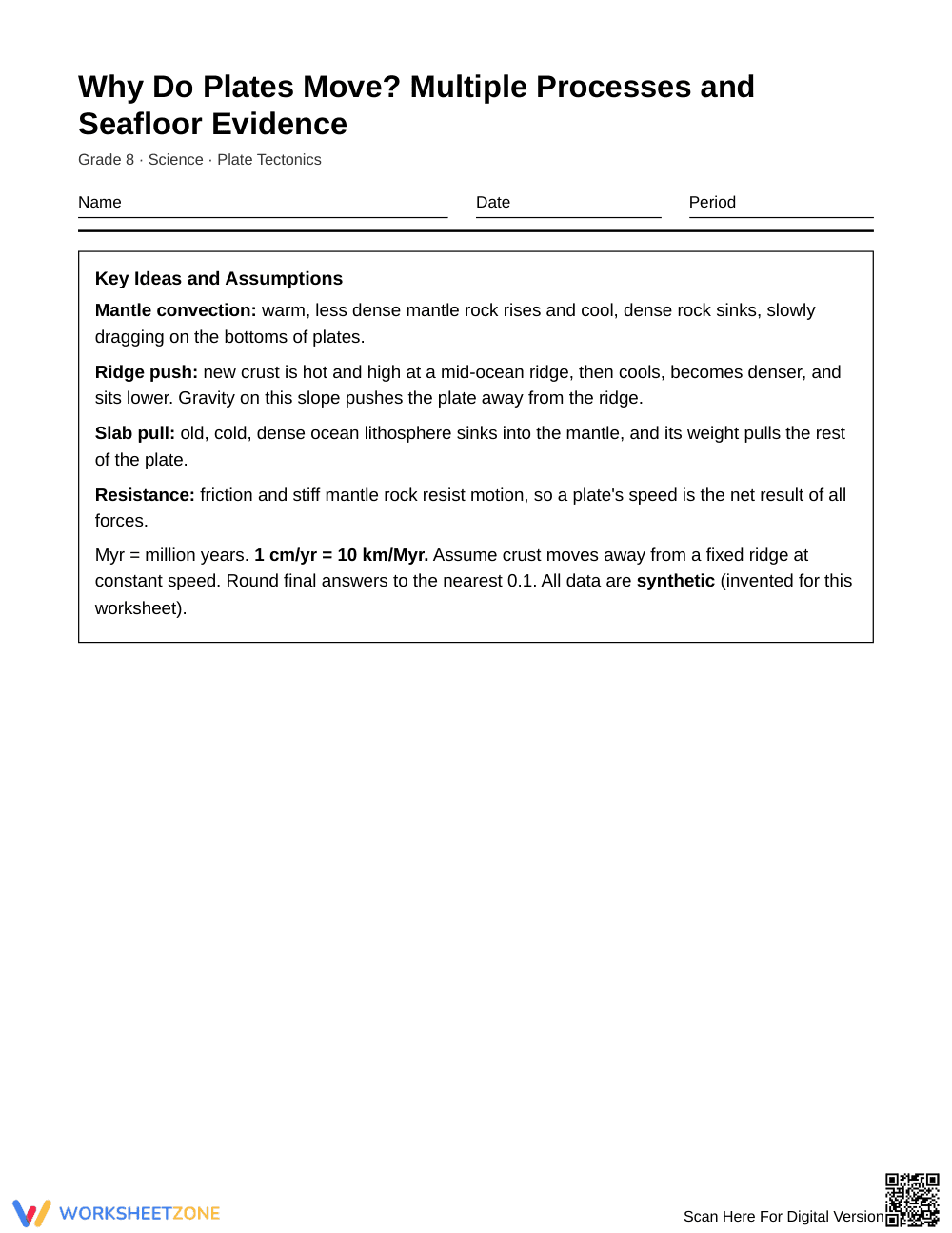
The worksheet opens with a Key Ideas box defining mantle convection, ridge push, slab pull, and resistance, plus unit conversions and assumptions. Three synthetic data tables follow: crust age along two transects, four plates with speed and sinking-edge data, and seafloor depth by age. Six tasks move through calculation, inverse reasoning, model comparison, and a written claim-evidence-reasoning response. A 3-page answer key shows the worked steps.
Skill Progression
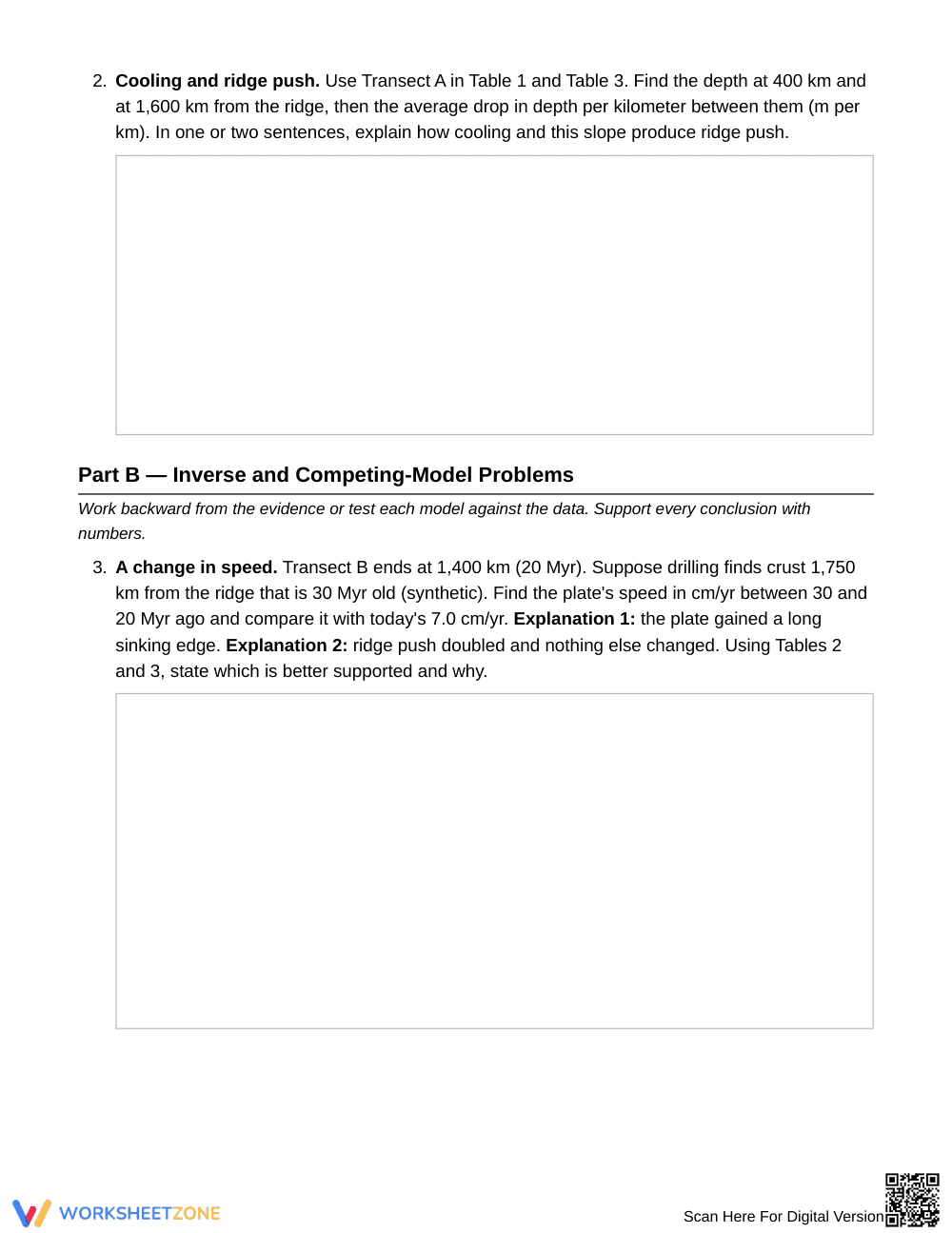
- Guided practice (Part A, 2 tasks): Constrained applications. Students calculate spreading rates and depth change using only the data given, with units shown at every step.
- Supported practice (Part B, 3 tasks): Inverse and competing-model problems. Students work backward from crust age, test two explanations for a speed change, and compare two models by prediction error.
- Independent practice (Part C, 1 task): Students write a defended explanation that names two processes, cites three numerical values, and identifies one limitation.
The sequence follows gradual release: I Do, We Do, You Do.
Standards Alignment
No standard code was supplied for this worksheet. The content supports middle school Earth science goals in which students use data and models to explain that several forces, including mantle convection, ridge push, and slab pull, combine with resistance to determine plate motion. Teachers can map the tasks to the standard their state or district uses for plate tectonics in lesson plans, IEP goals, or curriculum mapping tools.
How to Use It
- After direct instruction: Assign Parts A and B as independent or partner work once the three driving forces have been taught. Expect 30–40 minutes.
- As a unit-closing task: Use Part C as a written assessment of reasoning. Expect 10–15 minutes.
Formative tip: while students work, watch whether they attribute every speed difference to one force. Students who do this often skip the resistance idea in the Key Ideas box.
Who It's For
This worksheet suits Grade 8 science students who have met the basics of plate boundaries and can work with rates, tables, and simple linear models. Students who need support can start with Part A and use the Key Ideas box as a reference. Advanced students can focus on the model-limitation questions. It pairs well with a mid-ocean ridge and subduction zone diagram or anchor chart.
This Grade 8 Plate Tectonics worksheet teaches students to explain why multiple processes contribute to plate motion. Students apply mantle convection, ridge push, slab pull, and resistance to six data-driven tasks that use synthetic seafloor-age, plate-speed, and depth tables. They calculate spreading rates, link cooling crust to seafloor slope, and compare competing models by prediction error. They then write a claim-evidence-reasoning response that rejects a single-cause explanation. The structure follows the gradual release of responsibility described by Fisher & Frey (2014), moving from guided calculations through supported inverse problems to an independent written defense. A 3-page answer key supports quick, consistent scoring of every task.


