































Printable Parks and Trails Word Search | Grades 6–7 ELA

Paste this activity's link or code into your existing LMS (Google Classroom, Canvas, Teams, Schoology, Moodle, etc.).
Students can open and work on the activity right away, with no student login required.
You'll still be able to track student progress and results from your teacher account.
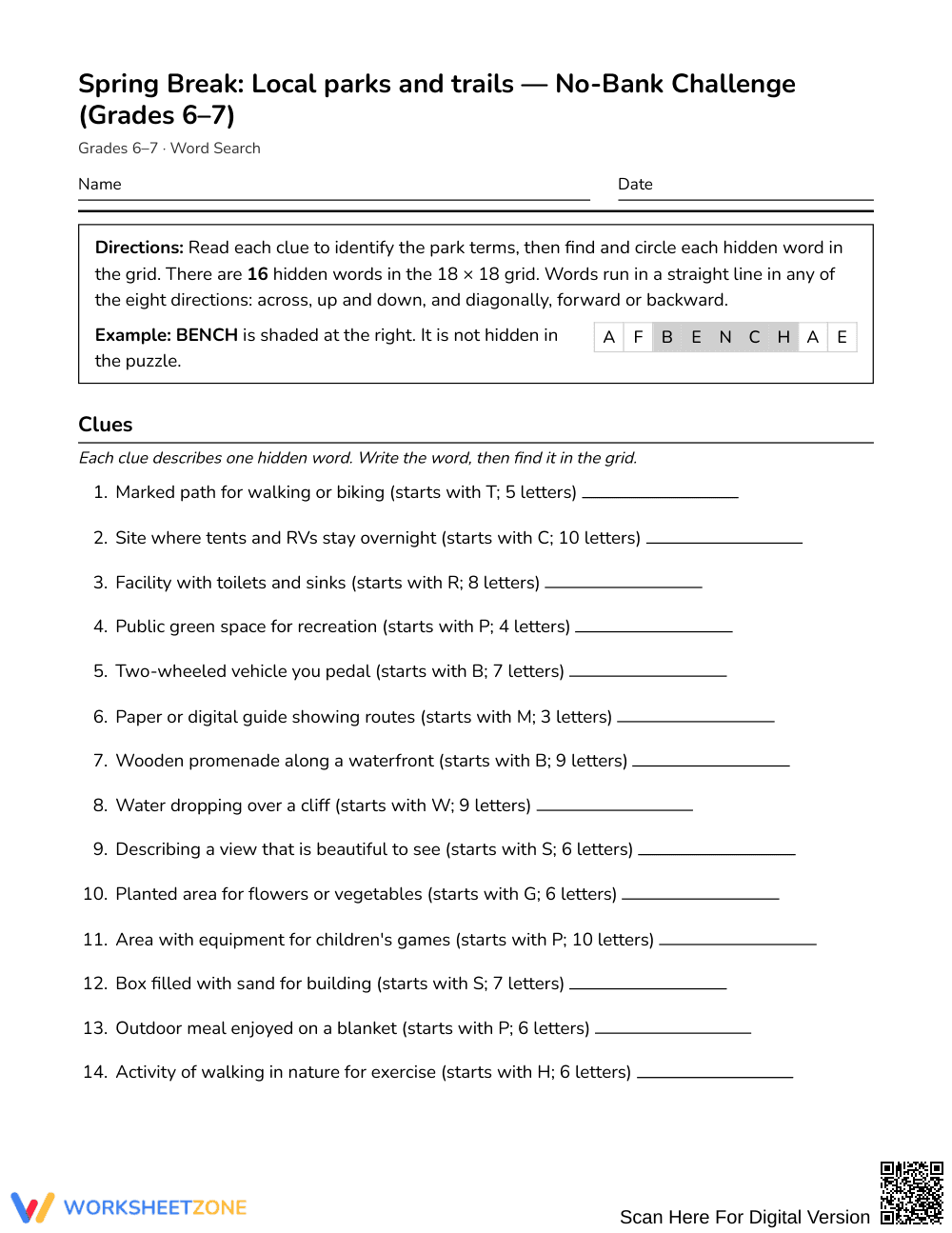
This local parks and trails word search strengthens vocabulary acquisition for middle school learners through active clue-based problem solving. Students decipher 16 descriptive definitions to identify outdoor recreation terms before finding each word hidden across the letter matrix. The activity builds contextual language skills, reinforces spelling, and supports environmental literacy without requiring advance teacher preparation.
At a Glance
- Grade: Grades 6–7 · Subject: English Language Arts (ELA)
- Standard: Not standards-assessed — focused vocabulary enrichment
- Skill Focus: Local parks and trails recreational vocabulary
- Format: 2 pages · 16 words · Complete answer key included · PDF
- Best For: Vocabulary enrichment, seasonal spring stations, and independent desk work
- Time: 20–30 minutes of active classroom practice
What's Inside
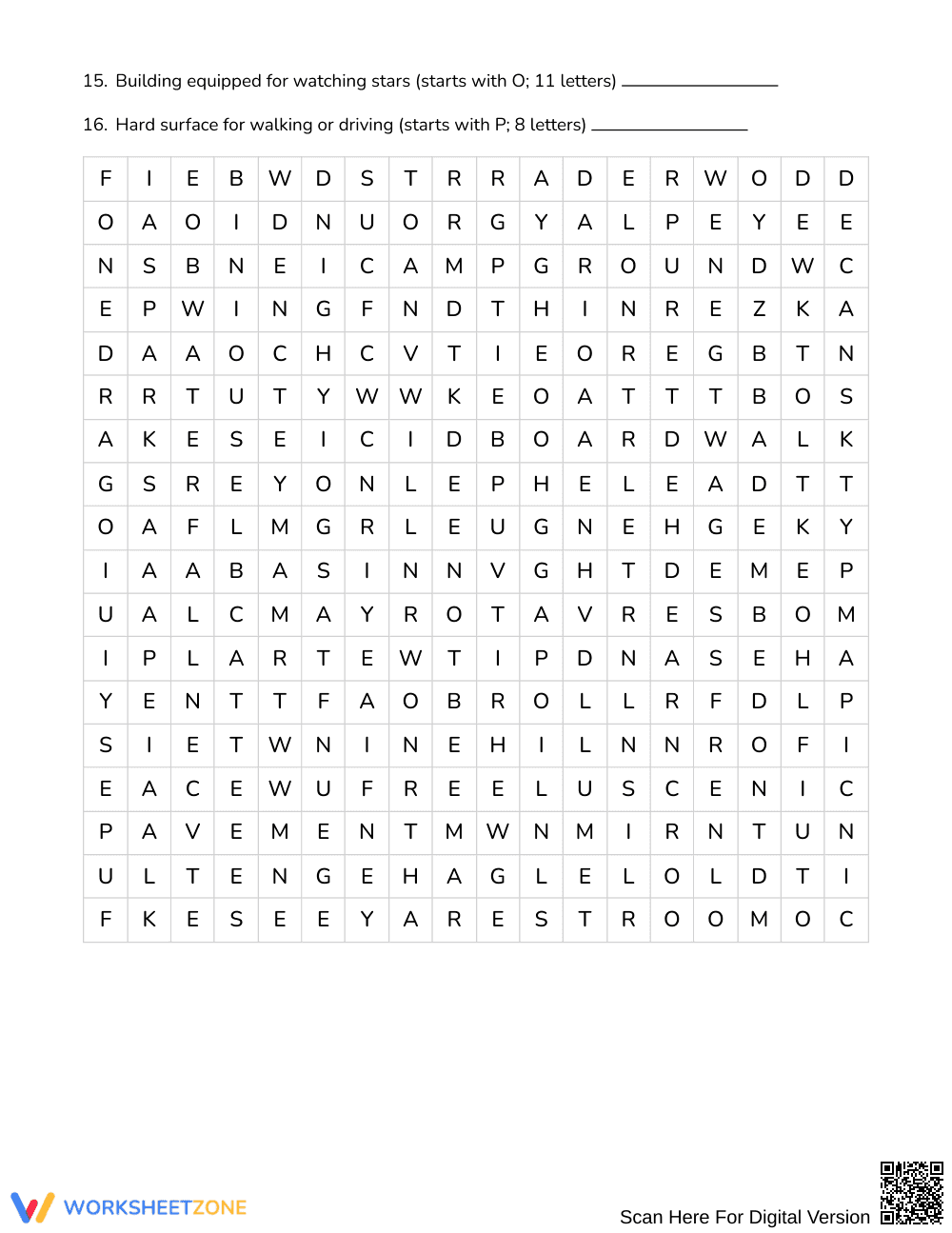
This 2-page printable activity features 16 clue-based hidden words. Rather than using a standard word bank, students read 16 definitions to identify terms like boardwalk, observatory, and campground before searching. A 3-page solution key shows the exact coordinate paths for every term.
How the Puzzle Works
Students locate 16 vocabulary words within an 18 x 18 grid. Without a word bank, learners must read each clue to determine the target word. Words run in eight directions: north, northeast, east, southeast, south, southwest, west, and northwest, encouraging careful visual scanning and pattern recognition.
Standards Alignment
This resource provides targeted vocabulary enrichment and is not aligned to a specific academic standard. It supports domain-specific language and contextual reasoning for Grades 6–7 English Language Arts.
How to Use It
Use this word search before reading informational park texts or assign it after direct instruction for independent practice. Circulate during work time to observe whether students solve clues before searching the grid. Completion time is 20 to 30 minutes.
Who It's For
This puzzle is designed for Grades 6–7 students, English language learners building recreation vocabulary, and early finishers. Provide clue hints for extra support. Pair it with an informational text on national parks or trail maps.
Designed for Grades 6–7 English Language Arts, this vocabulary enrichment word search builds local parks and trails vocabulary through 16 clue-based hidden words without relying on a traditional word bank. While the resource is not standards-assessed against state benchmarks, clue-driven vocabulary activities provide critical cognitive engagement and context-clue analysis. According to Fisher & Frey (2014), intentional word-learning strategies that connect semantic definitions with active orthographic retrieval substantially strengthen student retention and reading comprehension across complex informational texts. Students analyze contextual clues to deduce recreational terms such as boardwalk, observatory, and pavement, then systematically scan an 18 x 18 grid across eight distinct directions to confirm orthographic patterns. Complete with a 3-page answer key, this 2-page printable activity delivers rigorous seasonal practice in 20 to 30 minutes, reinforcing contextual word analysis and independent language acquisition for diverse middle school learners.


