


























Views
Downloads

Printable Paragraph Placement Worksheet | Grade 7 ELA
Paste this activity's link or code into your existing LMS (Google Classroom, Canvas, Teams, Schoology, Moodle, etc.).
Students can open and work on the activity right away, with no student login required.
You'll still be able to track student progress and results from your teacher account.
This Grade 7 ELA worksheet builds students' ability to analyze how and why nonfiction authors place paragraphs in a specific order, using a four-paragraph mentor text about a neighborhood tool library. Across 12 tasks in three scaffolded parts, students move from citing textual evidence to evaluating structural decisions—meeting the full demand of RI.7.5.
At a Glance
- Grade: 7 · Subject: ELA
- Standard:
RI.7.5— Analyze how an author organizes a text and explains how sections contribute to the whole- Skill Focus: Explaining paragraph placement in nonfiction text structure
- Format: 5 pages · 12 problems · Answer key included · PDF
- Best For: Guided practice during nonfiction text structure unit
- Time: 35–50 minutes
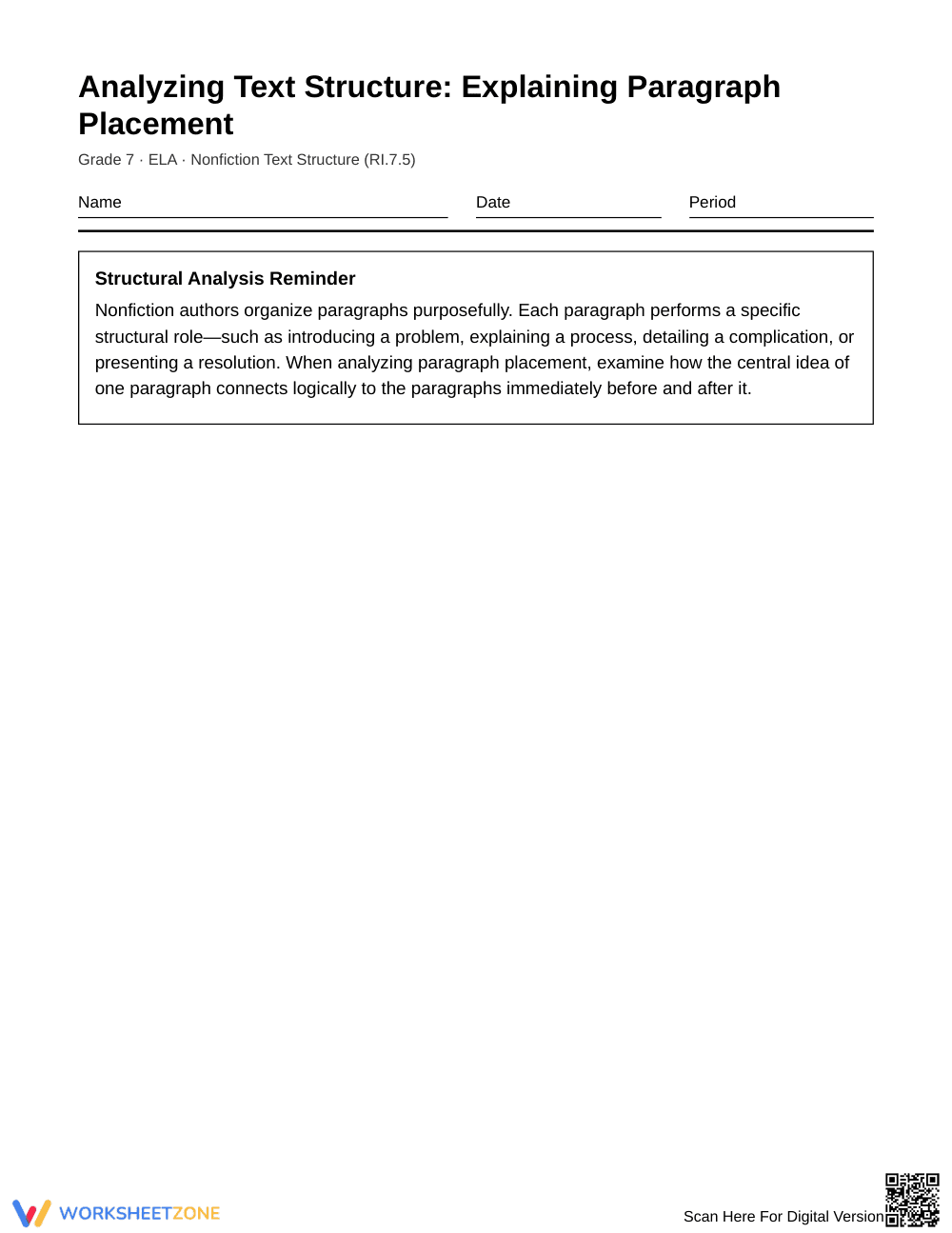
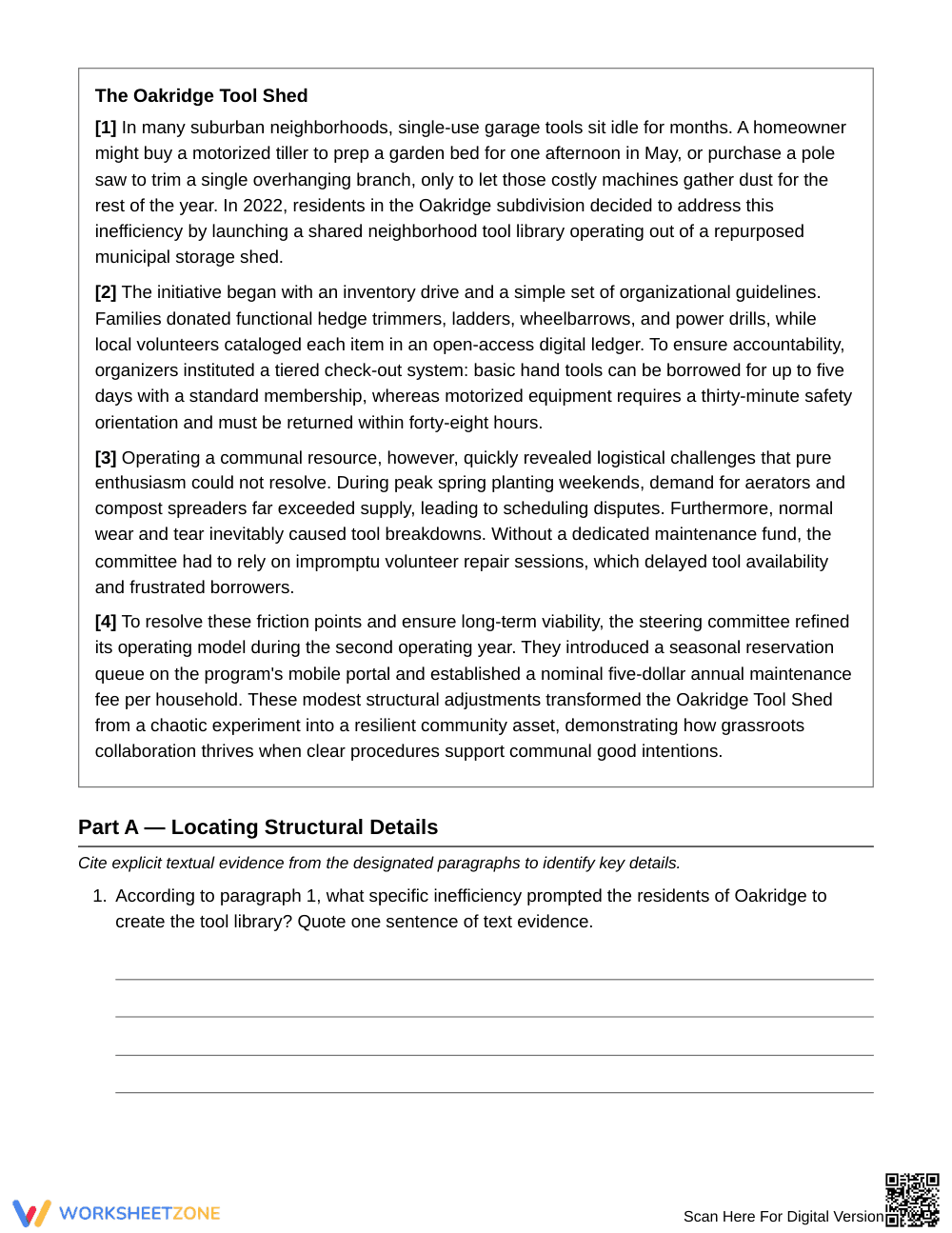
The worksheet opens with a Structural Analysis Reminder box that defines key analytical terms. The original nonfiction passage, "The Oakridge Tool Shed," is printed across four numbered paragraphs. The 12 tasks follow a scaffolded three-part sequence:
- Guided practice (Part A, 3 tasks): Students locate and quote explicit details from designated paragraphs to anchor their reading.
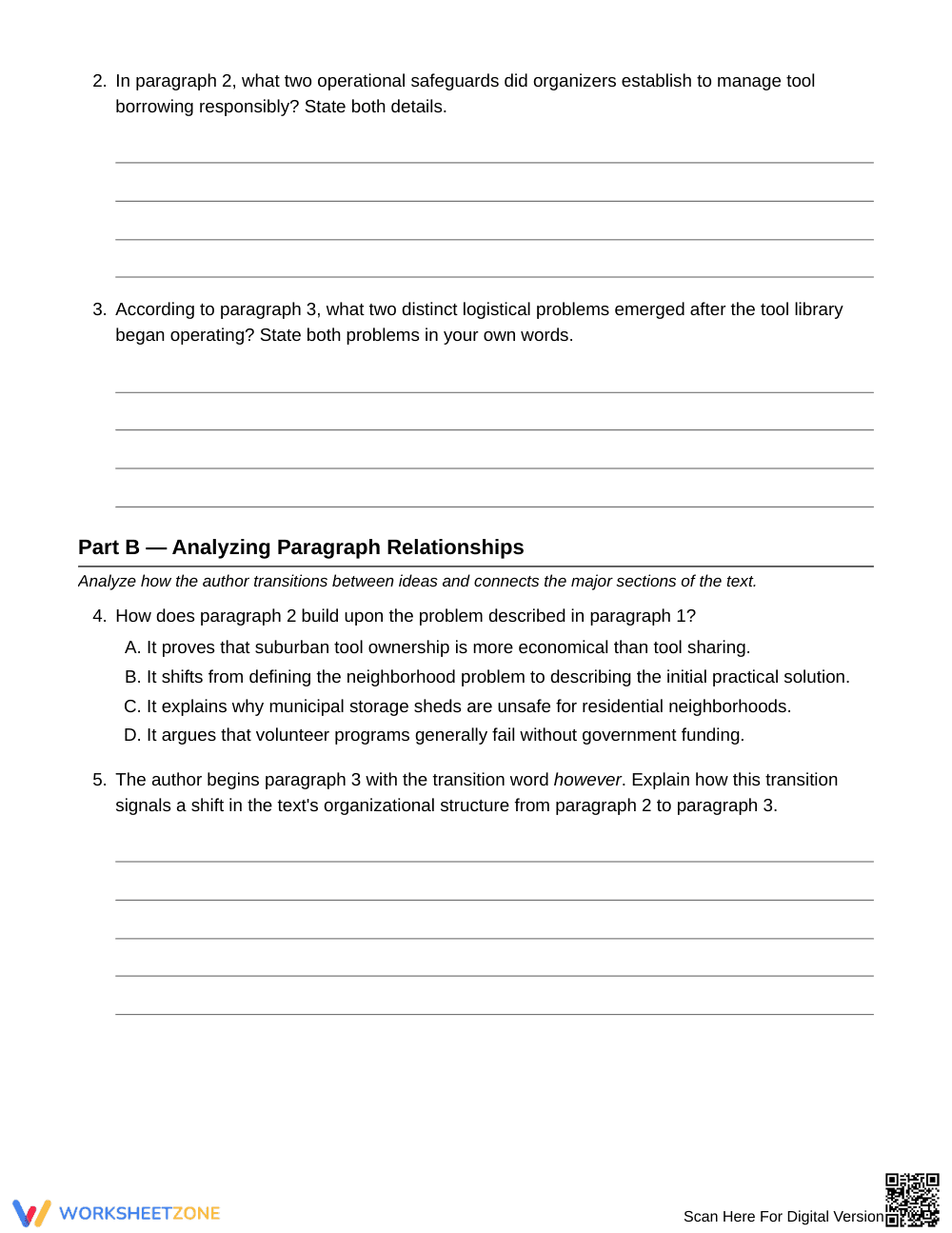
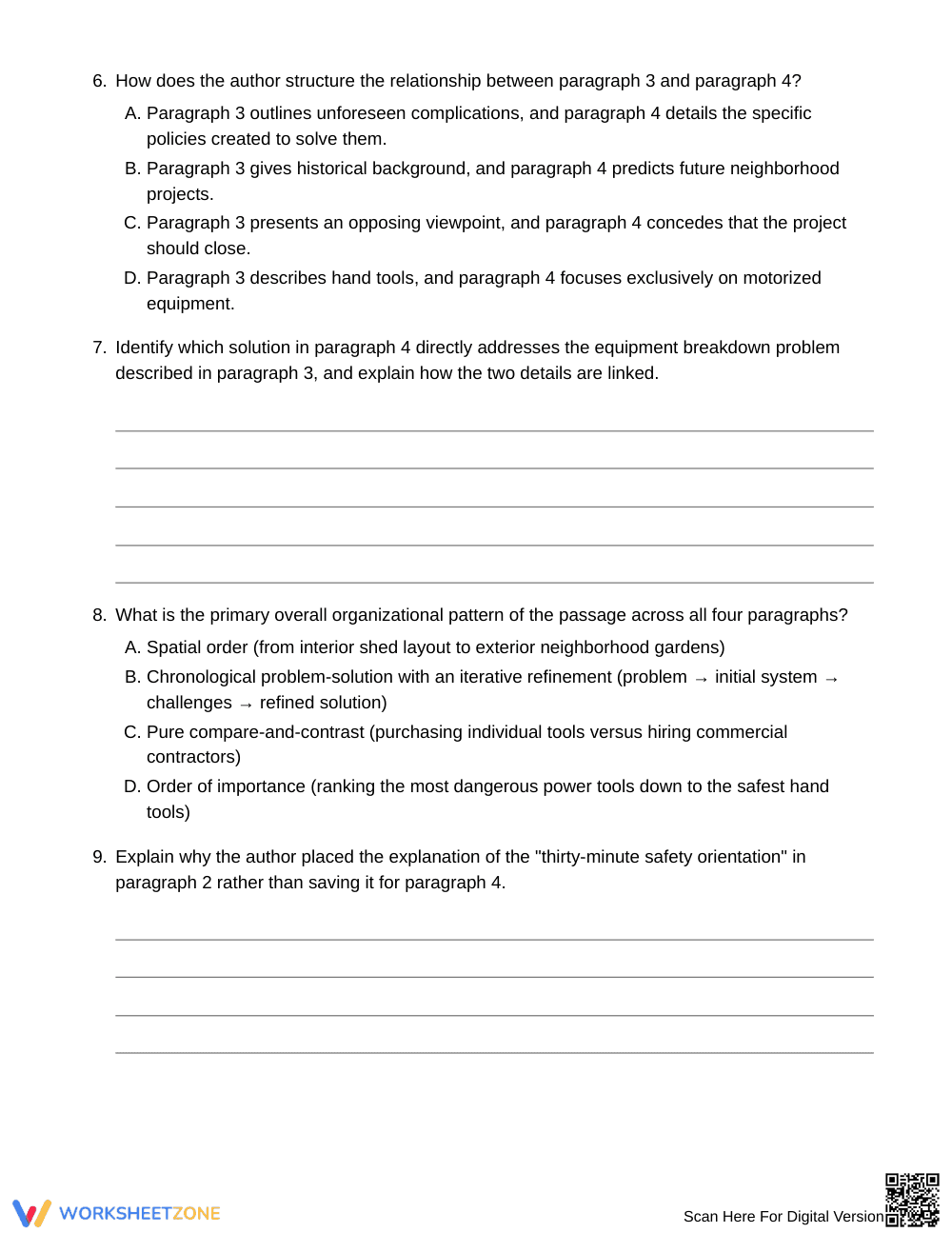
- Supported practice (Part B, 6 tasks): Students analyze transitions, paragraph relationships, and organizational patterns using four multiple-choice and two short open-response prompts.
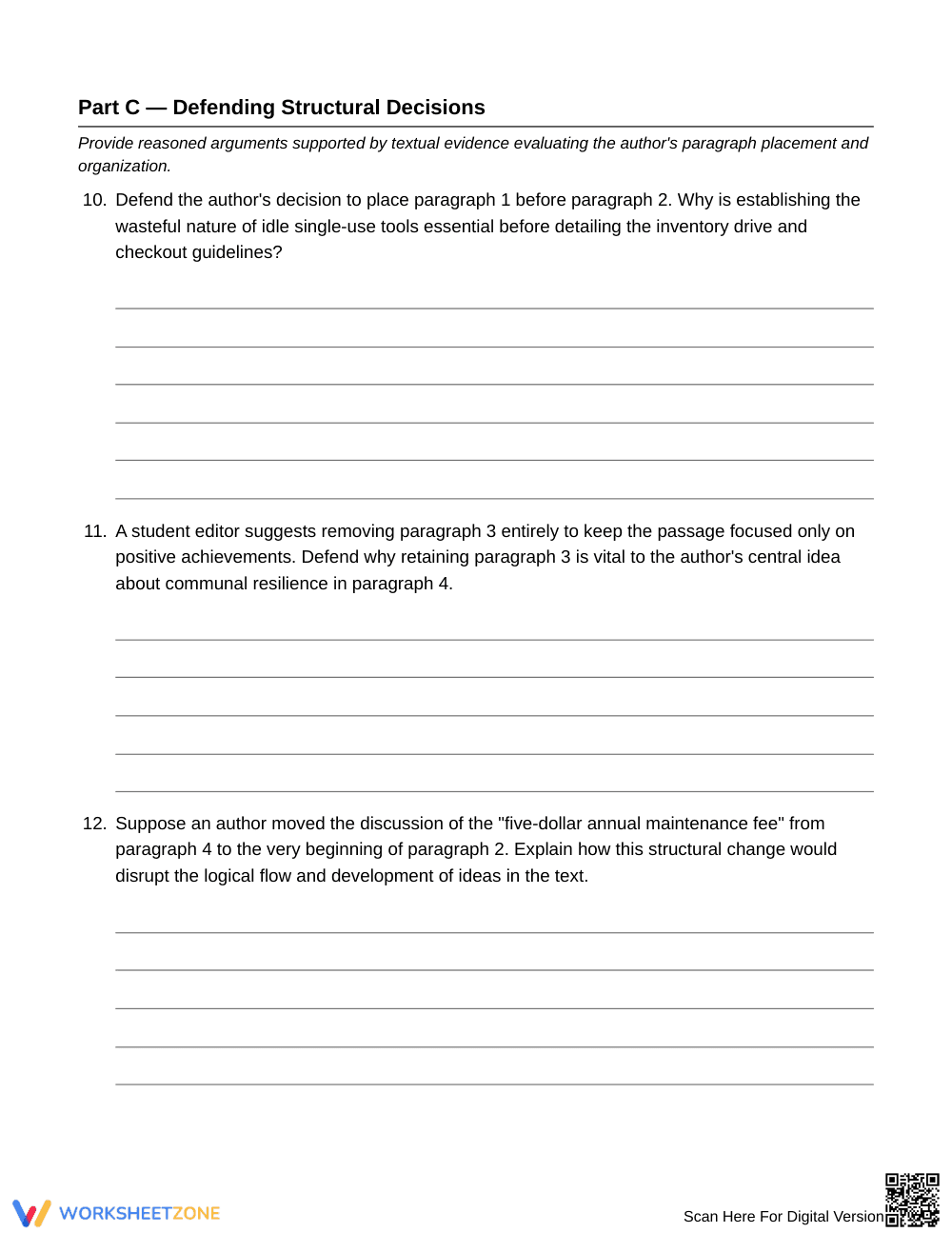
- Independent practice (Part C, 3 tasks): Students construct reasoned written arguments defending the author's structural choices, including the rhetorical impact of relocating or removing paragraphs.
Standards & Implementation
The primary standard is RI.7.5, requiring students to analyze how major sections contribute to the whole text. Supporting standard RI.7.1 is addressed in Part A through text-evidence retrieval. Assign the full worksheet during or after direct instruction on text structure. Parts A and B work well for 25 minutes of guided whole-class practice, while Part C serves as an independent check or homework assignment. Total completion takes 35–50 minutes.
This five-page, 12-task worksheet targets RI.7.5 by analyzing how nonfiction authors structure texts so that each paragraph contributes to the central idea. Students read an original four-paragraph passage organized in a problem-solution pattern and complete three sequenced task sets that build from evidence retrieval to structural defense. Research supports this scaffolded instructional design: Fisher & Frey (2014) demonstrate that gradual-release frameworks, in which explicit teacher modeling precedes supported and independent practice, produce significantly stronger reading comprehension outcomes than unscaffolded close-reading tasks alone. The resource design embeds that instructional framework directly into its three-part progression, giving educators a dependable, classroom-ready tool for formative assessment of structural analysis standards without requiring extra prep time. A complete answer key is included across the final pages, making it suitable for independent practice, small-group intervention, or substitute plans within any Grade 7 ELA nonfiction unit.


