































Printable Outing Plans Word Search | Grades 3–4 ELA

Paste this activity's link or code into your existing LMS (Google Classroom, Canvas, Teams, Schoology, Moodle, etc.).
Students can open and work on the activity right away, with no student login required.
You'll still be able to track student progress and results from your teacher account.
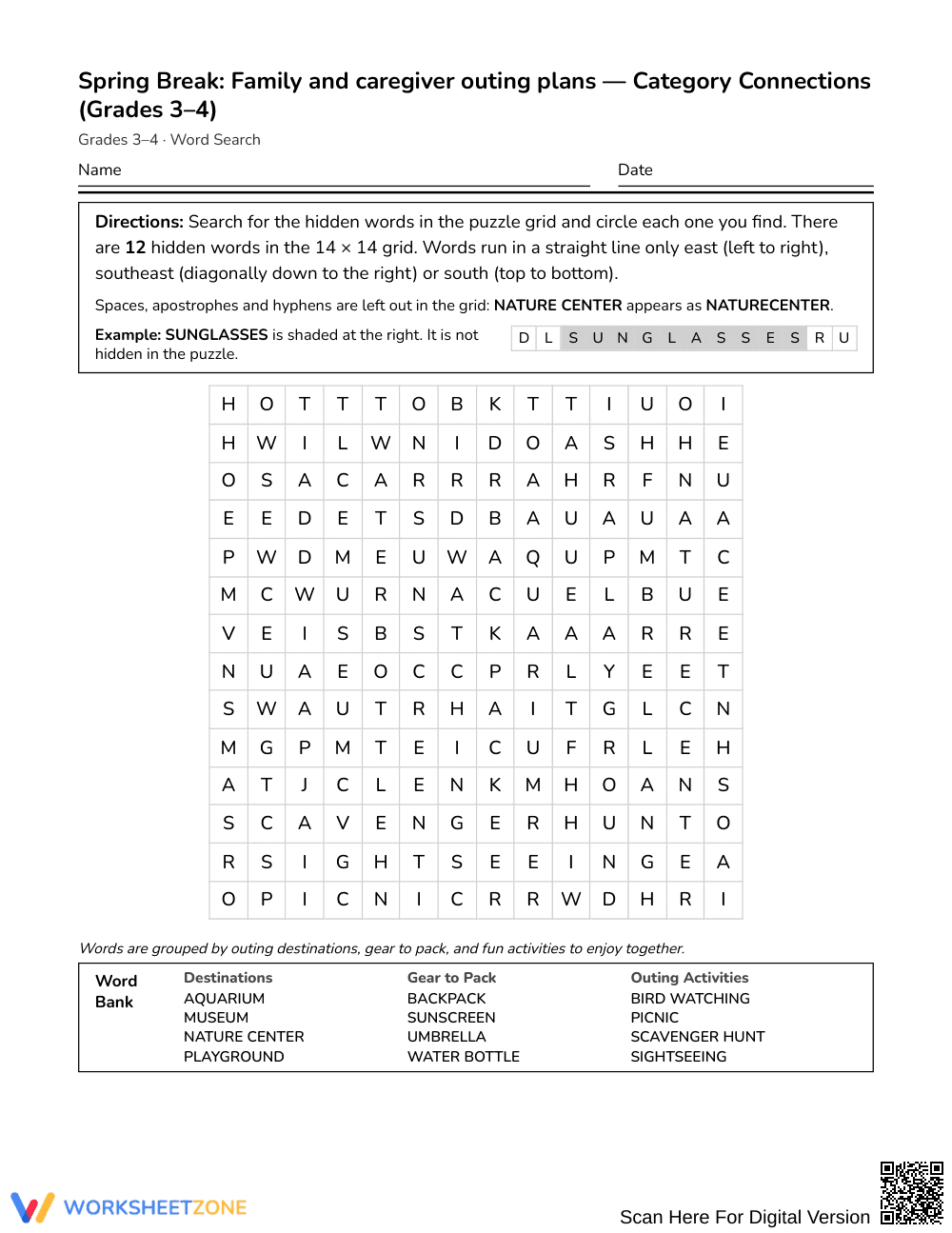
This Grades 3–4 vocabulary word search strengthens student recognition of family and caregiver outing plans across 12 targeted terms. Students identify thematic vocabulary connected to trip destinations, gear, and outdoor recreation while building orthographic awareness and visual scanning stamina. The ready-to-use puzzle promotes active vocabulary engagement through independent word discovery and structured category sorting.
At a Glance
- Grade: Grades 3–4 · Subject: ELA
- Standard: Not standards-assessed — vocabulary enrichment
- Skill Focus: Family and caregiver outing plans
- Format: 1 page · 12 words · Answer key included · PDF
- Best For: Vocabulary warm-up and early finishers
- Time: 15–20 minutes
The single-page printable features a 14 x 14 puzzle grid containing 12 thematic vocabulary words hidden in three directional paths: East, Southeast, and South. Words are organized into three distinct conceptual clusters—Destinations, Gear to Pack, and Outing Activities—to reinforce semantic associations alongside letter identification. A comprehensive three-page answer key provides clear visual overlays that highlight each hidden word location for swift grading or student self-checking.
Puzzle Mechanics and Structure
The activity centers on a 14 x 14 letter matrix tailored specifically for upper-elementary letter search. All 12 terms are arranged horizontally (East), diagonally downward (Southeast), or vertically (South), eliminating backward orientations to keep the visual challenge accessible and focused. Rather than searching an unstructured list, learners reference a categorized word bank that groups terms by context: destinations such as aquarium and nature center, essential gear like sunscreen and backpack, and engaging outings including scavenger hunt and picnic. This categorized layout encourages students to activate schema before locating each string of letters.
Standards Alignment
This resource serves as targeted vocabulary enrichment and is not aligned to a specific grade-level content standard. Instead, it functions as a supplemental ELA activity that strengthens general domain vocabulary, pattern recognition, and orthographic familiarity within everyday language contexts.
How to Use It
Introduce this word search before direct instruction in a spring writing unit to generate topical vocabulary, or distribute it after reading lessons as an independent extension for early finishers. During completion, circulate to observe student search patterns: note whether learners scan sequentially letter by letter or track phonemic chunks and initial consonants. Most students complete the full 12-word search within 15 to 20 minutes.
Who It's For
This puzzle is designed for third and fourth graders building leisure and community vocabulary. For emerging readers, provide highlighters to segment multisyllabic terms before searching; for advanced learners, invite students to write descriptive sentences using each found word. Pair this activity with an informational reading passage about outdoor state parks or a community-based writing prompt.
Structured word search puzzles promote print awareness and orthographic mapping by requiring elementary learners to analyze letter sequences and spatial patterns. Although designed as non-standardized vocabulary enrichment rather than formal standards-based assessment, engaging with themed terminology centered on family outing plans reinforces lexical retrieval and word recognition for developing readers. According to Fisher & Frey (2014), intentional exposure to categorized vocabulary clusters supports semantic network development and significantly deepens conceptual comprehension across elementary literacy domains. As students systematically locate target terms across the 14 x 14 grid in forward, downward, and diagonal paths, they practice visual scanning and sustained cognitive focus. This printable activity successfully pairs semantic categorization with low-stress orthographic practice, giving Grades 3–4 students an accessible, enjoyable routine to reinforce recreational and community vocabulary during independent literacy blocks, morning work, or seasonal classroom rotations.


