































Printable OT and OP Rhyming Word Search | Grades 1–2 ELA

Paste this activity's link or code into your existing LMS (Google Classroom, Canvas, Teams, Schoology, Moodle, etc.).
Students can open and work on the activity right away, with no student login required.
You'll still be able to track student progress and results from your teacher account.
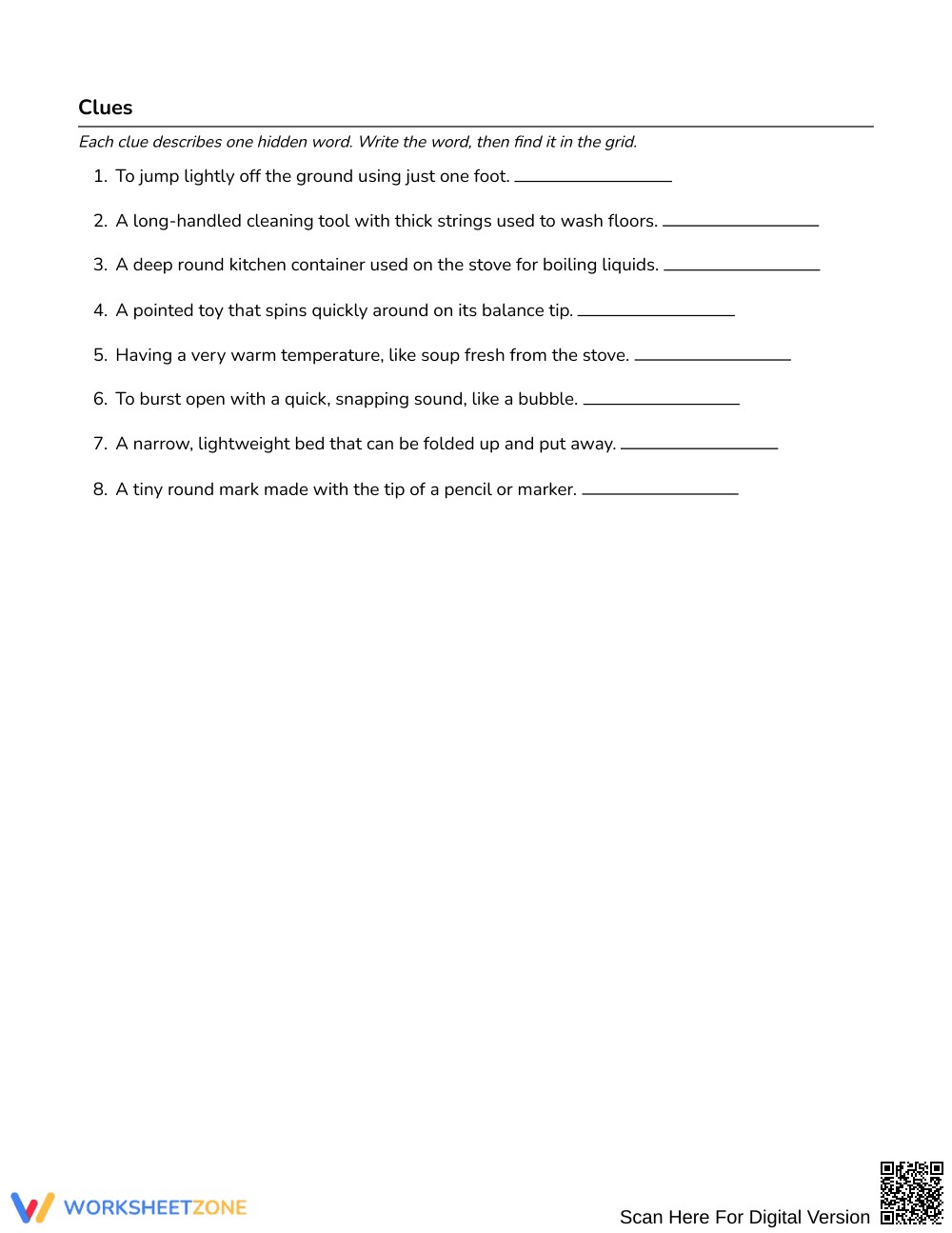
This rhyming word search strengthens early literacy skills by challenging students in Grades 1–2 to identify the ot and op word families. Learners read child-friendly definitions to determine mystery vocabulary terms, then locate all 8 target words in the grid to reinforce phonics patterns, orthographic mapping, and decoding accuracy.
At a Glance
- Grade: Grades 1–2 · Subject: English Language Arts
- Standard: Not standards-assessed — vocabulary enrichment
- Skill Focus: The ot and op word families
- Format: 2 pages · 8 words · Answer key included · PDF
- Best For: Phonics centers and morning work
- Time: 15–25 minutes
The activity provides an engaging two-page instructional packet designed to combine vocabulary development with visual letter scanning. Page 1 delivers a clean puzzle layout paired with eight riddle-style vocabulary clues. An alphabetical word list anchors student inquiry, while a matching two-page answer key allows teachers or aides to verify completed searches rapidly.
This clue detective activity challenges young readers through clear structural constraints. The puzzle features a 10 by 10 letter grid where all 8 target words run exclusively in easy-to-track orientations: horizontally from left to right (East) and vertically from top to bottom (South). Students decipher each definition clue, identify the rhyming match, and scan the structured grid to circle each term.
This resource serves as targeted vocabulary enrichment and phonemic awareness reinforcement rather than a formal standards-assessed test. It supports foundational reading routines by highlighting short vowel rhyme patterns across high-frequency CVC words. Educators can integrate these vocabulary exercises alongside district phonics curricula to reinforce sound-spelling correspondences without altering existing pacing guides.
Introduce this word search after direct phonics instruction on short "o" word families. In a guided literacy station, students read the clues aloud, identify the rhyming coda, and trace the matching letters. Alternatively, assign the puzzle as independent morning work to activate prior knowledge. During independent work, observe whether students scan initial consonants systematically or read full words when checking letter sequences. The activity takes approximately 15 to 25 minutes.
This activity supports primary grade learners in Grades 1–2 developing decoding fluency, including English language learners acquiring basic vocabulary. Differentiate by having emerging readers highlight the word endings before searching. Pair this puzzle directly with an anchor chart showing the -ot and -op word families or decodable short-vowel readers during small-group reading rotations.
According to research from Fisher & Frey (2014) on purposeful literacy learning, integrating structured vocabulary clues with orthographic recognition exercises strengthens lexical retrieval and word-pattern retention in early elementary readers. When young students decipher meaning-based hints to isolate rhyming units like the ot and op word families, they engage cognitive pathways that connect phonological awareness with printed graphemes. This dual-action approach transforms passive letter searching into active semantic decoding. Rather than treating word searches as basic time fillers, pairing descriptive clues with focused short vowel word families scaffolds vocabulary acquisition, enhances orthographic mapping, and builds self-monitoring reading habits. Early readers solidify phonics foundations by verifying that letter sequences match spoken sounds, demonstrating that clue-based puzzle routines provide effective foundational reinforcement during small-group literacy instruction and independent word study.


