




























Views
Downloads


Printable Object Apparent Shift Worksheet | Grade 6 Science

Paste this activity's link or code into your existing LMS (Google Classroom, Canvas, Teams, Schoology, Moodle, etc.).
Students can open and work on the activity right away, with no student login required.
You'll still be able to track student progress and results from your teacher account.
This Grade 6 science worksheet trains students to explain why objects appear shifted when viewed through reflective and refractive media. Learners analyze light transmission across boundaries, differentiate between actual and apparent position, and apply core principles of reflection and refraction. Structured tasks build mastery over optical ray mechanics.
At a Glance
- Grade: 6 · Subject: Science
- Standard: Light & Wave Behavior — Explain how reflection and refraction alter an object's apparent position
- Skill Focus: Explain Why an Object Appears Shifted
- Format: 5 pages · 10 problems · Answer key included · PDF
- Best For: Independent optical wave behavior practice
- Time: 30–45 minutes
What's Inside
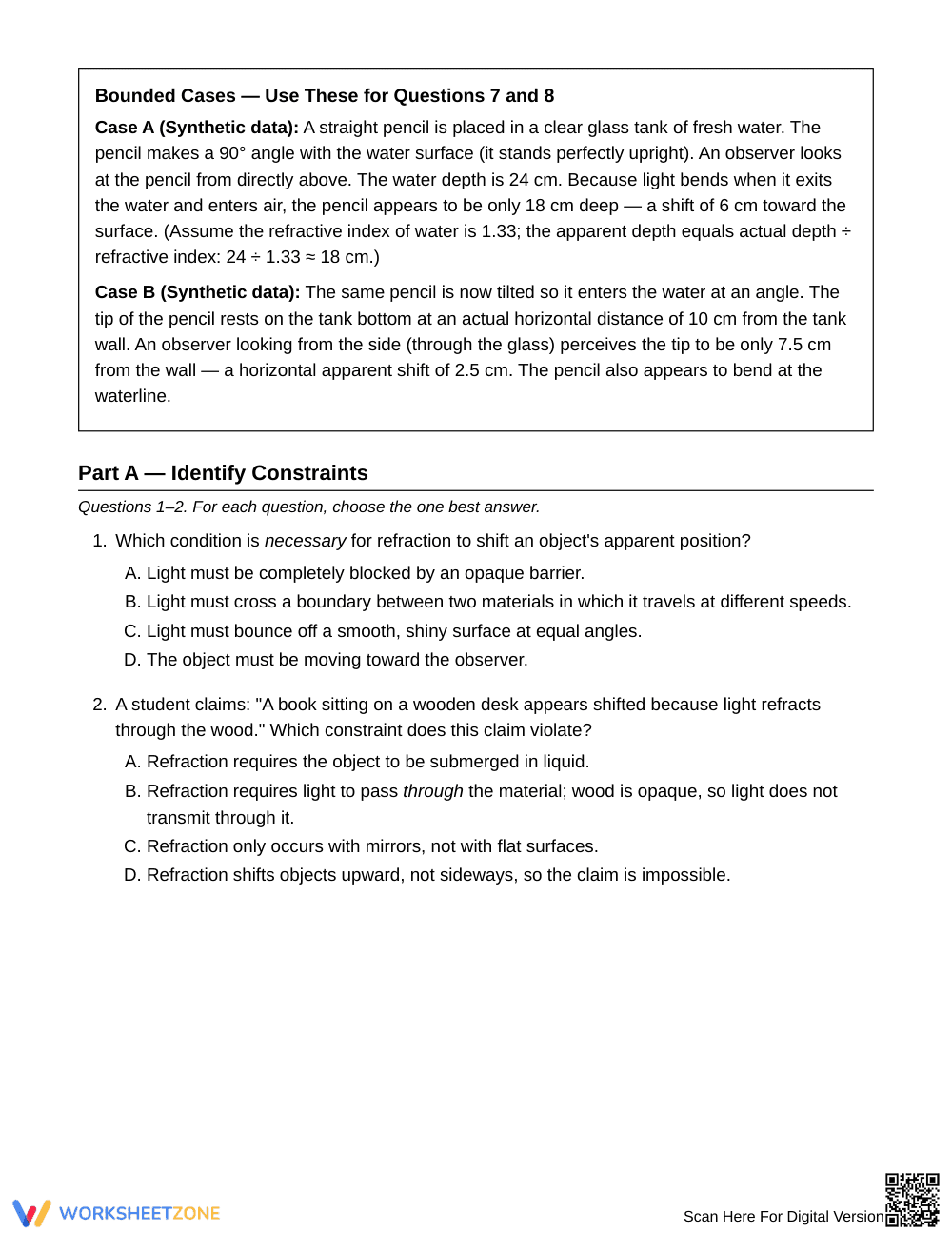
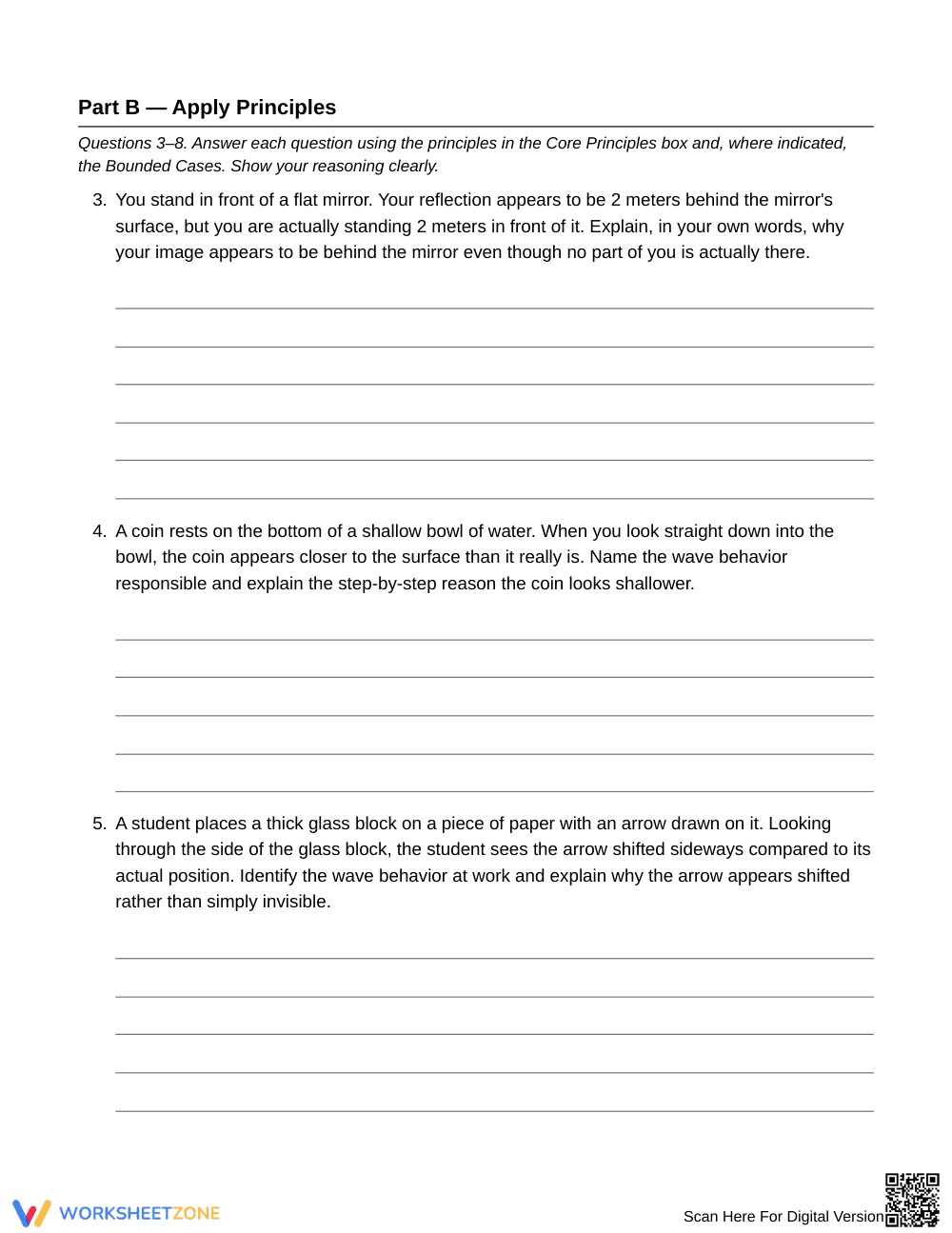
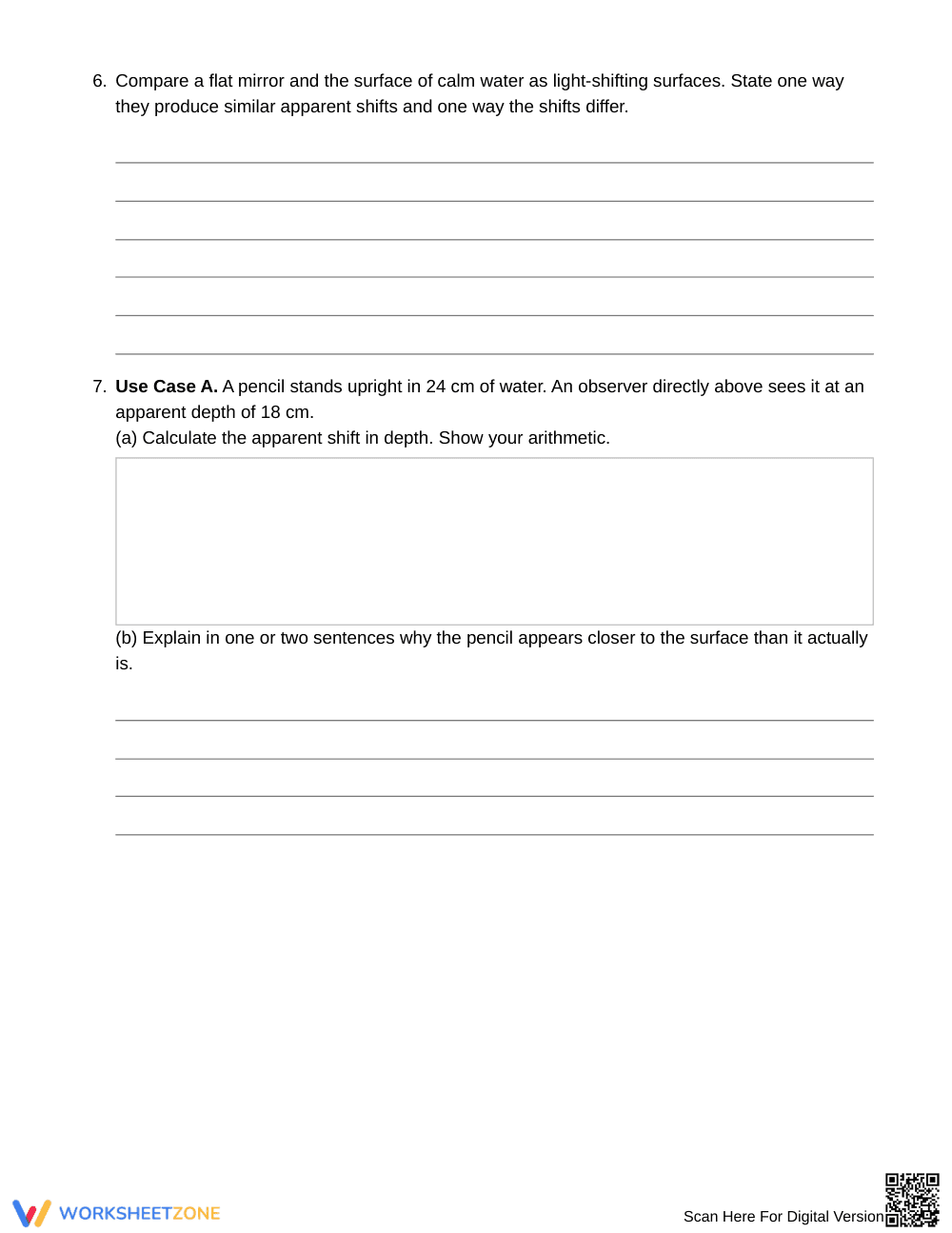
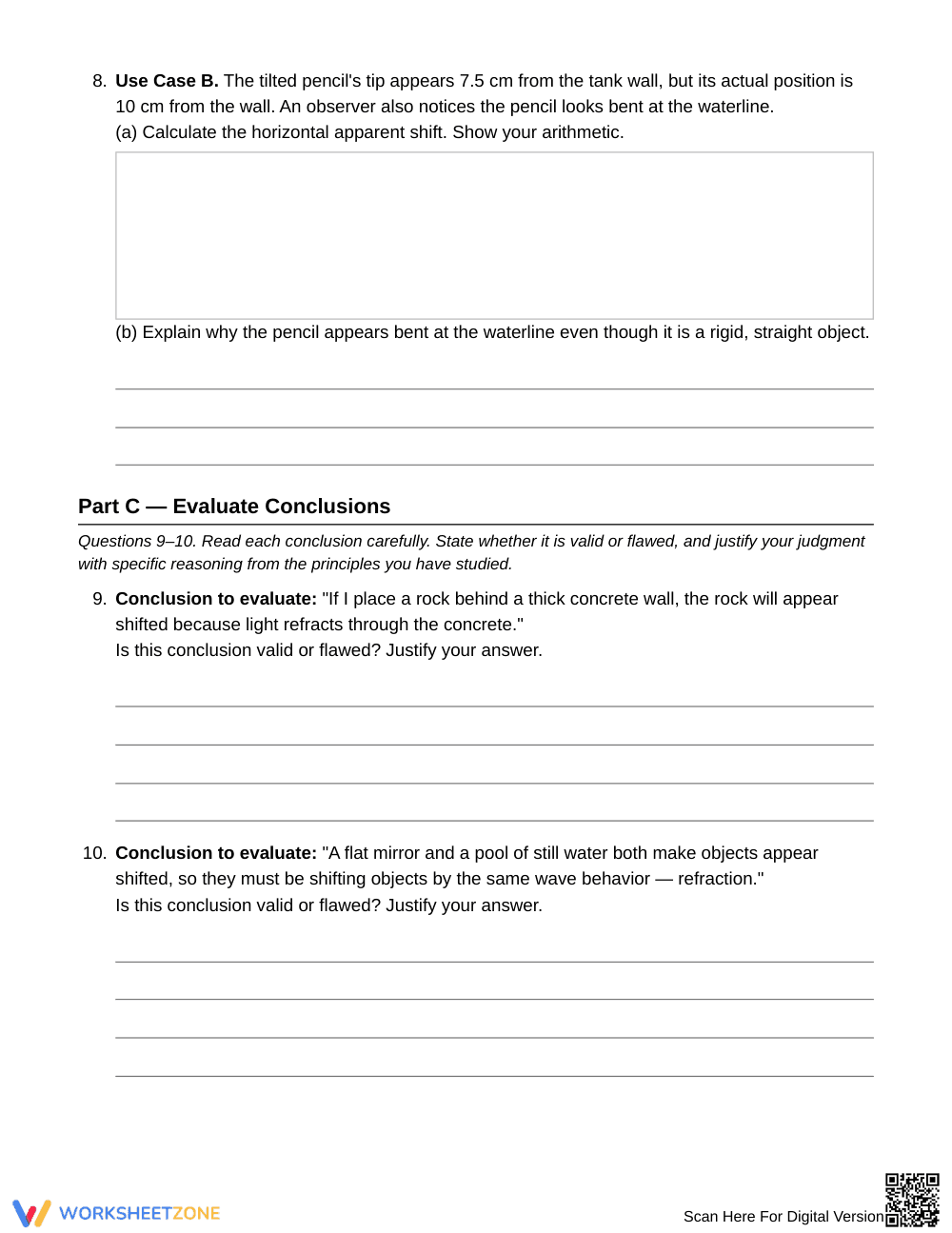
The 5-page printable resource includes a 10-task student worksheet accompanied by a 4-page answer key with step-by-step solutions. A Core Principles reference box defines reflection, refraction, and opacity alongside key ray terminology. Two synthetic data scenarios provide bounded values for vertical depth displacement and horizontal waterline bending. Task formats include constraint-based multiple choice, qualitative explanations, numerical shift calculations, and scientific claim evaluations.
Skill Progression
- Guided practice (Questions 1–2): Multiple-choice items isolate physical constraints and boundary conditions required for refraction, preventing misconceptions about opaque materials.
- Supported practice (Questions 3–8): Short-answer prompts and bounded data scenarios guide students to calculate numeric shift values and explain ray bending.
- Independent practice (Questions 9–10): Unscaffolded evaluation tasks require learners to critique scientific claims, distinguish reflection from refraction, and justify validity.
This sequence follows a gradual-release framework, shifting students systematically from guided constraint identification to independent scientific argumentation.
Standards Alignment
This worksheet aligns with middle school physical science standards for Light and Wave Behavior, specifically focusing on how light refracts and reflects across transparent media boundaries. Students trace wave paths to demonstrate why straight-line visual perception produces apparent displacement. Both standard codes can be copied directly into lesson plans, IEP goals, or district curriculum mapping tools.
How to Use It
Deploy this worksheet immediately following direct instruction on wave boundaries or as a focused mid-unit review station. During a 30- to 45-minute lesson, students review the optical reference text before completing the quantitative and conceptual tasks. For formative assessment, inspect Question 8b to verify that learners attribute the bent pencil to light refraction at the waterline rather than physical deformation.
Who It's For
This resource serves Grade 6 science students mastering fundamental physical science concepts. Embedded vocabulary definitions and bounded scenarios support English language learners and students needing structured reading scaffolds, while claim evaluations challenge advanced thinkers. Pair this worksheet with an introductory ray optics anchor chart or a hands-on pencil-in-water laboratory demonstration.
Structured wave behavior instruction requires students to bridge conceptual optics with concrete geometric reasoning. According to Fisher & Frey (2014), gradual-release instructional sequences that integrate explicit constraint identification before open-ended physical evaluation produce measurable gains in scientific problem-solving. This Grade 6 physical science worksheet targets the core skill of explaining why an object appears shifted through reflection and refraction. By moving from defined constraints to synthetic numerical cases—such as calculating apparent depth shifts of 6 centimeters in water—students build robust mental models of ray deviation. Grounded in middle school Light and Wave Behavior standards, the scaffolded tasks reinforce how light speed changes across medium boundaries, correcting common misconceptions about opaque materials and straight-line perception. The accompanying 4-page answer key provides explicit reasoning criteria, enabling teachers to verify whether students accurately distinguish between reflected virtual images and refracted apparent depths during formative evaluation.


