


























Views
Downloads



Printable Nuanced Idea Defense Worksheet | Grade 9 English I
Paste this activity's link or code into your existing LMS (Google Classroom, Canvas, Teams, Schoology, Moodle, etc.).
Students can open and work on the activity right away, with no student login required.
You'll still be able to track student progress and results from your teacher account.
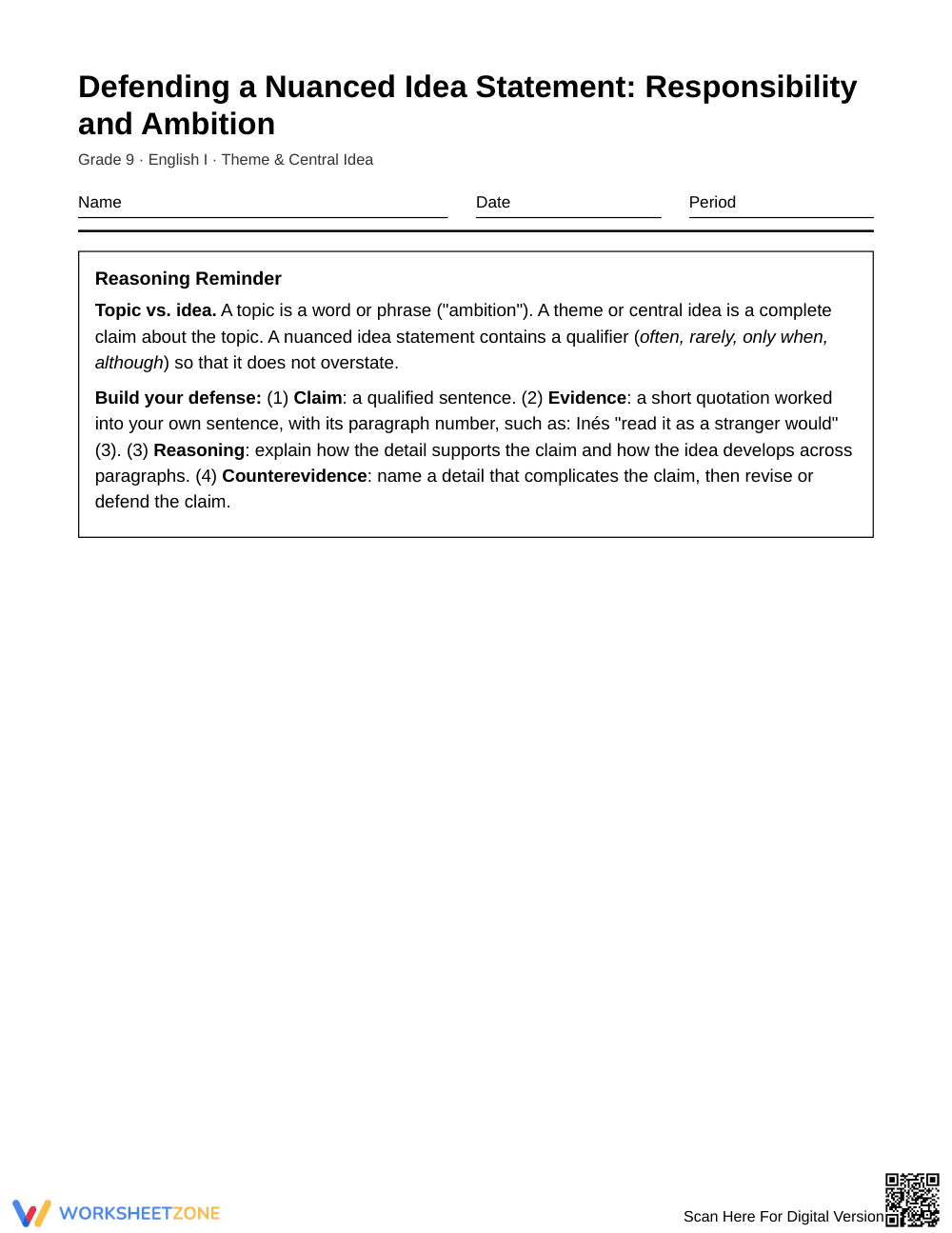
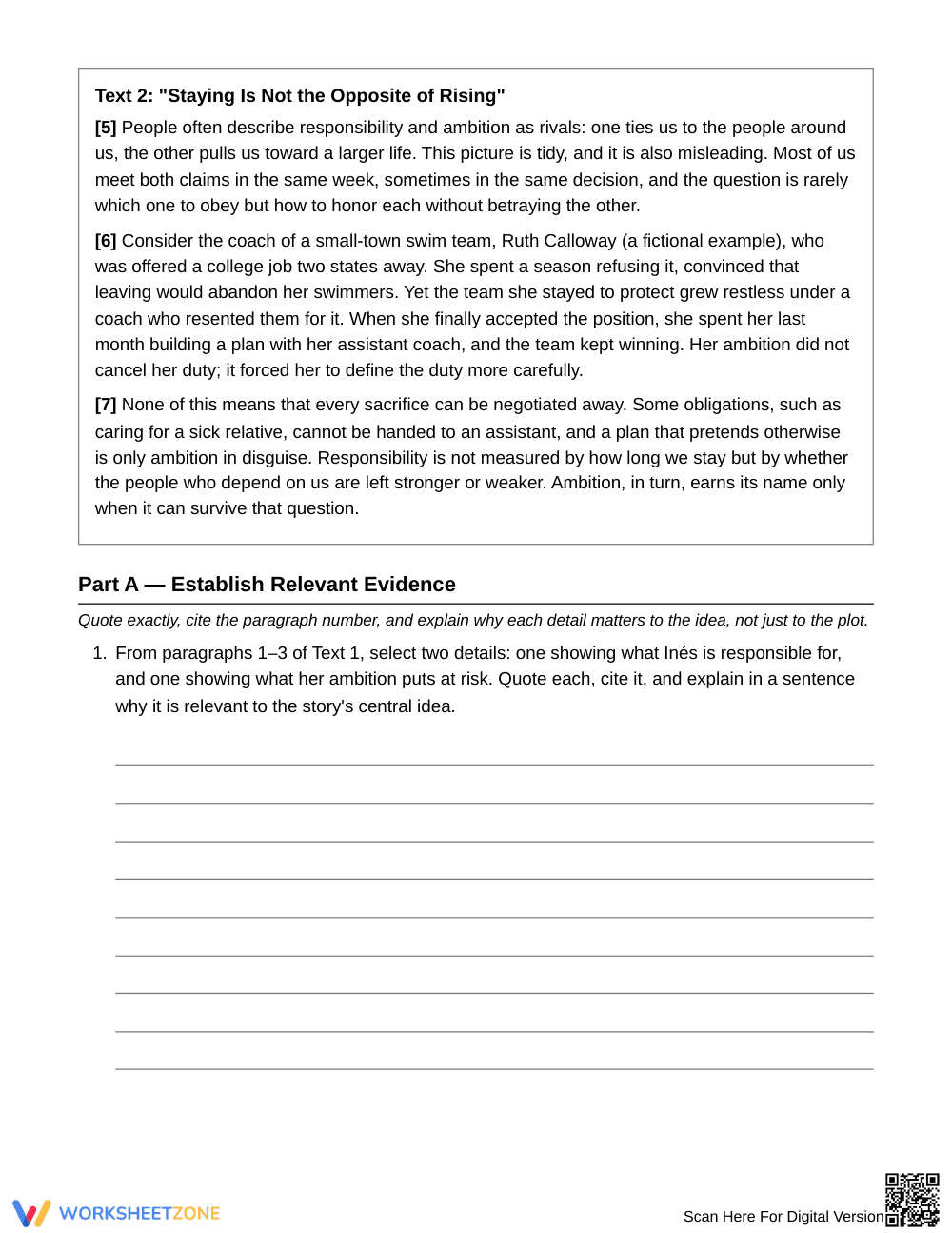
This worksheet teaches Grade 9 students to defend a nuanced idea statement about theme. Students select and cite relevant evidence, trace how an idea develops across paragraphs, and revise overstated claims against counterevidence, using a short story and a paired essay on responsibility and ambition.
At a Glance
- Grade: 9 · Subject: English I
- Standard:
RL.9-10.2— Identify a theme and explain how specific details shape it across a text- Skill Focus: Defending nuanced idea statements with textual evidence
- Format: 6 pages · 8 problems · Answer key included · PDF
- Best For: Paired-text theme writing after instruction
- Time: 45–60 minutes
What's Inside
The six-page packet begins with a Reasoning Reminder that separates topic from idea and outlines a four-step defense: claim, evidence, reasoning, counterevidence. Students read a short story, “The Ledger,” and a paired essay, then complete eight tasks in three parts. A three-page answer key is included.
Skill Progression
- Guided practice (2 tasks, Part A): Students quote and cite specific details with paragraph numbers, supported by the Reasoning Reminder and targeted paragraph ranges.
- Supported practice (4 tasks, Part B): Students write qualified idea statements and trace development across paragraphs, with required quotation counts.
- Independent practice (2 tasks, Part C): Students answer an overstated classmate claim and a competing reading with minimal scaffolding.
The sequence follows gradual release: I Do, We Do, You Do.
Standards Alignment
RL.9-10.2 — Determine a theme or central idea of a text and analyze in detail how it develops, emerging and being shaped and refined by specific details. The standard code can be copied directly into lesson plans, IEP goals, or district curriculum mapping tools.
How to Use It
- After direct instruction: Assign Part A in class as guided close reading, then release students to Parts B and C.
- As formative assessment: Use Part C as an exit task to see whether students can revise an overstated claim.
Observation tip: while students write, check that every idea statement has a qualifier and that quotations carry paragraph numbers. Expect 45–60 minutes, or two shorter sessions.
Who It's For
Grade 9 English I students building evidence-based literary analysis. Students who need support can complete Part A and the first Part B tasks with the Reasoning Reminder open; advanced writers can concentrate on the cross-text and counterevidence tasks. Pair it with a short anchor chart on topic versus theme.
This Grade 9 English I worksheet addresses RL.9-10.2, which asks students to determine a theme or central idea and analyze how specific details shape and refine it. Students practice defending nuanced idea statements, meaning complete claims that contain a qualifier such as often, rarely, only when, or although, so that the idea does not overstate. Across eight tasks on six pages, they cite paragraph-numbered quotations from a short story and a paired essay on responsibility and ambition, trace how an idea develops across paragraphs, and revise a claim against counterevidence. The sequence follows the gradual release of responsibility model described by Fisher & Frey (2014), moving from guided evidence selection to independent defense. A three-page answer key is included, making the packet suitable for classroom instruction, formative assessment, and written-response practice in theme and central idea units.


