































Printable Nile Fishing Word Search | Grade 6 Social Studies

Paste this activity's link or code into your existing LMS (Google Classroom, Canvas, Teams, Schoology, Moodle, etc.).
Students can open and work on the activity right away, with no student login required.
You'll still be able to track student progress and results from your teacher account.
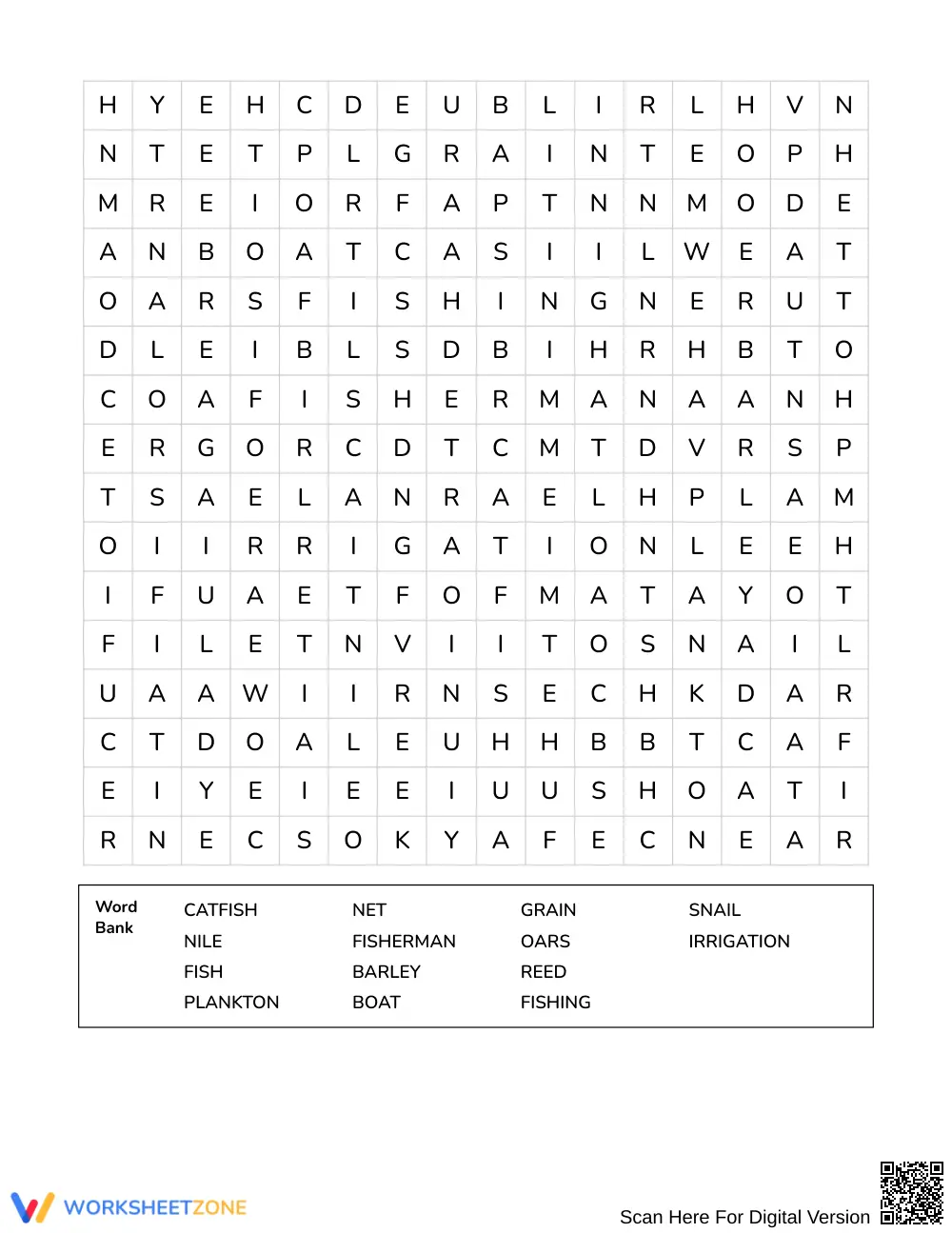
This Grade 6 Social Studies word search reinforces key ancient civilization vocabulary through focused puzzle-solving. Students identify 14 historical terms related to the Nile River's aquatic resources, agriculture, and daily survival. By connecting definitions to vocabulary search tasks, learners consolidate essential World History concepts and strengthen recall of ancient Egyptian economic foundations.
At a Glance
- Grade: Grade 6 · Subject: Social Studies (World History)
- Standard: Not standards-assessed — vocabulary enrichment
- Skill Focus: Ancient Egyptian fishing and Nile river resources
- Format: 2 pages · 14 words to find · Full answer key included · PDF
- Best For: Vocabulary review, lesson warm-ups, or early finishers
- Time: 15–25 minutes of classroom engagement
What's Inside
This 2-page print-and-go activity features 14 thematic vocabulary words paired with substantive historical clues to guide student discovery. Rather than relying solely on a simple word bank, the activity connects each term—such as irrigation, catfish, and barley—to concise contextual descriptions of life along the Nile River. A comprehensive answer key is included across separate pages, clearly outlining word placements to make checking student work fast and accurate.
Puzzle Structure
The activity is structured around a 16 x 16 letter grid designed to reinforce spatial processing and word recognition. The 14 targeted vocabulary terms run in four distinct directional orientations: northeast, east, southeast, and south. Students consult the provided clue sheet, which presents a shuffled word bank accompanied by factual definitions, allowing learners to verify historical meanings before locating each hidden word within the puzzle grid.
Standards Alignment
This educational word search is designed strictly for vocabulary enrichment and historical concept reinforcement; it is not formally aligned to a specific state or national curriculum standard. Teachers can integrate the activity alongside standard ancient civilizations curricula to build domain-specific background knowledge and support broader historical literacy goals.
How to Use It
Use this word search as an introductory engagement hook before direct instruction on Egyptian geography, priming students with key economic terminology. Alternatively, assign it after direct instruction as a low-stakes review station during small-group rotations. While students work, circulate and note which terms prompt frequent clarification to gauge prior knowledge of river ecosystems. Students typically finish within 15 to 25 minutes.
Who It's For
This resource is crafted for Grade 6 Social Studies learners studying early river valley civilizations. For striving readers or English learners, partner students to read the clues aloud before searching the grid. Pair this puzzle with an illustrated anchor chart displaying ancient Egyptian agricultural tools and river wildlife to reinforce visual associations.
Designed for Grade 6 Social Studies, this 14-word puzzle develops domain-specific vocabulary concerning ancient Egyptian fishing and Nile river resources without alignment to a formal standard code. Grounded in research by Fisher & Frey (2014) on intentional vocabulary acquisition in content-area classrooms, connecting content-rich definition clues to orthographic search tasks directly supports student word recognition, conceptual retention, and academic dialogue. Sixth-grade students examine crucial river valley terminology—including irrigation, reeds, and aquatic fauna—bridging basic lexical recall with broader historical context and environmental understanding. As demonstrated by Fisher & Frey (2014), purposeful exposure to technical language in low-anxiety instructional formats bolsters reading comprehension across introductory social studies units. This two-page learning activity functions effectively as an introductory schema builder, review station, or independent enrichment task that solidifies essential World History concepts through structured visual discovery.


