





























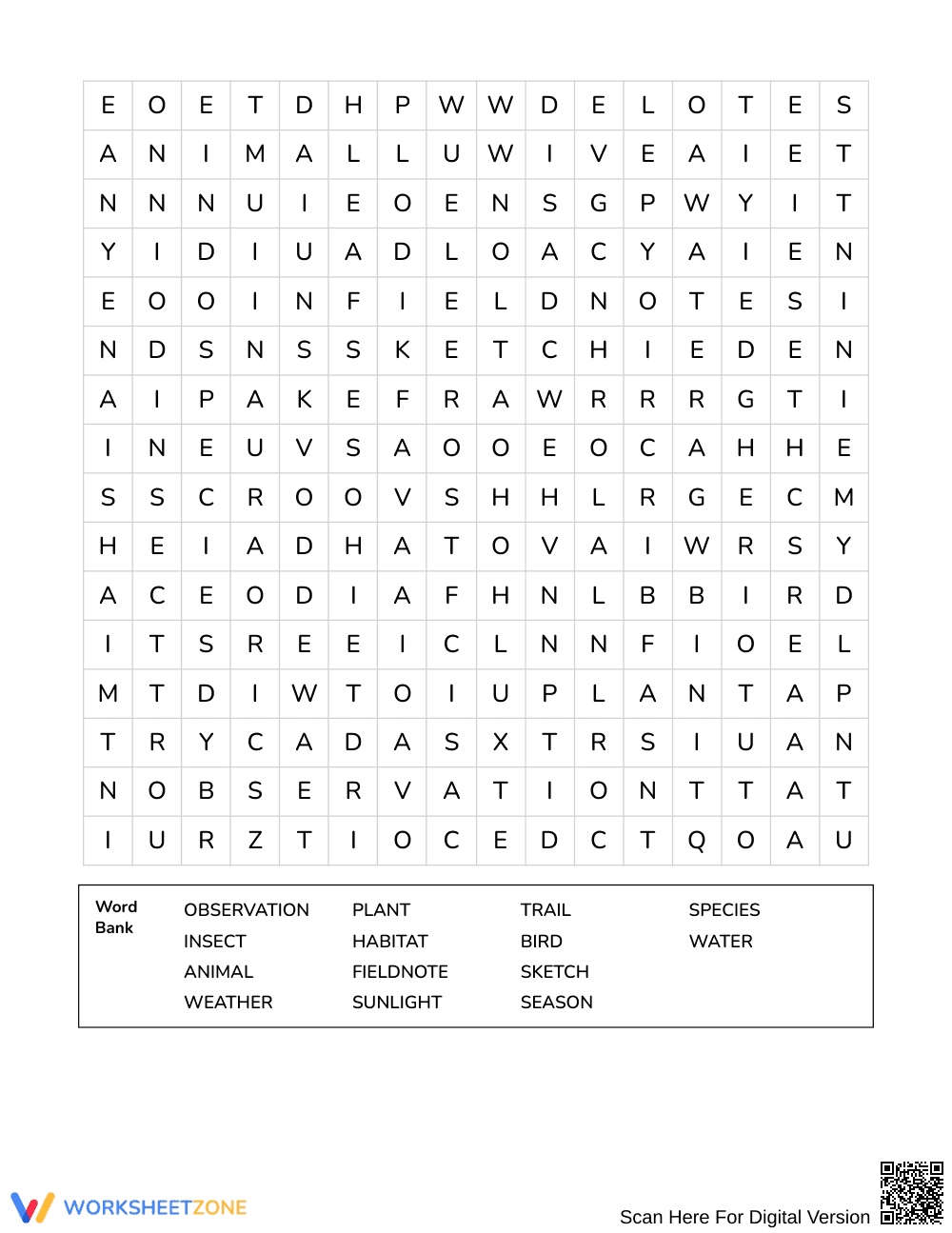


Printable Nature Journaling Word Search | Grades 4–5 ELA

Paste this activity's link or code into your existing LMS (Google Classroom, Canvas, Teams, Schoology, Moodle, etc.).
Students can open and work on the activity right away, with no student login required.
You'll still be able to track student progress and results from your teacher account.
This Grades 4–5 nature journaling word search reinforces outdoor science vocabulary through targeted puzzle solving. Students read descriptive clues to identify and locate 14 words hidden within the grid. The activity develops environmental literacy and contextual definition skills, making it an engaging companion for spring break exploration or nature study.
At a Glance
- Grade: Grades 4–5 · Subject: English Language Arts (ELA)
- Standard: Not standards-assessed — vocabulary enrichment
- Skill Focus: Nature journaling terminology and outdoor observation vocabulary
- Format: 2 student pages · 14 target words · Full answer key included · PDF
- Best For: Independent vocabulary enrichment, seasonal science units, and fast-finisher work
- Time: 20–30 instructional minutes
What's Inside
This 2-page printable features a 16 × 16 letter grid with 14 hidden words. Students read concise clues for outdoor terms like observation, habitat, and species, identifying each word before locating it in the shuffled word bank. A comprehensive answer key is included for rapid self-checking.
Puzzle Mechanics and Structure
This word search operates as a clue detective activity structured around specific design features:
- Grid Dimensions: A 16 × 16 grid provides an age-appropriate spatial challenge.
- Directions: Hidden words run in four compass directions—northeast, east, southeast, and south.
- Clues and Word Bank: Fourteen definition clues guide students to solve terms before scanning the shuffled word bank.
Standards Alignment
This resource provides targeted vocabulary enrichment and is not aligned to a formal standard. It is designed to broaden domain vocabulary during nature journaling, spring science, or environmental studies units.
How to Use It
Distribute this puzzle before outdoor fieldwork as an engaging anticipatory hook to introduce terms like sketch and trail, or assign it after direct instruction on nature journaling as independent station practice. During work time, observe whether students decipher clues prior to searching the grid to identify who needs vocabulary reinforcement. Completion requires 20 to 30 minutes.
Who It's For
This puzzle supports students in Grades 4–5 expanding their descriptive and observational vocabulary. For differentiation, provide struggling learners with first-letter coordinates, or challenge advanced students to use five discovered words in a field journal entry. It pairs naturally with an anchor chart detailing outdoor observation techniques.
Vocabulary acquisition research highlighted by Fisher & Frey (2014) demonstrates that intentional word exposure through contextual clues accelerates semantic retention and reading comprehension across intermediate grade levels. This Grades 4–5 nature journaling word search provides non-standard-assessed vocabulary enrichment by pairing 14 descriptive definitions with focused orthographic search tasks. Rather than completing passive letter searches, students engage in active retrieval by interpreting clues for foundational environmental terms including observation, habitat, species, and sunlight. Combining semantic clue deduction with visual-spatial scanning across four directional paths strengthens word recognition and domain-specific lexicon development. Teachers can deploy this two-page resource as an independent learning station, pre-fieldwork preparatory exercise, or seasonal spring break enrichment activity. Complete answer documentation supports immediate student feedback, ensuring learners build the environmental terminology and observational literacy required for meaningful outdoor inquiry and descriptive scientific journaling.


