

































Printable Narrative Turning Point Worksheet | Grade 6 ELA

Paste this activity's link or code into your existing LMS (Google Classroom, Canvas, Teams, Schoology, Moodle, etc.).
Students can open and work on the activity right away, with no student login required.
You'll still be able to track student progress and results from your teacher account.
This Grade 6 ELA worksheet builds students' ability to shape a complete narrative around a single, high-stakes turning point by guiding them through conflict analysis, pacing decisions, scene drafting, and targeted revision—all anchored to a vivid science-showcase scenario featuring two characters and a broken sculpture.
At a Glance
- Grade: 6 · Subject: ELA — Narrative Writing
- Standard:
W.6.3.b— Use narrative techniques such as dialogue, pacing, and description to develop events- Skill Focus: Shaping a story around one consequential turning point
- Format: 5 pages · 8 problems · Answer key included · PDF
- Best For: Guided narrative writing practice, grade 6
- Time: 40–55 minutes
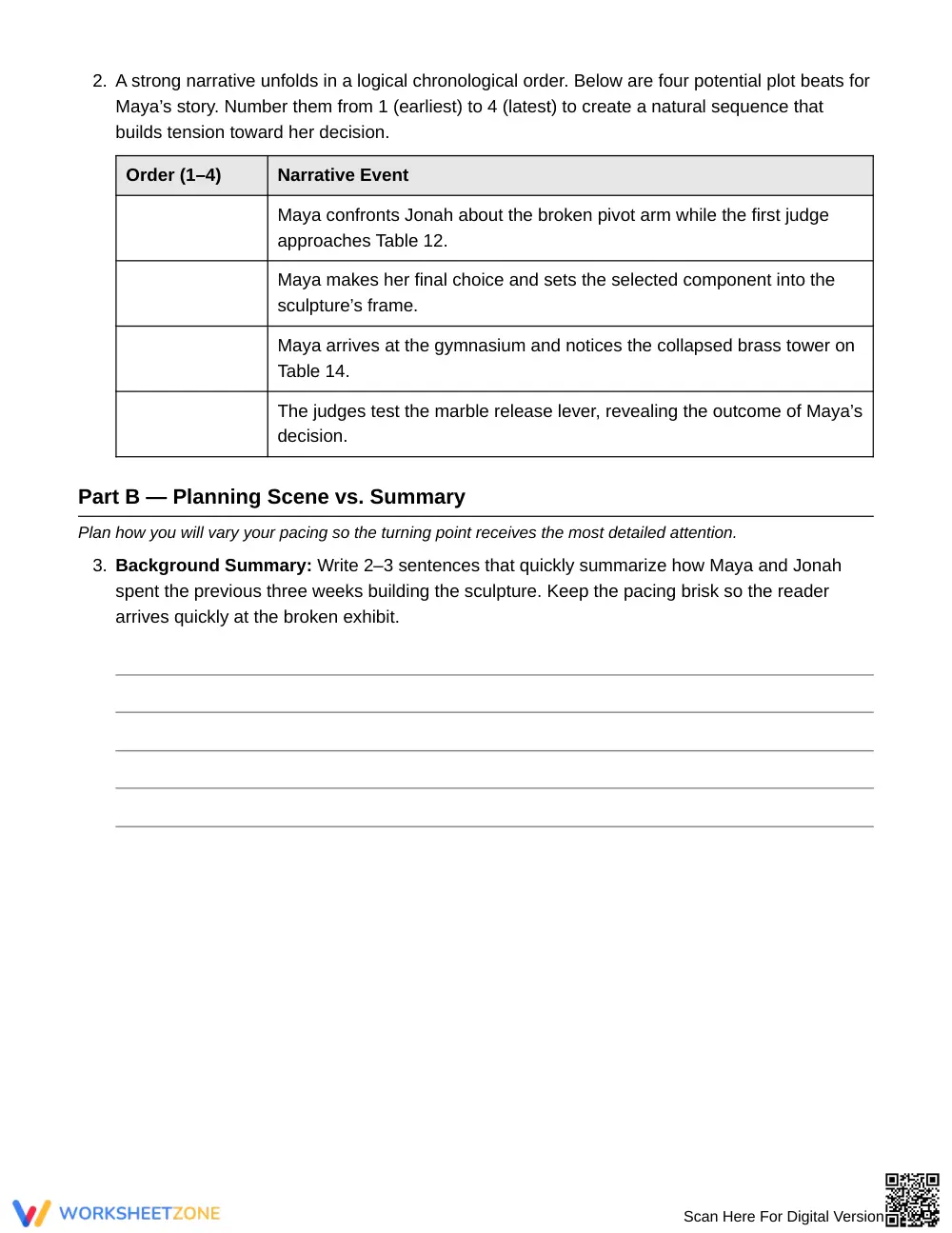
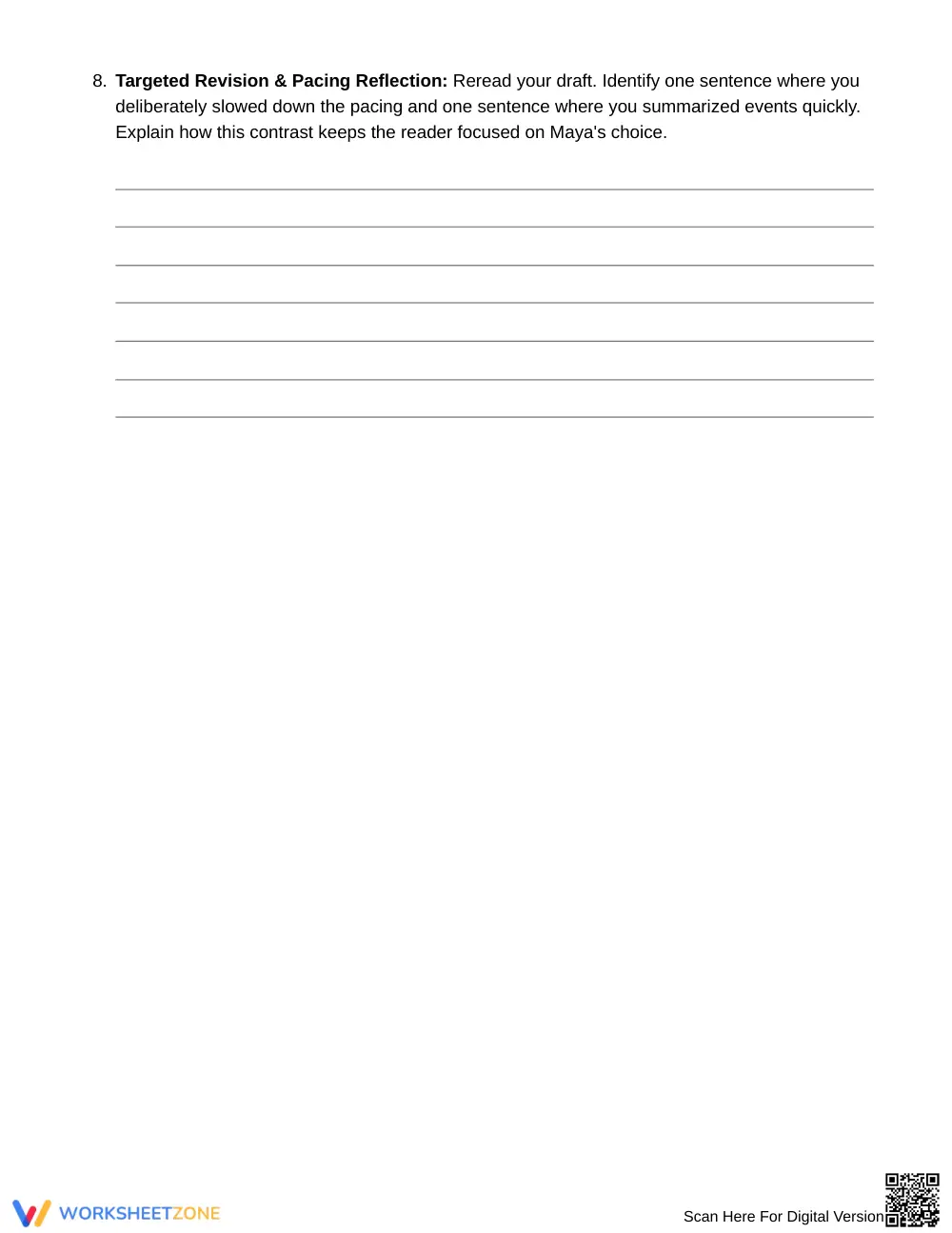
The worksheet spans 5 pages across three parts. Part A (2 tasks) asks students to identify the central conflict and sequence four plot beats in chronological order. Part B (4 tasks) moves into planning: students draft a background summary, list sensory details and an internal thought, write a 3–4 line dialogue exchange, and compose a transitional aftermath summary. Part C (2 tasks) challenges students to write a complete 200–250 word narrative and then complete a pacing reflection naming one slow-paced sentence and one fast-paced sentence. A full answer key covers all 8 tasks.
Skill Progression
- Guided practice (Part A): Two structured tasks—multiple choice and a sequencing table—orient students to the conflict and chronological logic before any writing begins.
- Supported practice (Part B): Four planning tasks break the turning point into manageable components—summary sentences, sensory detail lists, dialogue lines, and transitional phrases—so students build each layer before drafting.
- Independent practice (Part C): Students synthesize all prior work into a full narrative draft, then apply metacognitive reflection by identifying their own pacing choices. This mirrors the I Do, We Do, You Do gradual-release model.
How to Use It
Assign Parts A and B after direct instruction on scene versus summary pacing; students use the craft box as a reference while they plan. Assign Part C as an independent writing task during the same period or as homework, then use the pacing reflection as a formative-assessment exit ticket—look for whether students can name a specific sentence rather than a vague section, which reveals depth of craft awareness. Most students complete the full worksheet in 40–55 minutes.
Who It's For
Designed for on-grade sixth-grade writers in ELA or language arts classes. Students who need additional support benefit from completing Part B planning tasks in pairs before drafting independently in Part C. Advanced writers can add a second turning point or extend the narrative beyond 250 words. The worksheet pairs naturally with a mentor text featuring a single pivotal scene.
Aligned to W.6.3.b, this worksheet addresses the narrative technique skills that NAEP Grade 8 writing results consistently identify as underdeveloped: deliberate pacing and purposeful dialogue. Fisher & Frey (2014) demonstrate that gradual-release structures—moving students from analysis to planning to independent production—produce stronger transfer of writing craft than open-ended prompts alone. This worksheet operationalizes that sequence across three scaffolded parts, giving students a concrete conflict scenario, structured planning templates, and a metacognitive reflection task. The 8-task progression ensures that every student arrives at the independent draft having already made key decisions about chronology, sensory language, and dialogue, reducing cognitive overload and increasing the likelihood that the final narrative demonstrates genuine control of pacing around a single turning point.


