































Printable Multiple Alleles Worksheet | Grade 10 Biology

Paste this activity's link or code into your existing LMS (Google Classroom, Canvas, Teams, Schoology, Moodle, etc.).
Students can open and work on the activity right away, with no student login required.
You'll still be able to track student progress and results from your teacher account.
Mastering non-Mendelian genetics requires connecting probability mathematics with complex biological inheritance. This Grade 10 biology worksheet provides rigorous practice calculating genotypic and phenotypic probabilities across multi-allelic systems, codominant traits, and lethal alleles. Students apply product and sum rules to predict offspring frequencies and analyze inheritance hierarchies.
At a Glance
- Grade: 10 · Subject: Biology
- Standard: Life Science Genetics — Calculate phenotypic and genotypic probabilities across multi-allelic and codominant inheritance systems
- Skill Focus: Calculate Probabilities with Multiple Alleles in Genetics
- Format: 5 pages · 12 problems · Full answer key included · Printable PDF
- Best For: Advanced genetics practice, homework, and comprehensive assessment review
- Time: 45–60 minutes
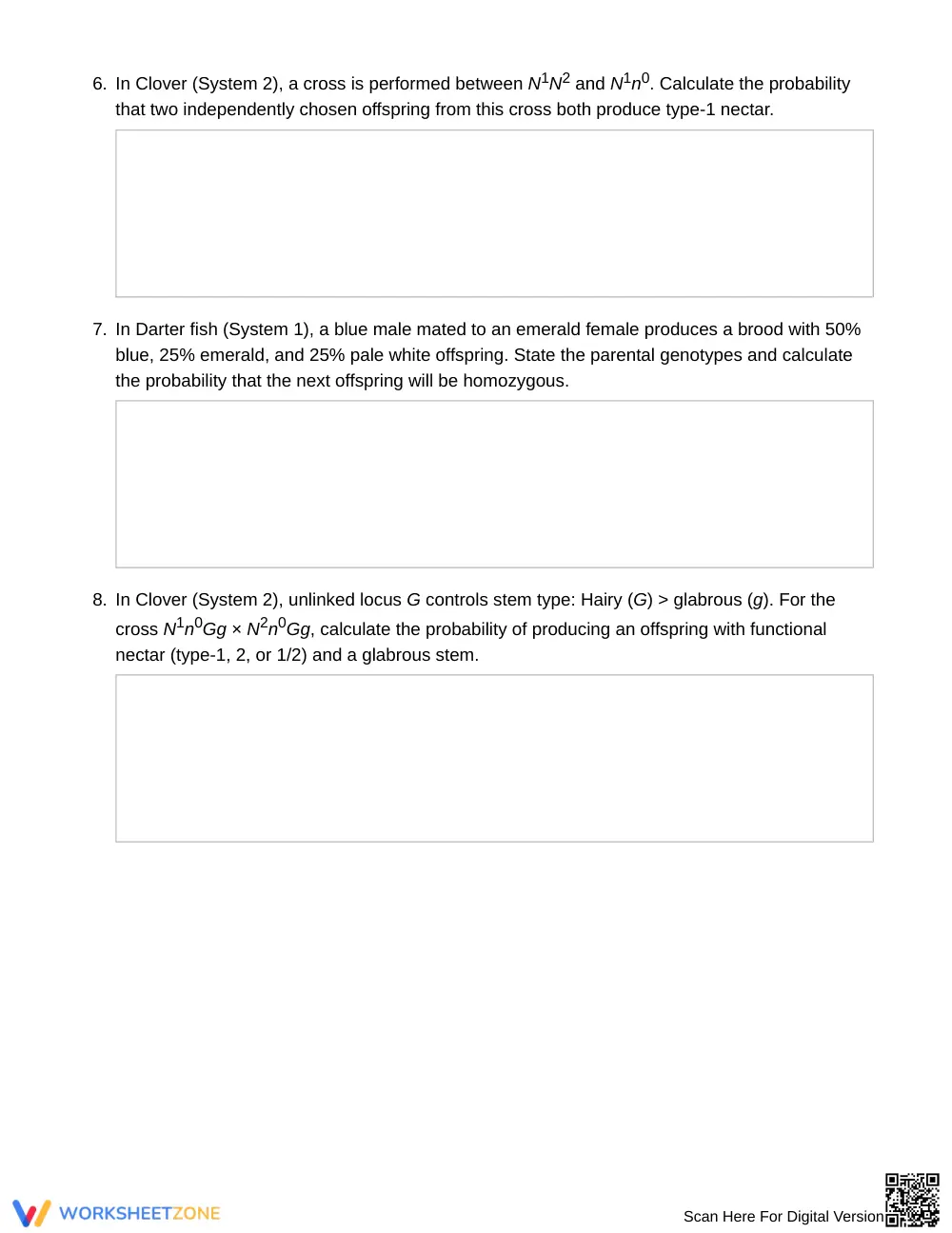
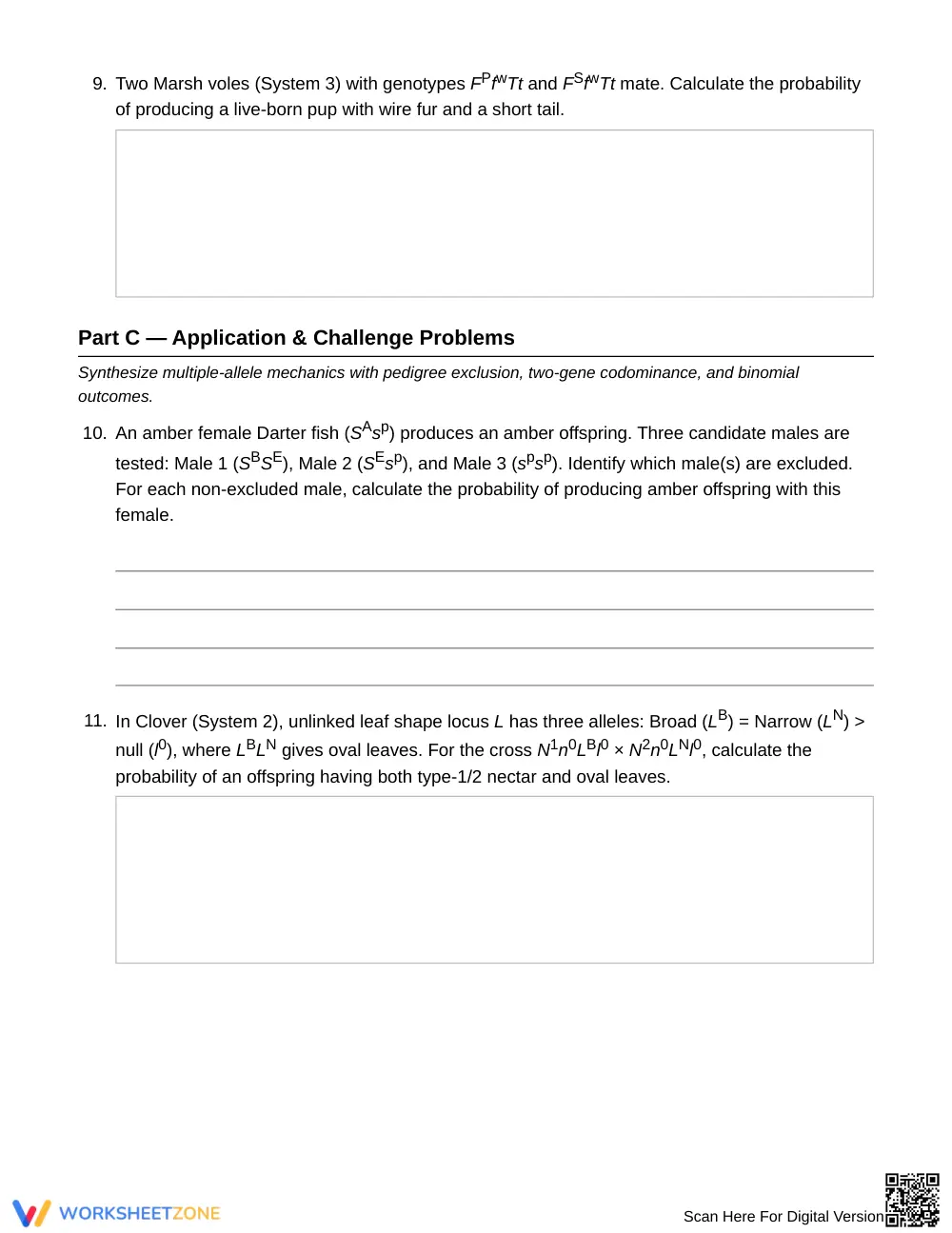
This 5-page printable resource includes a 3-page student worksheet featuring 12 structured genetics problems and a 2-page answer key with worked solutions. A foundational reference section introduces product, sum, and conditional probability rules alongside three synthetic systems modeling dominance hierarchies, codominance, and embryonic lethality.
Skill Progression
- Guided practice (Part A, Problems 1–3): Students solve single-locus crosses using defined dominance hierarchies and codominant systems.
- Supported practice (Part B, Problems 4–9): Scaffolding advances to two-locus dihybrid crosses, conditional probabilities accounting for embryonic lethal genotypes, and multi-event outcomes.
- Independent practice (Part C, Problems 10–12): Learners complete complex tasks including candidate parent exclusion, two-gene codominance, and multi-pup binomial probability calculations without hints.
This sequence follows a gradual-release model, advancing students smoothly from basic rule application to multi-step genetic analysis.
Standards Alignment
This worksheet aligns with high school life science standards for inheritance of traits, requiring students to apply mathematical concepts to explain genetic variation. Both standard codes can be copied directly into lesson plans, IEP goals, or district curriculum mapping tools.
How to Use It
Administer this worksheet after direct instruction on non-Mendelian inheritance. Use Part A for guided checks for understanding, then assign Parts B and C for partner work or independent homework. Formative assessment tip: verify that students re-normalize denominators when calculating live-born probabilities in lethal crosses. Expected completion time is 45 to 60 minutes.
Who It's For
This resource serves Grade 10 general biology and honors students ready for advanced quantitative genetics. Support struggling learners with Punnett square templates, while challenging advanced students with odds ratios. Pair this printable with an anchor chart summarizing Mendelian versus non-Mendelian probability rules.
According to Fisher & Frey (2014), structured instructional progressions that guide students from guided practice toward independent problem solving significantly strengthen conceptual mastery and quantitative reasoning in secondary science classrooms. This Grade 10 biology resource enables learners to calculate complex genetic probabilities across multiple-allele systems and non-Mendelian inheritance patterns. By engaging with 12 rigorous tasks across 5 pages, students master dominance hierarchies, codominant phenotypes, and conditional probability adjustments for lethal alleles. Learners apply the product rule and sum rule across multi-locus crosses, systematically evaluate parental genotype exclusions, and solve multi-pup binomial probability distributions. The gradual release framework scaffolded within this worksheet fosters disciplined scientific computation and higher-order analytical thinking. Providing comprehensive step-by-step answer keys and authentic synthetic genetic models, this educational resource bridges statistical literacy with core biological principles, ensuring high school students build enduring fluency in advanced genetic analysis.


