





























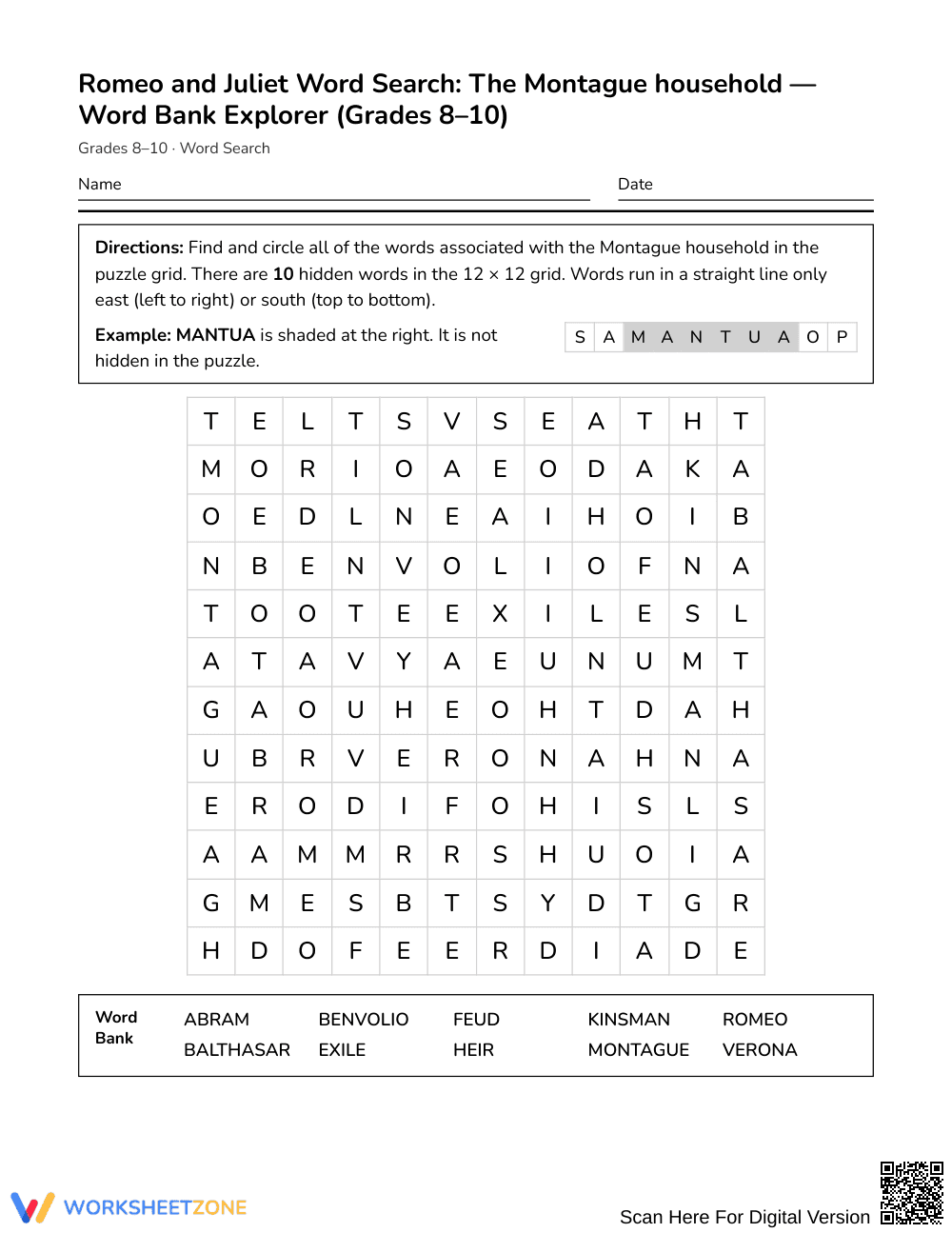


Printable Montague Household Word Search | Grades 8–10 ELA

Paste this activity's link or code into your existing LMS (Google Classroom, Canvas, Teams, Schoology, Moodle, etc.).
Students can open and work on the activity right away, with no student login required.
You'll still be able to track student progress and results from your teacher account.
This printable word search introduces and reinforces key characters, settings, and thematic terms connected to the Montague family in William Shakespeare's Romeo and Juliet. Students locate 10 vocabulary terms while reviewing contextual clues, building vital recognition of character roles and civic conflict before engaging with complex dramatic scenes.
At a Glance
- Grade: Grades 8–10 · Subject: English Language Arts
- Standard: Not standards-assessed — vocabulary enrichment
- Skill Focus: Montague Household Vocabulary
- Format: 1 page · 10 words · Answer key included · PDF
- Best For: Drama unit introduction and vocabulary review
- Time: 15–20 minutes
What's Inside
This 1-page resource features a clean word grid paired with an alphabetical word bank and contextual clues for each term. Every entry includes a specific clue tying the character or concept directly to acts and scenes in the play, accompanied by a comprehensive 3-page answer key showing full letter coordinates.
Puzzle Structure and Mechanics
Students solve a clear 12 x 12 letter grid containing 10 hidden terms related to the Montague faction. Words run in two accessible orientations: left to right (East) and top to bottom (South). An alphabetical word bank provides concise dramatic descriptions for every term, guiding students to connect each name or concept with its literary function as they search.
Standards Alignment
This resource serves as targeted vocabulary enrichment and is not aligned to a specific academic standard. It provides supplementary background knowledge that supports reading comprehension during literary study of classic Elizabethan drama.
How to Use It
Distribute this activity during the launch of Act 1 to familiarize readers with the Montague lineage before reading dialogue aloud. Alternatively, assign it as a bellringer before exploring Act 3 to review Benvolio's kinship and Romeo's impending banishment. Circulate while students work to observe whether they read the text clues or rely solely on letter matching. Expect completion within 15 to 20 minutes.
Who It's For
Designed for Grades 8–10 English Language Arts students beginning their study of Shakespearean drama, this puzzle supports visual learners and emerging readers through directional constraints. Pair this activity directly with a character family tree graphic organizer or an introductory slide deck on the Verona street brawl.
Targeted vocabulary acquisition in secondary literature units establishes foundational textual access for complex dramatic works such as Shakespeare's tragedies. According to Fisher & Frey (2014), intentional exposure to domain-specific terminology and character networks through varied orthographic tasks strengthens semantic memory and text comprehension. By isolating 10 thematic terms central to the Montague household—including key familial titles, pivotal characters, and recurring narrative motifs like exile and feud—this puzzle provides low-stakes cognitive rehearsal before students encounter early modern dialogue. Contextual definitions embedded alongside the word list reinforce semantic associations, helping adolescent readers bridge historical language conventions with dramatic plot functions. Consequently, learners build familiarity with essential character relationships, ensuring smoother navigation of complex verse and character conflicts throughout subsequent whole-class dramatic readings. Regular integration of structured word-recognition activities promotes word consciousness, expands working vocabulary, and anchors reader confidence during rigorous literary study.


