




























Views
Downloads

Printable MLK Nobel Word Search | Grades 6–7 Social Studies

Paste this activity's link or code into your existing LMS (Google Classroom, Canvas, Teams, Schoology, Moodle, etc.).
Students can open and work on the activity right away, with no student login required.
You'll still be able to track student progress and results from your teacher account.
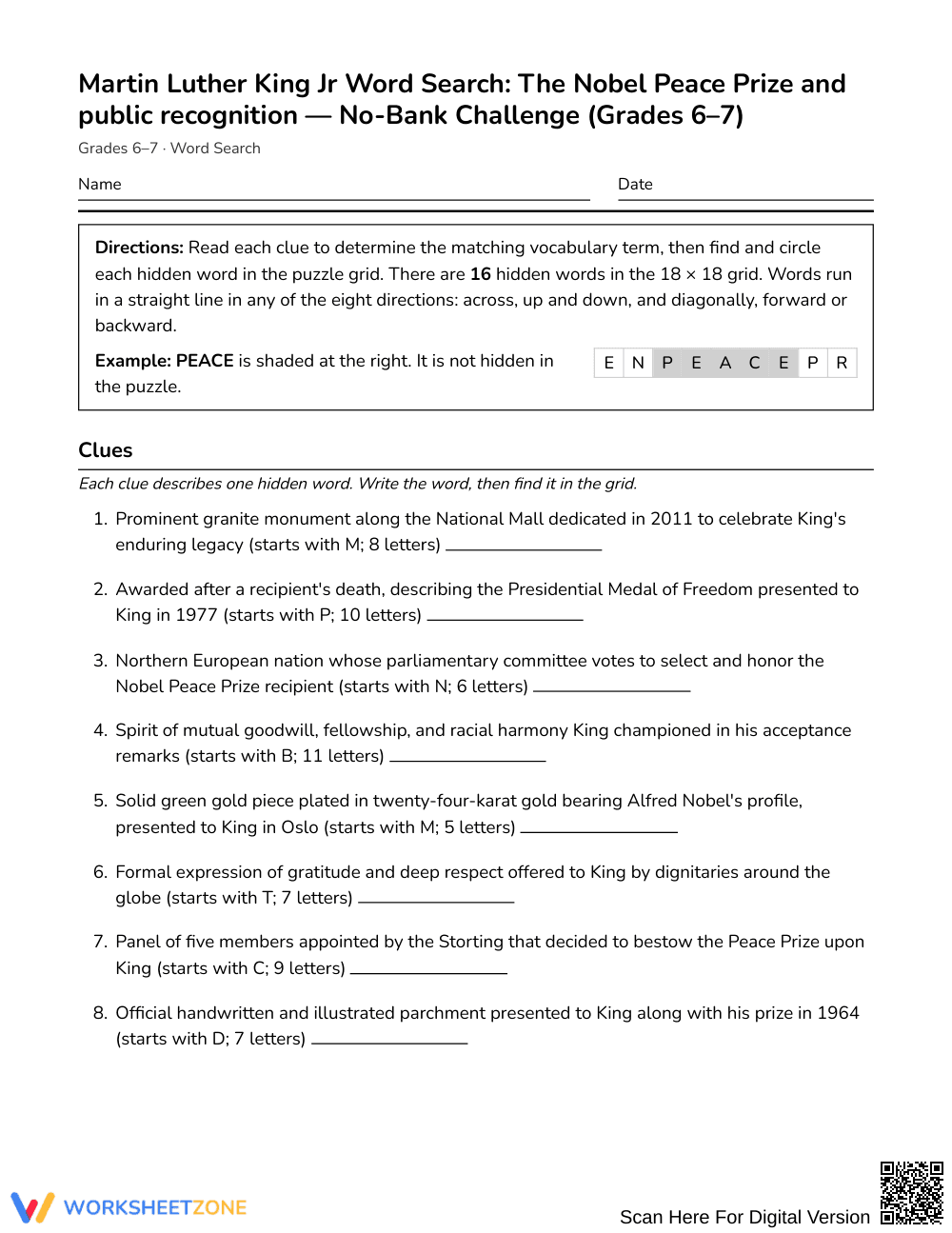
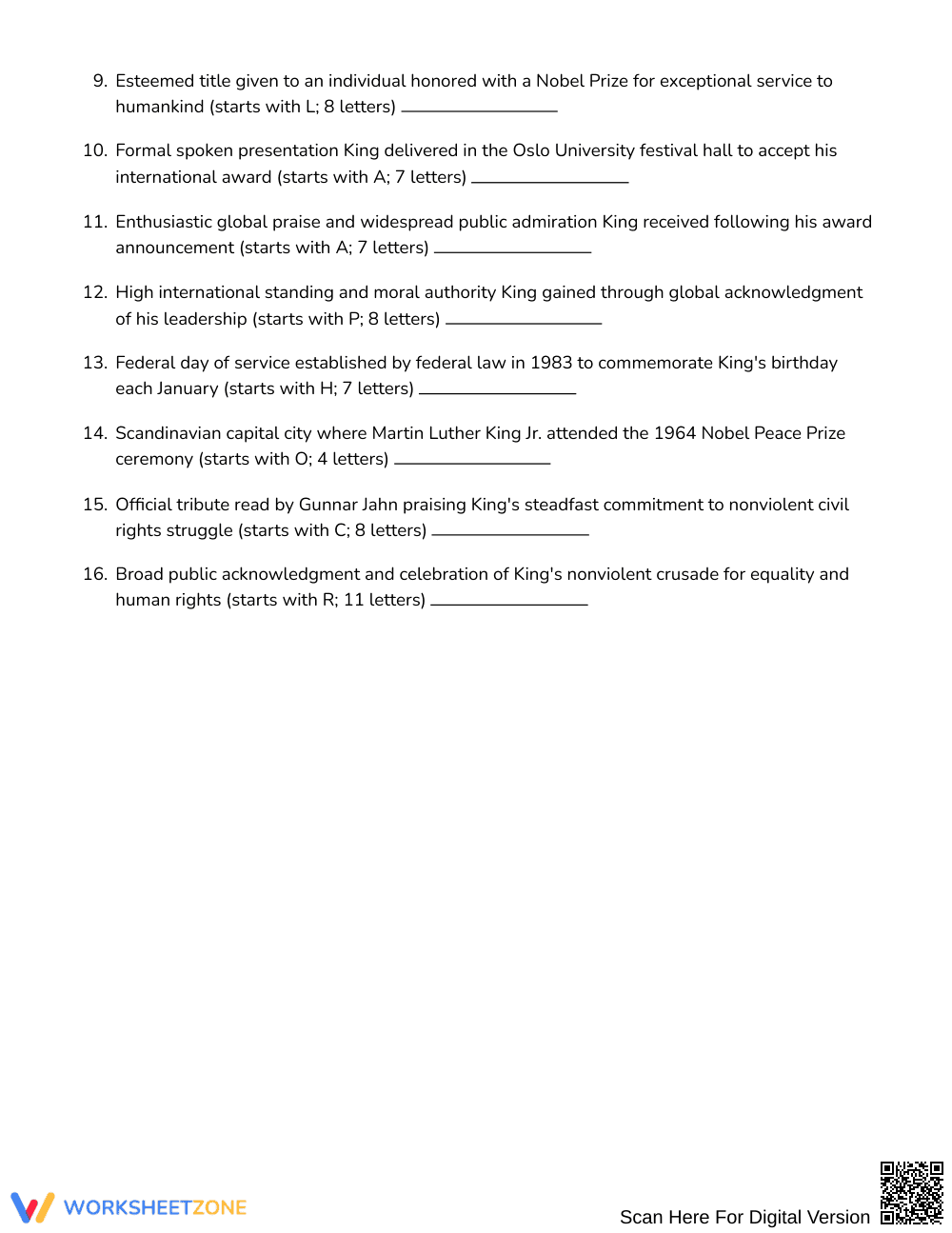
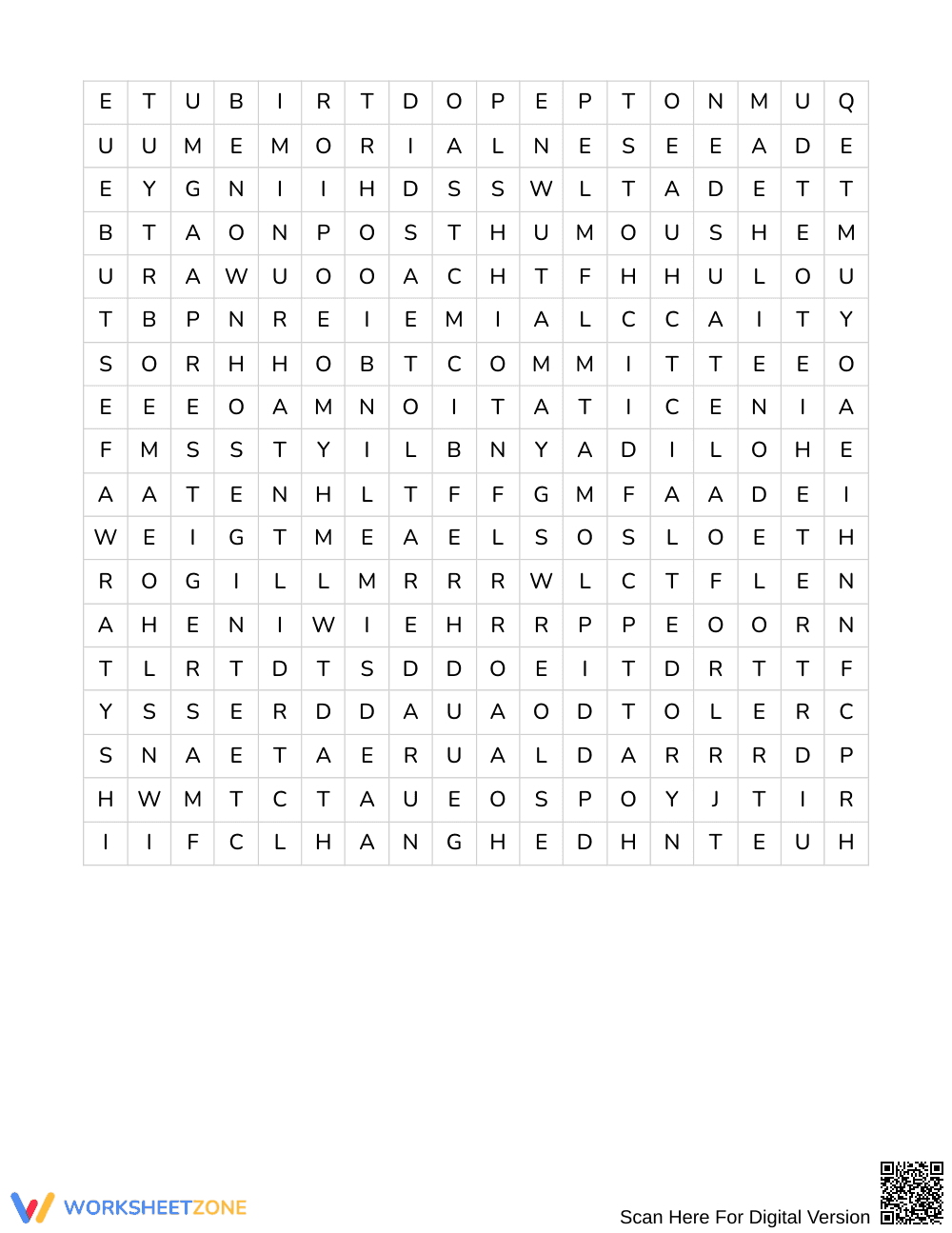
This Martin Luther King Jr. word search strengthens historical vocabulary and reading comprehension for middle school social studies learners. Students analyze 16 informational clues about Dr. King's 1964 Nobel Peace Prize and enduring public recognition, deciphering key academic terms before locating them within an engaging no-bank puzzle format.
At a Glance
- Grade: Grades 6–7 · Subject: Social Studies
- Standard: Not standards-assessed — vocabulary enrichment
- Skill Focus: The Nobel Peace Prize and public recognition
- Format: 3 pages · 16 words · Answer key included · PDF
- Best For: Vocabulary reinforcement and historical review
- Time: 20–30 minutes
What's Inside
This 3-page printable PDF features an advanced no-bank word search designed to deepen content mastery. Rather than simply scanning for an alphabetized list of words, students read 16 rigorous historical clues covering figures, locations, and concepts such as Oslo, laureate, posthumous, and brotherhood. A complete four-page answer key provides clear solution paths for fast, efficient grading.
Puzzle Mechanics and Structure
The activity challenges students with a dense 18 x 18 letter grid containing 16 hidden vocabulary words. Words run in all 8 compass directions: North, Northeast, East, Southeast, South, Southwest, West, and Northwest. Because this activity omits a traditional word bank, students must first use deductive reasoning to solve each clue, ensuring active cognitive engagement throughout the puzzle.
Standards Alignment
This resource serves as targeted vocabulary enrichment and is not aligned to a formal state or national content standard. Instead, it supports cross-curricular literacy by introducing specialized social studies terms and reinforcing historical details regarding civil rights milestones, global diplomacy, and national memorials.
How to Use It
Implement this word search during or immediately after a direct instruction lesson on Dr. King's international impact, or utilize it as a dynamic enrichment station during Martin Luther King Jr. Day units. For formative assessment, observe whether students can identify vocabulary terms from the clues alone before they begin searching the grid. The activity takes approximately 20 to 30 minutes to complete.
Who It's For
This activity is designed for Grades 6–7 social studies students studying the American Civil Rights Movement and 20th-century world history. For differentiated support, pair striving readers to decipher challenging clues cooperatively, or invite advanced learners to write original sentences incorporating abstract terms like prestige. Pair this activity directly with a primary source reading of King's 1964 acceptance speech in Oslo.
Vocabulary acquisition in secondary social studies requires active cognitive engagement rather than passive rote memorization. According to Fisher & Frey (2014), content-area literacy develops most reliably when learners encounter discipline-specific terminology within meaningful informational contexts and retrieve those definitions during structured learning tasks. This 16-word activity operationalizes that principle by replacing passive word-bank searching with clue-driven historical analysis centered on Dr. Martin Luther King Jr.'s 1964 Nobel Peace Prize and subsequent public recognition. By prompting middle school students to decipher contextual clues relating to international diplomacy, legislative honors, and civil rights leadership before locating target vocabulary across an 18 by 18 grid, the resource reinforces conceptual retention and domain-specific reading comprehension. Educators can utilize this rigorous enrichment exercise to evaluate student recall of key historical figures, global award traditions, and nonviolent philosophy while supporting sustained vocabulary development across diverse middle school social studies classrooms.


