




























Views
Downloads



Printable Mitosis Disruption Worksheet | Grade 9 Biology

Paste this activity's link or code into your existing LMS (Google Classroom, Canvas, Teams, Schoology, Moodle, etc.).
Students can open and work on the activity right away, with no student login required.
You'll still be able to track student progress and results from your teacher account.
This worksheet teaches students to infer which stage of the cell cycle a treatment disrupted by reading a consistent set of cell counts. Students convert counts into stage durations, weigh competing models, and defend a conclusion with numbers, building data-based reasoning about mitosis.
At a Glance
- Grade: 9 · Subject: Biology
- Standard: Cell cycle and mitosis — students use data to infer which stage a treatment disrupted.
- Skill Focus: Inferring a disrupted cell cycle stage from observations
- Format: 5 pages · 6 problems · Answer key included · PDF
- Best For: Data reasoning after mitosis instruction
- Time: 40–55 minutes
What's Inside
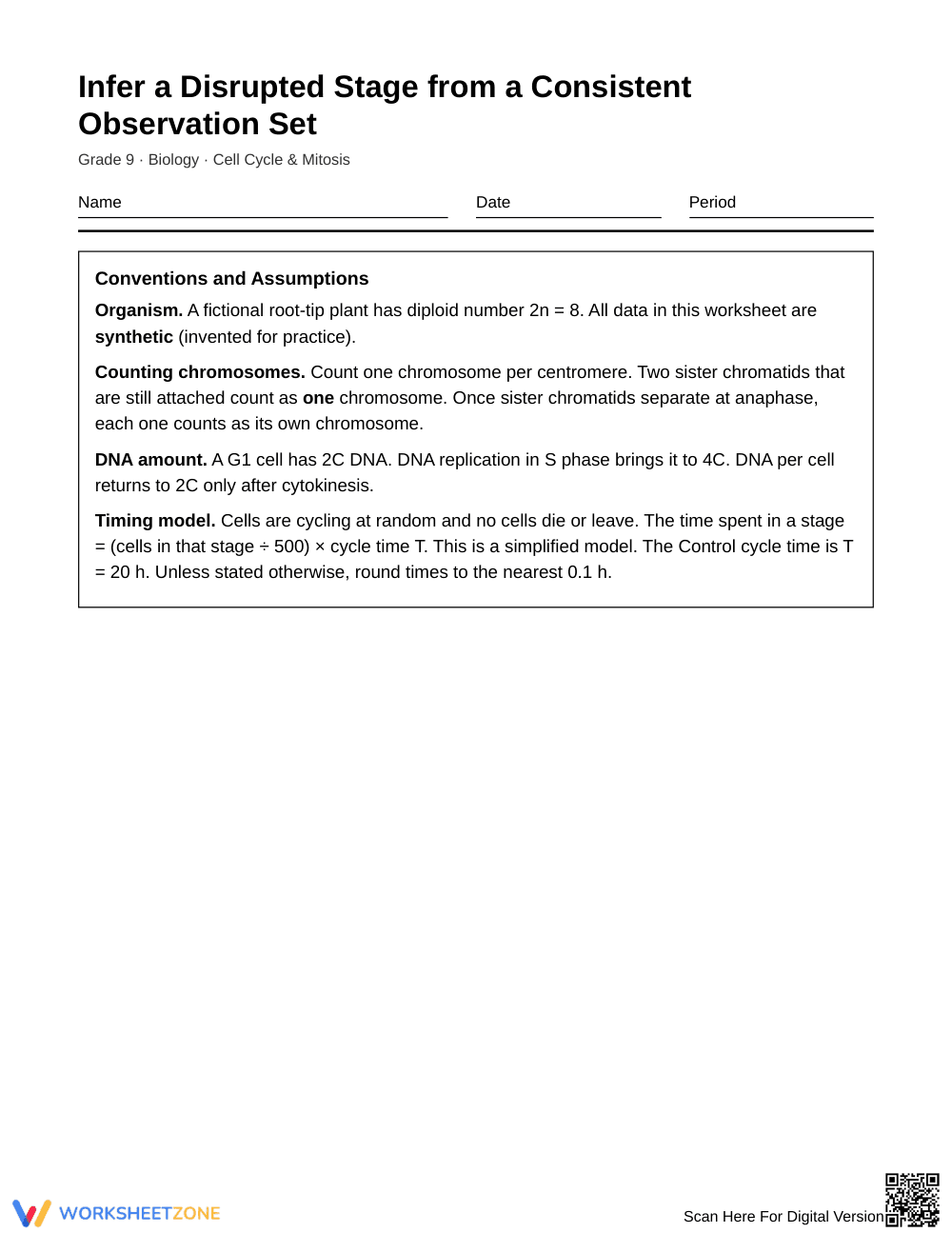
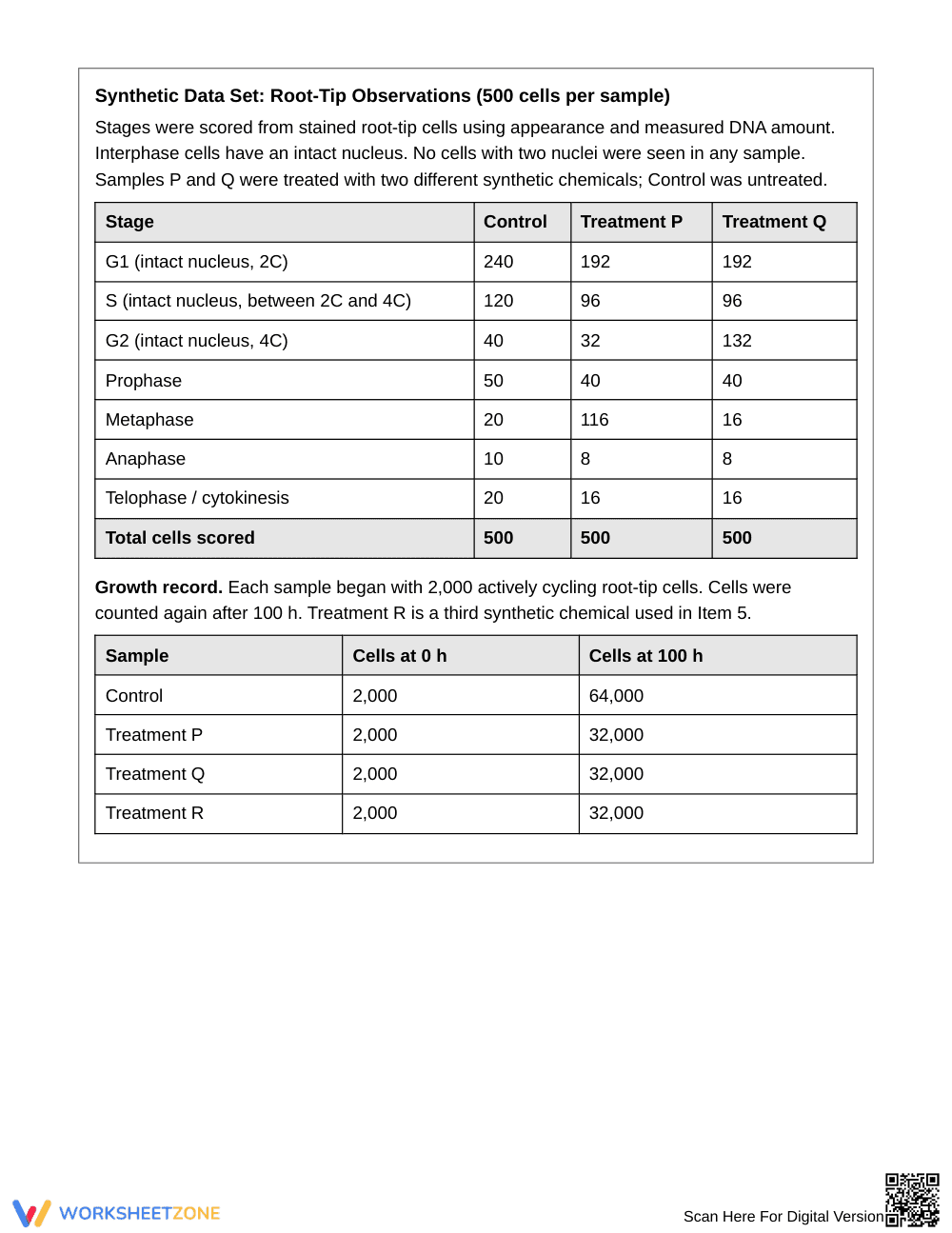
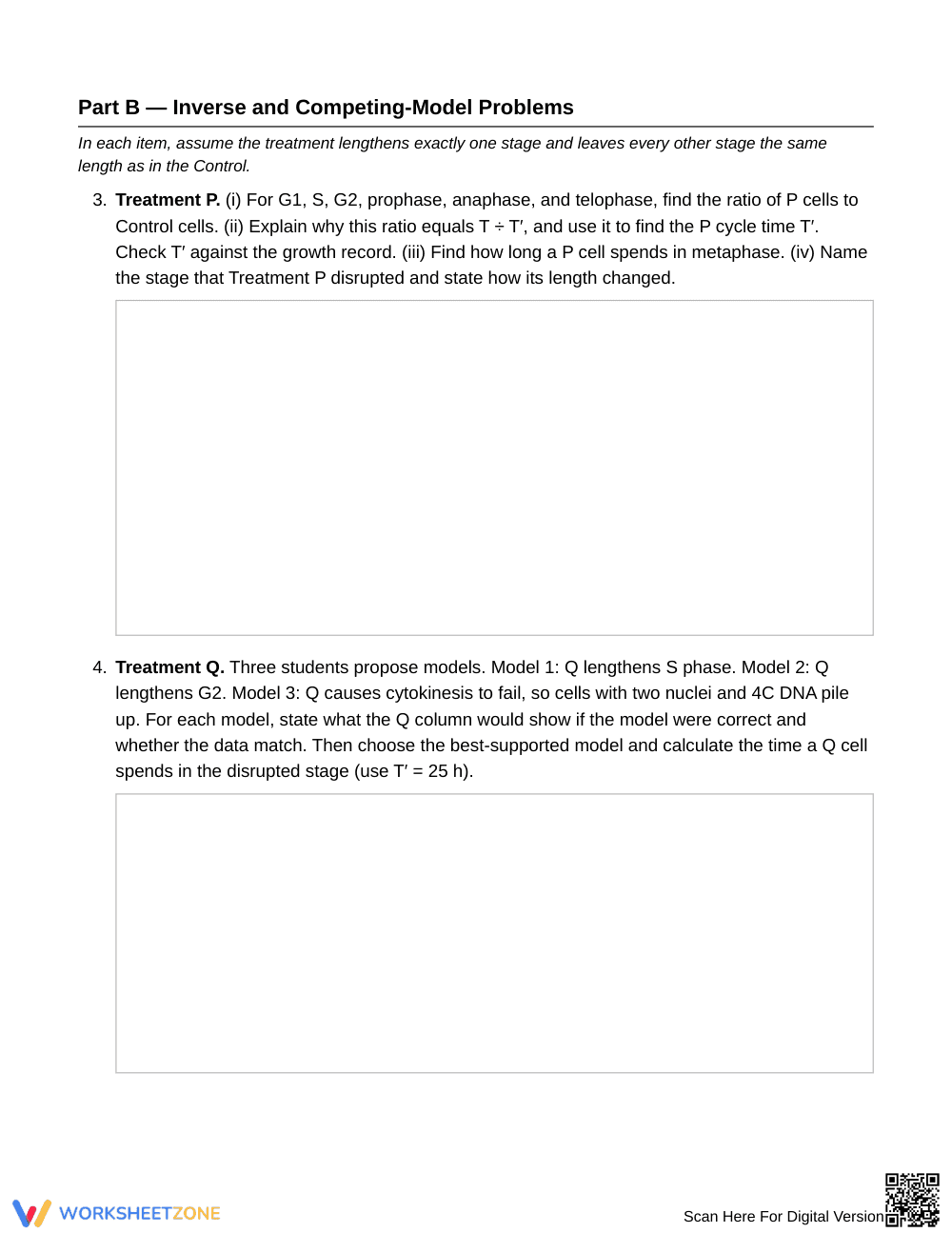
The worksheet opens with a conventions box covering chromosome counting, DNA amount (C values), and a simple timing model with a 20-hour Control cycle. A synthetic data set follows: 500-cell root-tip samples for a Control and two treatments, plus a growth record that includes a third treatment. Six tasks include stage-time calculations, a chromosome and DNA table, inverse ratio problems, competing-model comparisons, and a written claim-evidence-reasoning response. An answer key with worked steps is included. The data are invented for practice.
Skill Progression
- Guided practice (2 tasks, Part A): Constrained calculations with the conventions stated. Students find stage durations, predict counts, and complete a chromosome and DNA table.
- Supported practice (3 tasks, Part B): Inverse problems for Treatments P, Q, and R. Each one gives a ratio or model structure, and students test competing explanations against the counts.
- Independent practice (1 task, Part C): Students evaluate a classmate's claim and write a defended response citing specific numbers.
This sequence follows gradual release: I Do, We Do, You Do.
Standards Alignment
No standard code was supplied for this worksheet. It addresses the cell cycle and mitosis: students describe what happens at each stage, track chromosome number and DNA amount, and use quantitative evidence to support an explanation. Teachers can attach the code used by their state or district when entering it into lesson plans, IEP goals, or curriculum mapping tools.
How to Use It
- After direct instruction: Assign Parts A and B as classwork once students have seen all stages of mitosis.
- Assessment prep: Assign Part C as a written response before a unit test.
While students work, watch for whether they use the ratio of treated to Control counts or only compare raw numbers. Expect 40–55 minutes in total.
Who It's For
Grade 9 Biology students who have learned the stages of mitosis and are ready for quantitative reasoning. Students who need support can complete Part A first and discuss Part B in pairs. Pair it with a labeled cell cycle diagram or an anchor chart of chromosome and DNA counts.
The Grade 9 Biology worksheet “Infer a Disrupted Stage from a Consistent Observation Set” teaches students to deduce which stage of the cell cycle a treatment disrupted by converting synthetic root-tip cell counts into stage durations. Across 6 tasks, students apply a timing model, track chromosome number and DNA amount, test competing explanations against 500-cell samples, and defend a claim with evidence and reasoning. The task sequence follows the gradual release of responsibility framework described by Fisher & Frey (2014), moving from guided calculation to independent argument. Students practice proportional reasoning, since the ratio of treated to Control cell counts equals the ratio of cycle times, and learn that chromosome and DNA counts alone cannot distinguish a G2 delay from a metaphase delay. The printable resource includes an answer key and runs five pages, suiting units on mitosis and cell cycle regulation.


