


























Views
Downloads



Printable Literary Conflict Worksheet | Grade 7 ELA
Paste this activity's link or code into your existing LMS (Google Classroom, Canvas, Teams, Schoology, Moodle, etc.).
Students can open and work on the activity right away, with no student login required.
You'll still be able to track student progress and results from your teacher account.
This printable literature worksheet develops Grade 7 students' ability to analyze internal and external conflict and track how character decisions propel plot progression. Featuring an engaging narrative, "The Last Practice Slot," students examine conflicting motivations, evaluate turning points, and cite specific textual evidence to construct evidence-based literary analysis responses.
At a Glance
- Grade: 7 · Subject: Reading Literature
- Standard:
CCSS.ELA-LITERACY.RL.7.3— Analyze how story elements interact and how conflicts shape plot progression- Skill Focus: Literary Conflict Analysis
- Format: 3 pages · 10 problems · Answer key included · PDF
- Best For: Independent practice, close reading, homework
- Time: 35–45 minutes
What's Inside
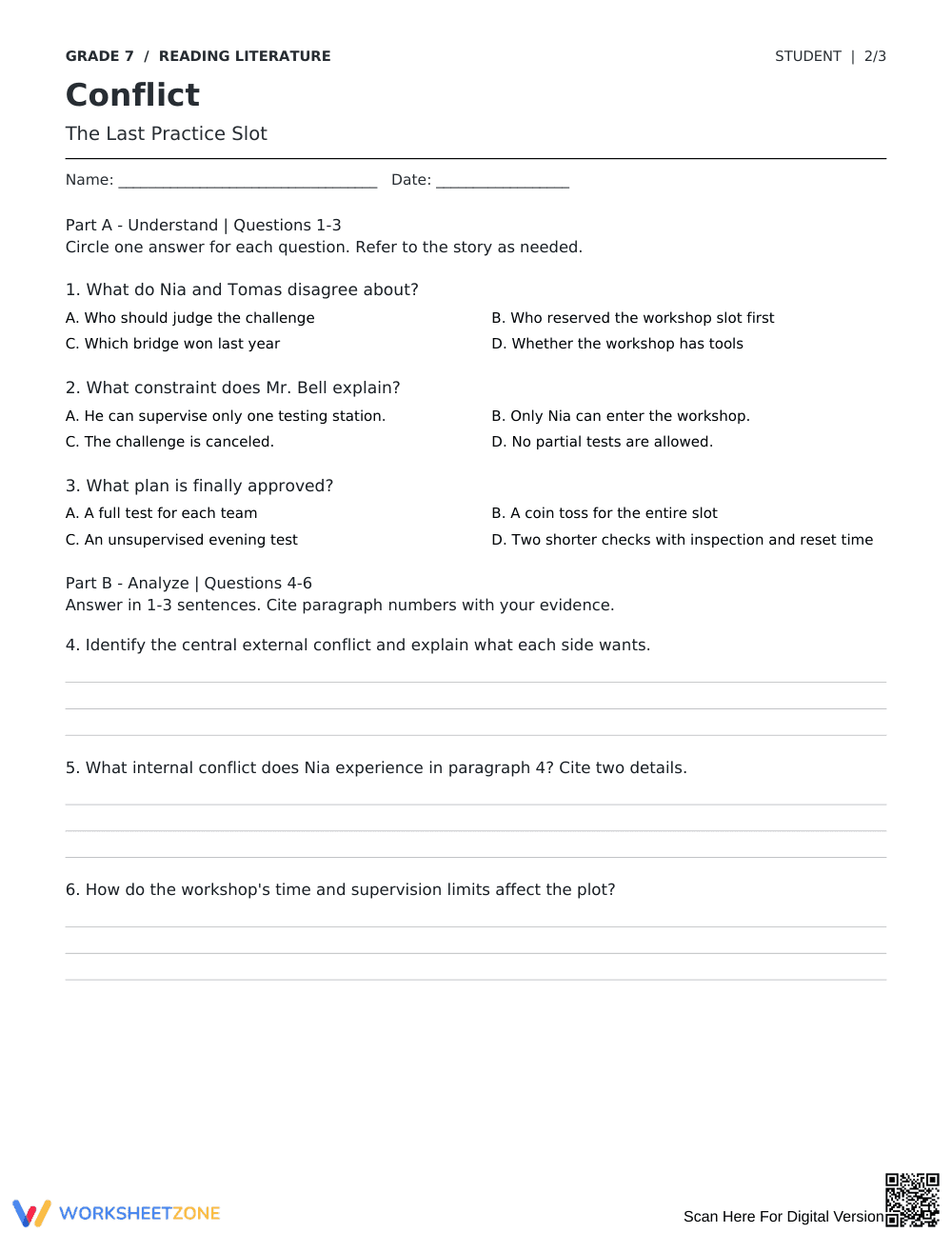
The resource includes an 8-paragraph realistic fiction passage followed by a 10-item assessment spanning 3 student pages. Tasks progress from three multiple-choice questions targeting basic comprehension to seven open-response items requiring paragraph citations. A 2-page teacher answer key provides full model responses, evidence citations, and a comprehensive 30-point scoring rubric.
Skill Progression
- Guided practice (Questions 1–3): Students identify surface-level disagreements, external constraints, and basic plot facts through 3 multiple-choice questions.
- Supported practice (Questions 4–8): Learners analyze internal versus external conflict, setting limitations, and turning points across 5 short-response items requiring direct paragraph citations (1–3 sentences).
- Independent practice (Questions 9–10): Students synthesize complex narrative dynamics in 2 extended constructed responses (3–5 sentences), evaluating unresolved tension and explaining how internal struggles drive external resolutions.
This deliberate sequence follows the gradual-release model, transitioning students from literal story recall to sophisticated text-based literary evaluation.
Standards Alignment
This worksheet directly aligns with primary standard `CCSS.ELA-LITERACY.RL.7.3`: Analyze how particular elements of a story or drama interact (e.g., how setting shapes the characters or plot). Additionally, it reinforces supporting standard `CCSS.ELA-LITERACY.RL.7.1` by requiring students to cite several pieces of textual evidence to justify their analytical claims. Both standard codes can be copied directly into lesson plans, IEP goals, or district curriculum mapping tools.
How to Use It
Assign this worksheet directly after mini-lessons on literary conflict types or plot structure to provide structured independent practice. It also serves effectively as a close-reading assessment during small-group reading rotations. During formative observation, check whether students distinguish Nia's internal hesitation in paragraph 4 from the external schedule dispute with Tomas before they begin the extended synthesis section. The full activity requires 35–45 minutes to complete.
Who It's For
Designed for general education Grade 7 English language arts classrooms, this worksheet also supports striving readers through paragraph-by-paragraph chunking and sentence-length guidelines. It pairs naturally with an anchor chart detailing internal versus external conflict types and character motivation before students read the passage.
Targeting CCSS.ELA-LITERACY.RL.7.3, this Grade 7 reading literature worksheet equips middle school students to analyze how conflicting character motivations, external constraints, and internal emotional dilemmas interact to drive narrative plot resolution. As documented in research on structured comprehension and text-dependent questioning by Fisher & Frey (2014), instructional scaffolds that move learners from literal comprehension to multi-sentence textual analysis substantially improve critical thinking, reading stamina, and analytical writing proficiency. The passage and its 10-item scaffolded question set require students to locate textual evidence, differentiate interpersonal disputes from internal reservations, and synthesize multi-paragraph narrative arcs. Incorporating explicit paragraph references across both short and extended responses strengthens student mastery in defending analytical claims. This resource provides educators with reliable formative data and a structured 30-point scoring framework to monitor individual student progress toward standard mastery in middle school literary analysis.


