




























Views
Downloads

Printable Liquid Volume Word Search | Grade 2 Math

Paste this activity's link or code into your existing LMS (Google Classroom, Canvas, Teams, Schoology, Moodle, etc.).
Students can open and work on the activity right away, with no student login required.
You'll still be able to track student progress and results from your teacher account.
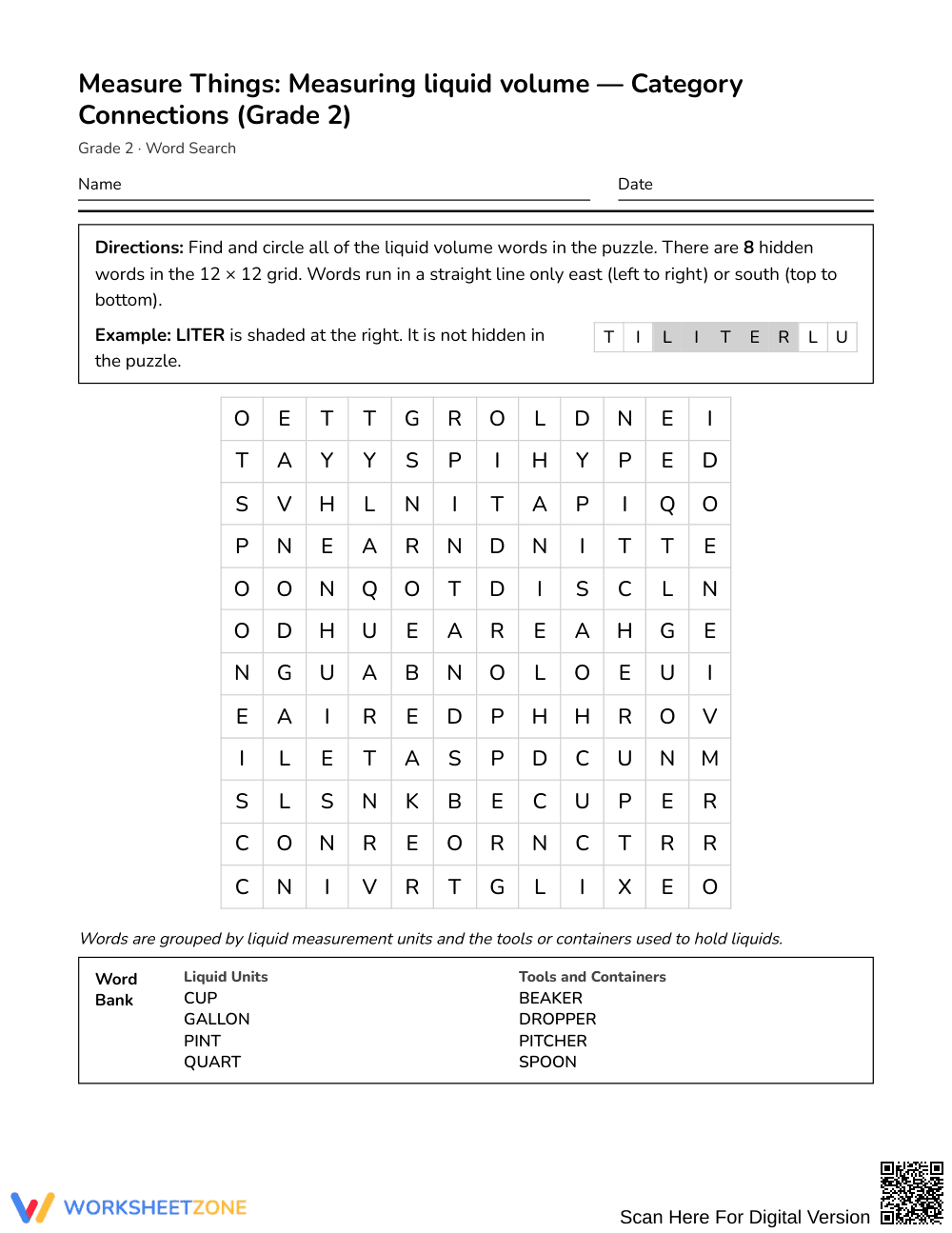
This Grade 2 math word search reinforces liquid volume vocabulary through structured word recognition. Students locate 8 measurement words to build familiarity with common units and tools. By connecting domain-specific words with physical definitions, learners strengthen math literacy before tackling complex capacity calculations.
At a Glance
- Grade: Grade 2 · Subject: Math
- Standard: Not standards-assessed — vocabulary enrichment
- Skill Focus: Measuring liquid volume units, scientific tools, and containers
- Format: 1 printable student page · 8 hidden vocabulary words · Full answer key included · PDF
- Best For: Vocabulary review, introductory math centers, and early finishers
- Time: 10–15 minutes of focused student seatwork
What's Inside
This single-page puzzle presents 8 liquid volume words organized into two categories: Liquid Units and Tools and Containers. Students search for measurement units including cup, pint, quart, and gallon, alongside practical equipment like beaker, dropper, pitcher, and spoon. Accompanying student clues provide clear definitions explaining how each unit or tool functions in liquid measurement. A complete 2-page answer key highlights all word placements within the grid, enabling rapid grading and self-checking.
Puzzle Structure and Mechanics
The activity uses a 12 x 12 letter grid tailored for Grade 2 visual tracking. To maintain accessible practice, hidden words run in two directions: horizontally from left to right (E) and vertically from top to bottom (S). No diagonal or backwards placements are included. Students reference a categorized word bank supported by concise clue definitions that reinforce meaning as learners find each term.
Standards Alignment
This resource provides targeted vocabulary enrichment and is not aligned to an assessed mathematics standard. While second-grade standards prioritize linear measurement, introducing capacity vocabulary builds essential background knowledge for volume standards in later grades. Establishing familiarity with units like cups and quarts strengthens contextual understanding during science investigations and real-world math applications.
How to Use It
Use this word search before direct instruction as a vocabulary preview, or assign it after hands-on capacity investigations for independent practice. Students typically finish within 10 to 15 minutes. For formative assessment, observe whether students consult the category headers and clue definitions or simply search for letter combinations, noting who understands how measurement tools differ from units.
Who It's For
This word search is designed for Grade 2 students learning liquid volume concepts. For learners needing additional support, provide highlighters to mark initial letters or pair students for partner solving. Pair this activity with a classroom capacity anchor chart showing real containers to help visual learners connect vocabulary words with physical objects.
Vocabulary acquisition in early elementary mathematics serves as a foundational bridge to conceptual understanding, particularly when learners encounter domain-specific measurement terminology. Although this resource is non-standards-assessed vocabulary enrichment rather than a standard-aligned assessment, identifying terms like gallon, quart, pint, and beaker prepares second-grade students for subsequent capacity units. According to Fisher & Frey (2014), intentional exposure to technical vocabulary through structured categorization and print-based word recognition helps young learners internalize specialized language before formal procedural instruction begins. By organizing terms into distinct units and container tools within a predictable 12 x 12 grid, this activity reinforces orthographic mapping and semantic connections simultaneously. Integrating definitional clues alongside directional word searches enables primary students to bridge spoken vocabulary and written academic expressions efficiently, establishing a resilient linguistic base for future liquid measurement tasks and hands-on science investigations across early elementary curricula.


