





























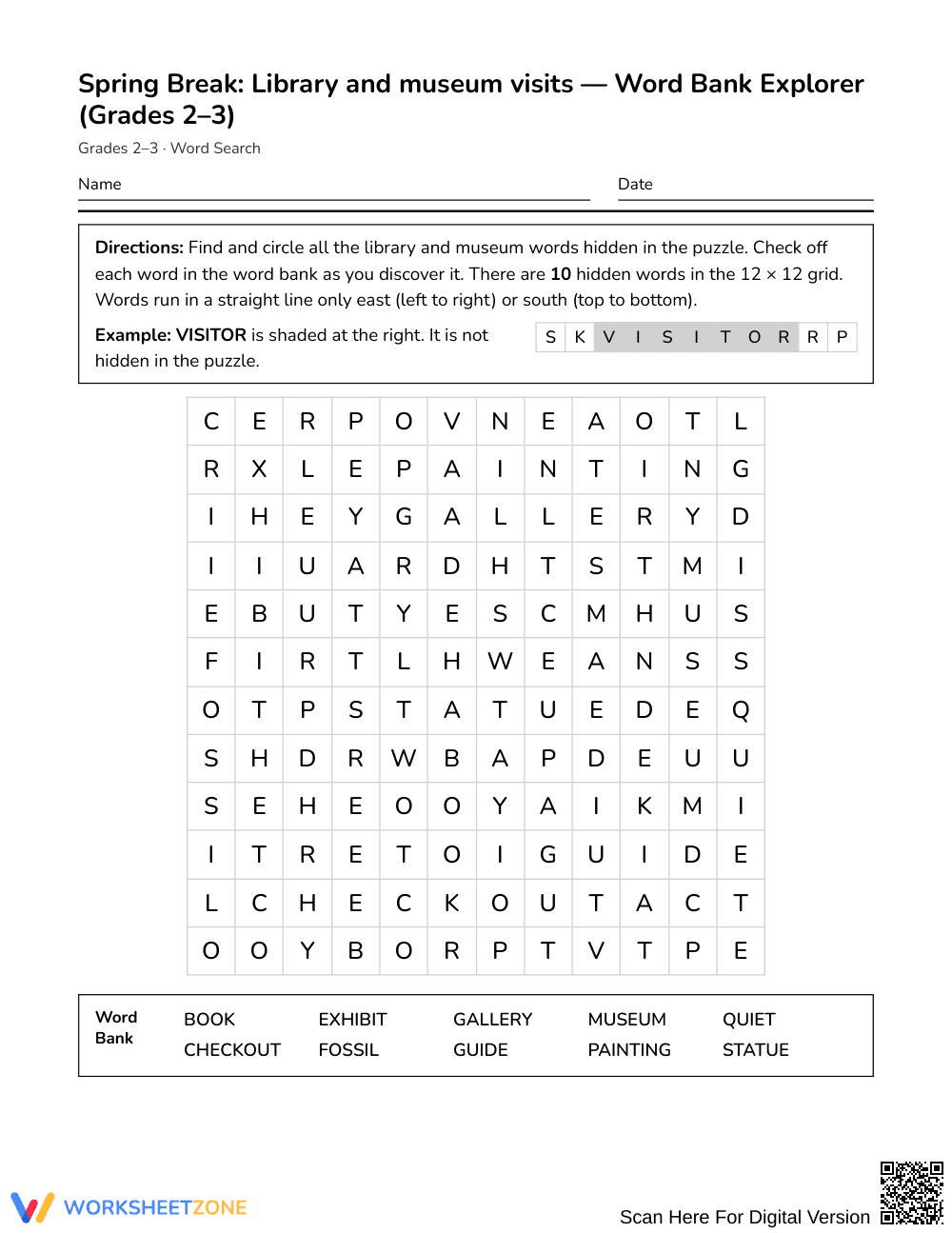


Printable Library & Museum Word Search | Grades 2–3 ELA

Paste this activity's link or code into your existing LMS (Google Classroom, Canvas, Teams, Schoology, Moodle, etc.).
Students can open and work on the activity right away, with no student login required.
You'll still be able to track student progress and results from your teacher account.
This Grades 2–3 vocabulary word search introduces early elementary learners to key cultural community destinations through focused word recognition. Students locate 10 theme-based terms related to visiting libraries and museums, reinforcing foundational spelling and thematic vocabulary while building content knowledge. The clean one-page format provides purposeful, independent engagement suitable for spring break units or enrichment.
At a Glance
- Grade: Grades 2–3 · Subject: English Language Arts
- Standard: Not standards-assessed — vocabulary enrichment
- Skill Focus: Library and museum visits vocabulary
- Format: 1 page · 10 words · Answer key included · PDF
- Best For: Independent vocabulary review and fast finishers
- Time: 15–25 minutes
This printable resource features a single-page word search puzzle organized on an accessible 12 × 12 letter grid. An alphabetical word bank presents 10 curated terms, each paired with an explicit student-friendly definition that clarifies essential concepts like galleries, exhibits, and quiet checkout areas. The package includes a comprehensive two-page visual answer key showing precise word placements to streamline checking.
Puzzle Structure and Mechanics
To support developing readers in Grades 2–3, the puzzle utilizes targeted structural supports:
- 12 × 12 Grid Layout: A compact grid limits visual overwhelm, helping young learners track letter sequences accurately across lines.
- Restricted Search Directions: Hidden terms run strictly left-to-right (East) and top-to-bottom (South), avoiding backward or diagonal reversals that confuse emerging readers.
- Defined Vocabulary Bank: The alphabetical bank lists all 10 words alongside contextual definitions, reinforcing reading comprehension before students search the letter array.
Standards Alignment
This activity serves strictly as supplemental vocabulary enrichment and is not aligned to a formal academic content standard. Instead of assessing specific benchmarks, it reinforces spelling patterns, word recognition, and background knowledge about civic community spaces. Teachers can integrate this activity freely across thematic units on community helpers, spring break excursions, or informational reading without needing formal standards tracking.
How to Use It
Deploy this word search during independent seatwork after introducing a thematic reading unit on community institutions, or place it in an early-finisher station. During completion, observe whether students cross-reference the provided definitions to verify word meaning or rely solely on letter matching. Learners typically complete the 10-word puzzle in 15 to 25 minutes with zero upfront teacher instruction.
Who It's For
This activity is designed for second- and third-grade elementary students expanding their tier-two vocabulary, including English language learners who benefit from clear contextual glosses. Pair this puzzle with an informational read-aloud about public libraries or an interactive virtual museum tour to connect word recognition directly with real-world experiences.
According to curriculum research highlighted by EdReports 2024, intentional exposure to domain-specific vocabulary significantly enhances reading fluency and text comprehension for early elementary students. This word search activity develops essential vocabulary centered on library and museum visits, reinforcing word recognition through an accessible 10-word puzzle format. Rather than presenting isolated spelling lists, the resource pairs each search term with a functional, student-friendly definition, prompting learners to connect unfamiliar academic concepts like exhibits, fossils, and galleries with meaningful real-world contexts. Orthographic pattern recognition reinforces letter sequence familiarity while restricted directional placement supports emerging decoders. Because vocabulary enrichment activities of this nature operate outside high-stakes standards assessment, they provide low-anxiety language practice that strengthens background knowledge. Integrating contextual vocabulary review into primary literacy blocks ensures that Grades 2–3 learners build the robust conceptual schema necessary to comprehend complex informational texts across diverse subject areas.


