




























Views
Downloads


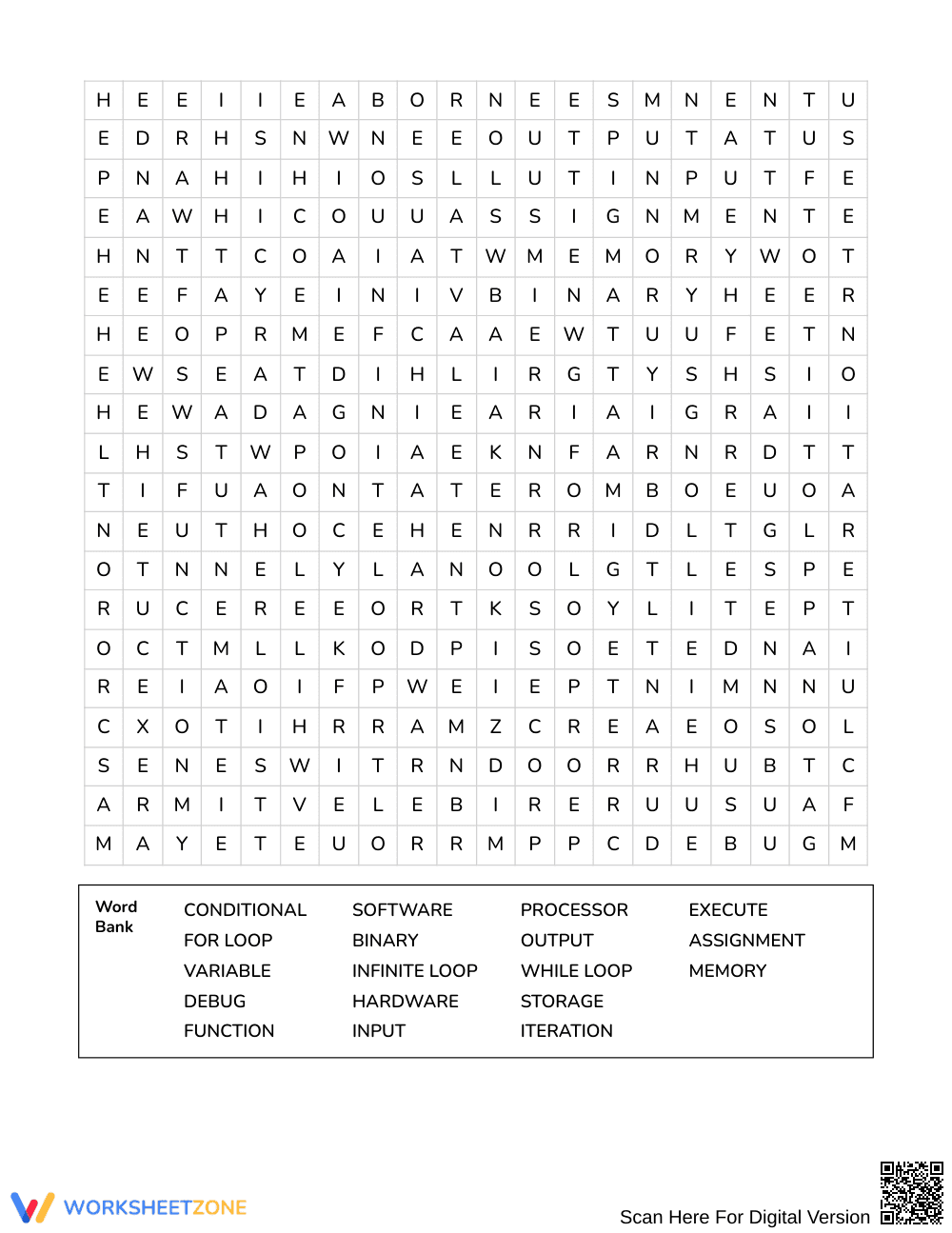

Printable Hardware & Software Word Search | Grades 7–8 ELA

Paste this activity's link or code into your existing LMS (Google Classroom, Canvas, Teams, Schoology, Moodle, etc.).
Students can open and work on the activity right away, with no student login required.
You'll still be able to track student progress and results from your teacher account.
This computer science vocabulary word search strengthens middle school literacy by connecting technical definitions to essential hardware and programming terms. Students review 18 concepts, distinguishing physical components like processors and storage from programmatic structures like iteration and conditionals, reinforcing cross-curricular informational vocabulary through focused puzzle retrieval.
At a Glance
- Grade: Grades 7–8 · Subject: English Language Arts (ELA)
- Standard: Not standards-assessed — vocabulary enrichment
- Skill Focus: Comparing data programs and hardware
- Format: 3 pages · 18 hidden words · Full answer key included · PDF
- Best For: Informational STEM vocabulary review and early finishers
- Time: 20–35 minutes
What's Inside
This 3-page printable activity features 18 hidden vocabulary terms distributed across an extensive letter grid with definition clues. Rather than copying terms from a simple list, students read concise technical definitions for concepts like binary, memory, functions, and loops to deduce each word. The resource includes a shuffled word bank for scaffolding alongside a comprehensive 4-page answer key.
Puzzle Structure and Mechanics
The activity centers on a 20 x 20 letter grid designed to reinforce pattern recognition. Words are hidden across all 8 directional orientations: north, northeast, east, southeast, south, southwest, west, and northwest. Students solve definition clues to identify target words, using a shuffled word bank to verify spelling before locating terms forwards, backwards, or diagonally.
Standards Alignment
This resource serves as targeted vocabulary enrichment and is not aligned to a specific academic content standard. It reinforces foundational computer science terminology within English Language Arts instruction, providing non-standardized support for informational reading comprehension and technical language acquisition across middle school classrooms.
How to Use It
Introduce this word search after direct instruction on computer systems to reinforce distinctions between hardware and software. Alternatively, assign it as a collaborative warm-up before reading STEM informational texts. During the activity, check whether students deduce answers from clues or rely on the shuffled bank. Expected completion time is 20 to 35 minutes.
Who It's For
This activity is designed for Grades 7–8 students expanding technical literacy in general ELA or introductory computer classes. It offers helpful differentiation for visual learners through its dual clue-and-bank structure. Pair this printable with an informational article on computer architecture or a diagram labeling internal hardware components.
Academic literacy in middle school requires deliberate instruction in domain-specific terminology, particularly when distinguishing abstract technical concepts like data programs from concrete computer hardware. According to Fisher & Frey (2014), intentional vocabulary acquisition flourishes when learners encounter domain-specific terms across varied modalities, including contextual clues, definition synthesis, and guided retrieval practice. Although this resource functions as vocabulary enrichment rather than a standards-assessed instrument, it directly reinforces language acquisition by requiring students to evaluate 18 precise definitions before searching for matching terms across a complex letter grid. Engaging with technical terminology through multiple cognitive touchpoints strengthens students' informational reading stamina and conceptual memory retention. By bridging STEM content with language arts strategies, this print-and-go puzzle provides structured support that prepares Grades 7–8 learners to interpret technical manuals, comprehend science texts, and articulate foundational computing principles with greater linguistic accuracy and confidence.


