































Printable Grade 7 Density & Intensive Properties Worksheet

Paste this activity's link or code into your existing LMS (Google Classroom, Canvas, Teams, Schoology, Moodle, etc.).
Students can open and work on the activity right away, with no student login required.
You'll still be able to track student progress and results from your teacher account.
This five-page Grade 7 Science worksheet builds student mastery of density and intensive physical properties through 12 carefully sequenced problems. Students calculate density, identify unknown materials using reference data, and explain why intensive properties serve as dependable identification tools.
At a Glance
- Grade: 7 · Subject: Science
- Standard: Physical Properties of Matter — Distinguish intensive from extensive properties and use density to identify substances
- Skill Focus: Density calculation, intensive vs. extensive properties, unknown material identification
- Format: 5 pages · 12 problems · Answer key included · PDF
- Best For: Guided practice during physical properties unit
- Time: 40–55 minutes
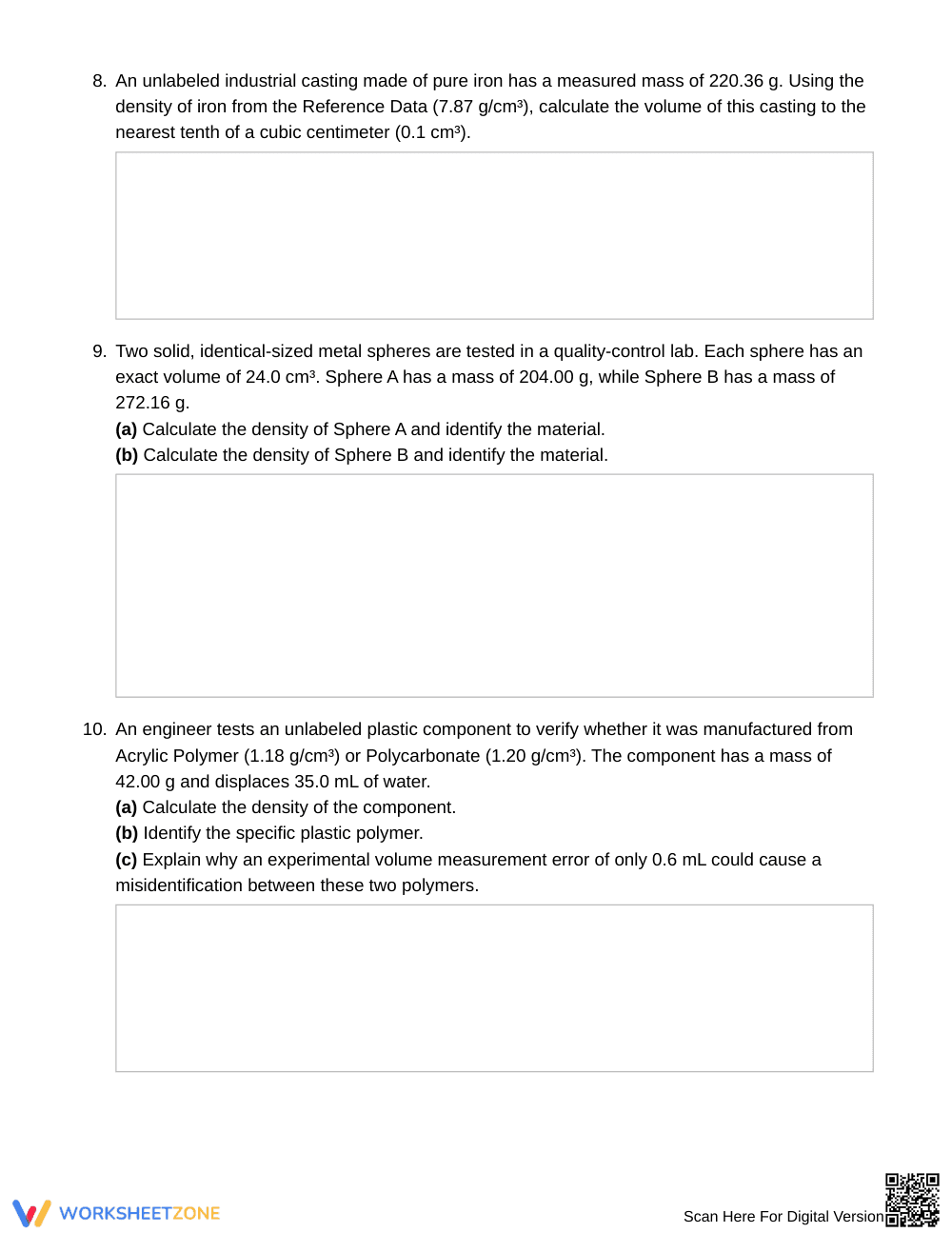
The worksheet spans five student pages organized into three parts. Part A presents four tasks defining intensive and extensive properties alongside the density formula, prompting learners to classify attributes and evaluate block subdivisions. Part B includes six direct calculation problems where students apply d = m/V, rearrange formulas, and identify unknown specimens using a ten-material reference data table. Part C offers two scientific-reasoning tasks requiring students to evaluate flawed claims using quantitative logic.
Skill Progression
- Guided practice (Part A): Students review core principles and classify properties before calculating values.
- Supported practice (Part B): Structured sub-parts guide learners through volume calculations, formula rearrangements, and material identification.
- Independent practice (Part C): Scaffolding drops as students analyze errors in scientific reasoning and justify conclusions.
How to Use It
Assign this resource following direct instruction on density and property types. Parts A and B work well for collaborative partner practice across 30 to 40 minutes, while Part C serves as an effective independent exit ticket. Teachers can also utilize Part B as targeted small-group intervention for students who need additional formula practice.
Who It's For
This resource supports Grade 7 science classes exploring physical properties of matter. Structured sub-parts assist on-level learners, while multi-step calculations and error analysis challenge advanced students. It pairs smoothly with hands-on graduated cylinder investigations and property classification charts.
Density is one of the most frequently assessed physical science concepts at the middle school level. Research from Fisher and Frey (2014) on gradual release instructional models demonstrates that structured practice worksheets, particularly those moving from conceptual classification to procedural calculation to evaluative reasoning, produce stronger retention than single format drill tasks. This worksheet applies that progression across 12 tasks: students first distinguish intensive from extensive properties using a printed rule box, then calculate density for rectangular solids and irregular objects via water displacement, and finally critique scientifically flawed claims. The ten material reference data table grounds every identification task in a realistic laboratory context. The included answer key covers all 12 problems and supports self-assessment, peer review, or teacher-led correction. The worksheet is ready to print as a PDF and requires no additional materials beyond a standard classroom calculator.


