




























Views
Downloads
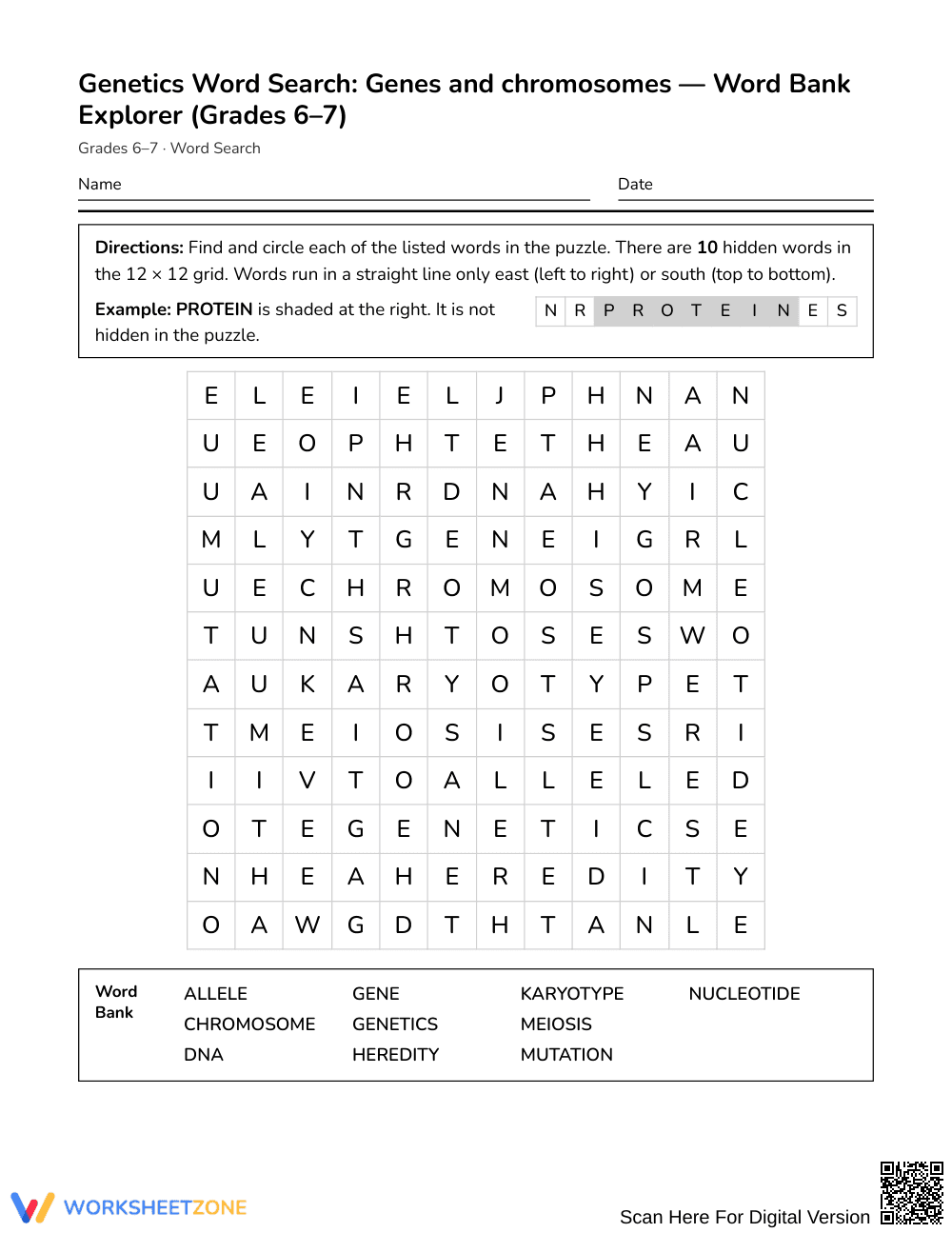

Printable Genetics Word Search | Grades 6–7 Science

Paste this activity's link or code into your existing LMS (Google Classroom, Canvas, Teams, Schoology, Moodle, etc.).
Students can open and work on the activity right away, with no student login required.
You'll still be able to track student progress and results from your teacher account.
Reinforce key genetics vocabulary with this focused word search activity designed for middle school life science. Learners review core terminology related to genes and chromosomes while searching for essential terms across a clean puzzle grid. This self-contained resource strengthens foundational literacy in cell biology, scientific spelling, and conceptual recall during independent or introductory work.
At a Glance
- Grade: Grades 6–7 · Subject: Science
- Standard: Not standards-assessed — vocabulary enrichment
- Skill Focus: Genes and chromosomes
- Format: 1 page · 10 words · Answer key included · PDF
- Best For: Early finishers, warm-ups, sub plans
- Time: 15–20 minutes
This printable activity presents a 12 by 12 letter grid containing 10 target vocabulary terms centered on genetics and chromosome structure. Below the grid, learners reference an alphabetical word bank paired with explanatory definitions for words such as nucleotide, karyotype, and meiosis. A complete two-page answer key provides clear visual coordinates, allowing educators or students to verify letter locations instantly.
Puzzle Structure and Mechanics
The activity is structured around an accessible 12 by 12 puzzle grid designed for focused middle school engagement. All 10 hidden terms run strictly in East (horizontal, left-to-right) and South (vertical, top-to-bottom) directions, avoiding diagonal or backward placements that might frustrate developing readers. An alphabetical word bank guides systematic searching, while concise definitions reinforce conceptual meaning alongside spatial recognition. Because word paths are direct and clearly oriented, students maintain attention on vocabulary retention rather than decoding convoluted letter patterns.
Standards Alignment
This activity serves as supplemental vocabulary enrichment and is not formally aligned to a specific state or national science standard. Instead, it supports middle school life science curricula by building familiarity with specialized genetics terminology prior to direct instruction or laboratory investigations.
How to Use It
Deploy this word search at two distinct moments in your instructional sequence. Introduce it as an engaging unit preview before starting cell division and heredity lectures, prompting learners to read each glossary-style clue. Alternatively, keep it ready as an independent wrap-up task or sponge activity for early finishers after a genetics lab. During work time, observe whether students read the definitions or simply hunt letters, redirecting them to explain how terms like allele and chromosome connect. Most students finish within 15 to 20 minutes.
Who It's For
This resource is tailored for Grades 6–7 general science, introductory biology, or life science classrooms. It accommodates diverse learners through straightforward East and South word orientations, providing supportive language exposure for multilingual students and striving readers without overwhelming them. For a complete lesson, pair this puzzle with an introductory reading passage on Gregor Mendel, an illustrated diagram of DNA structure, or an interactive chromosome labeling graphic organizer.
Building robust domain-specific vocabulary is essential for mastering complex life science concepts such as genes and chromosomes. Research by Fisher & Frey (2014) emphasizes that intentional exposure to academic terminology within structured, low-stakes activities directly supports reading comprehension and scientific communication. When middle school learners interact with specialized science terms—including nucleotide, meiosis, and karyotype—in guided formats, they establish cognitive anchors that facilitate deeper conceptual understanding during subsequent inquiry-based tasks. Although this resource functions as an unaligned vocabulary enrichment puzzle rather than a standards-assessed measurement tool, embedding explicit definitions alongside visual word recognition reinforces both orthographic memory and conceptual categorization. Consistent practice with foundational biology terms prepares students in Grades 6–7 to comprehend dense informational texts, participate meaningfully in collaborative scientific discourse, and accurately articulate the mechanisms governing heredity and genetic variation.


