

































Printable Genetic Information Worksheet | Grade 9 Biology

Paste this activity's link or code into your existing LMS (Google Classroom, Canvas, Teams, Schoology, Moodle, etc.).
Students can open and work on the activity right away, with no student login required.
You'll still be able to track student progress and results from your teacher account.
This Grade 9 Biology worksheet helps students explain how DNA stores genetic information and how RNA carries a copy of that information to the ribosome. Students apply base-pairing rules, analyze base-percentage data, and evaluate claims, so they finish able to reason about why genetic information is copied rather than lost.
At a Glance
- Grade: 9 · Subject: Biology
- Standard: Not specified — students use base-pairing rules and data to explain how DNA information is copied
- Skill Focus: Explain storage and transfer of genetic information
- Format: 5 pages · 10 problems · Answer key included · PDF
- Best For: Reinforcing the DNA and RNA unit
- Time: 35–45 minutes
What's Inside
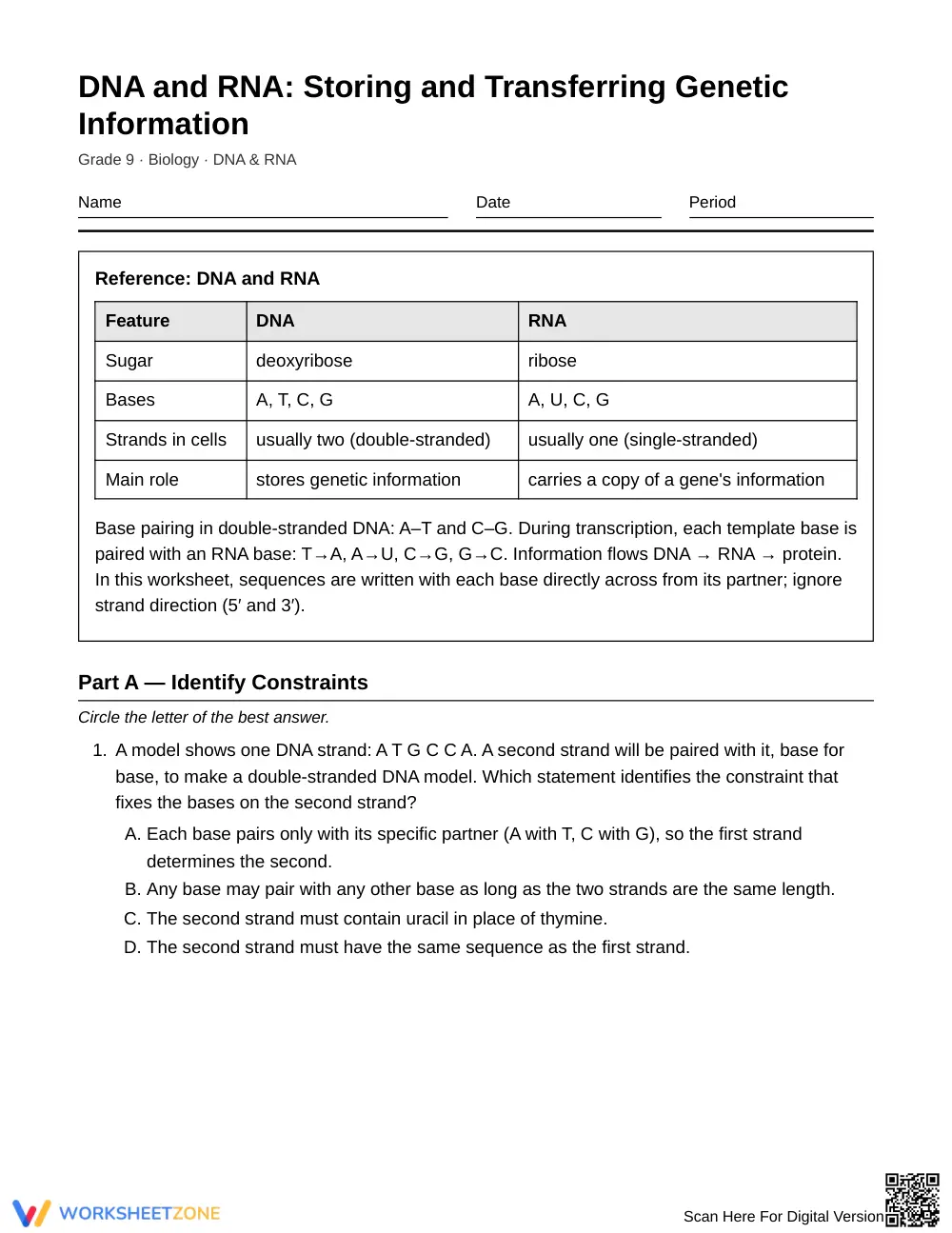
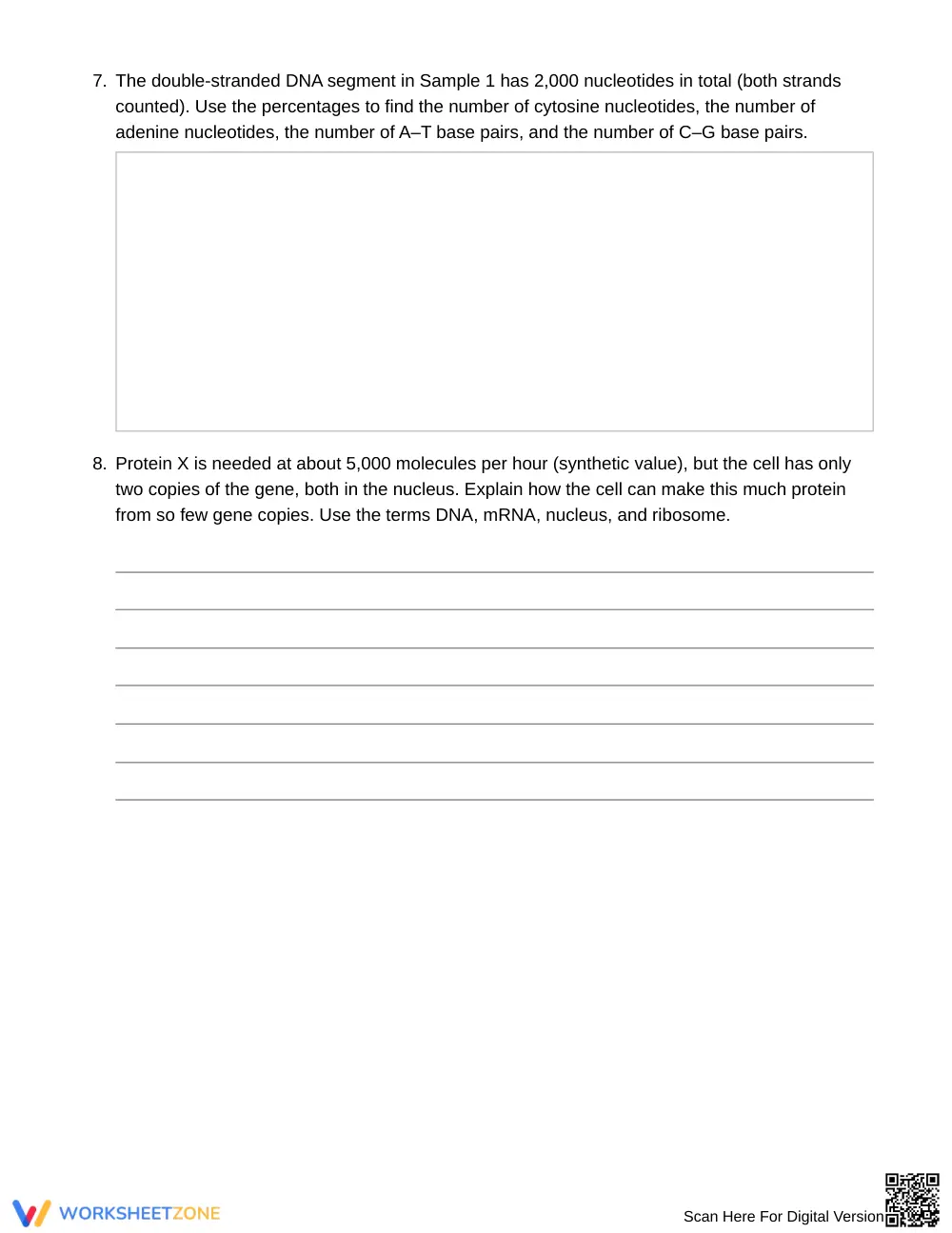
The packet opens with a reference table comparing DNA and RNA (sugar, bases, strands, main role) and a short statement of the pairing rules. Students then complete 10 tasks across three parts: two multiple-choice constraint questions, six applied questions built on two synthetic cases, and two claim-evaluation questions. Case 1 follows a 12-base-pair gene segment through transcription. Case 2 uses a base-percentage table from a liver cell. A 2-page answer key is included.
Skill Progression
- Guided practice (Part A, 2 problems): Students identify the structural constraints of DNA pairing and RNA composition, with the reference table as a full scaffold.
- Supported practice (Part B, 6 problems): Students transcribe a template strand, count bases, interpret percentage data, and explain protein production using the terms DNA, mRNA, nucleus, and ribosome.
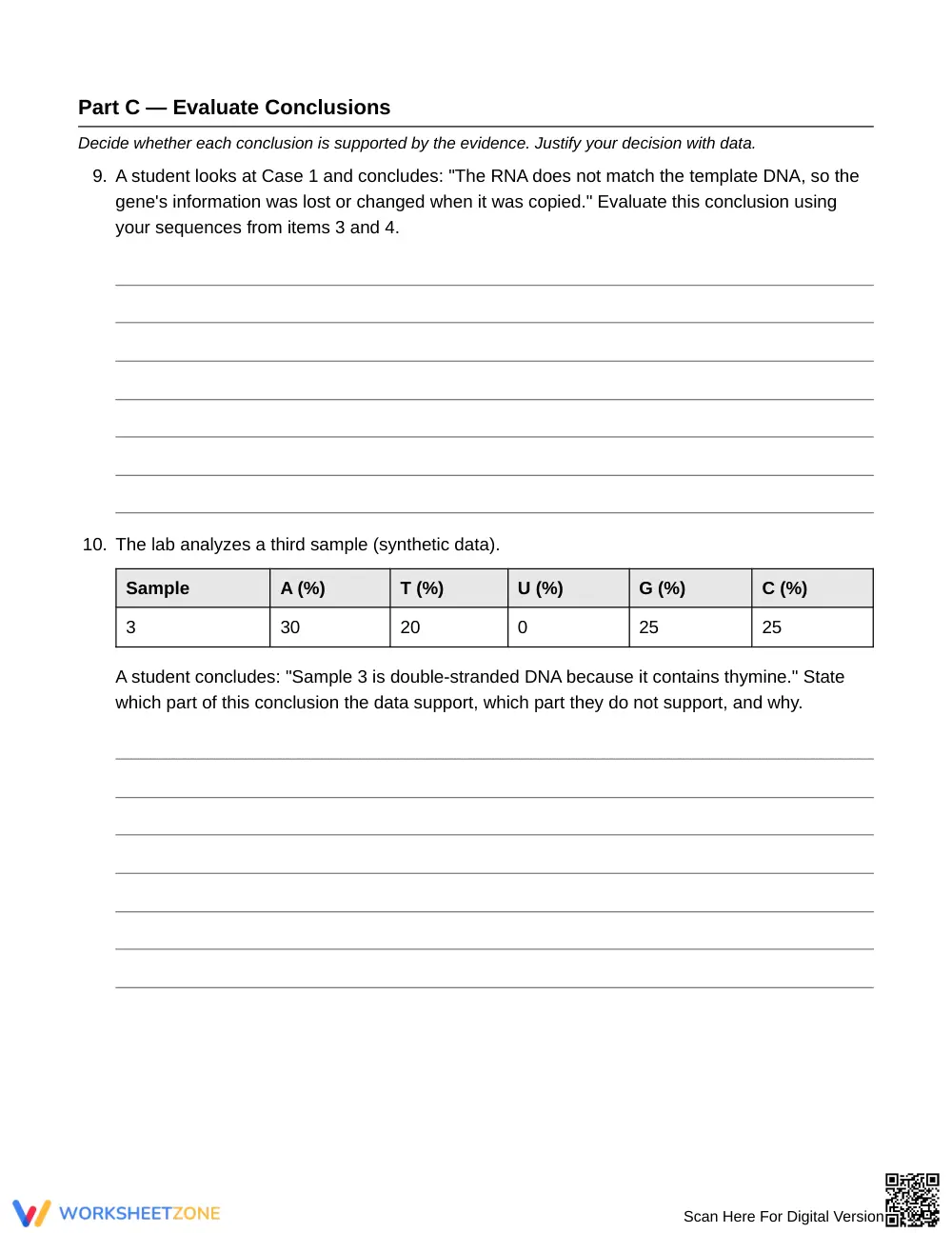
- Independent practice (Part C, 2 problems): Students judge whether a conclusion is supported by data and justify the decision with evidence.
This sequence follows a gradual-release model: I Do, We Do, You Do.
Standards Alignment
No standard code was supplied for this worksheet, so none is listed. The tasks align with high school biology expectations that students explain how DNA structure determines the storage of genetic information and how RNA transfers it for protein synthesis. Teachers can map the tasks to their own standard.
How to Use It
- After direct instruction: Assign Parts A and B as in-class practice once transcription has been taught. Circulate during Case 1 and check whether students apply T→A, A→U, C→G, and G→C correctly.
- As a unit review: Assign Part C as an exit task or homework to check evidence-based reasoning.
Formative tip: watch for students who expect the RNA to match the template strand. That misconception is the target of the first Part C question.
Who It's For
This worksheet suits Grade 9 Biology students in a DNA and RNA unit. Students who need more support can keep the reference table open and work Case 1 in pairs. Students ready for more challenge can write full justifications in Part C. It pairs well with a transcription anchor chart or a short lesson on the central dogma.
DNA stores genetic information in two paired strands, and RNA carries a copy of a gene's information from the nucleus to the ribosome. This Grade 9 Biology worksheet asks students to explain that storage and transfer using base-pairing rules, a 12-base-pair template, and base-percentage data. Its 10 tasks move from identifying structural constraints to applying transcription to evaluating claims with evidence. This structure follows the gradual-release approach described by Fisher & Frey (2014), in which teacher modeling gives way to guided and then independent practice. Students practice the reasoning pattern of identifying a constraint, applying a rule, and judging a conclusion against data. The five-page packet includes a reference table and a 2-page answer key, so teachers can score responses quickly and spot misconceptions such as expecting RNA to match its template.


