




























Views
Downloads


Printable Food Origins Word Search | Grades 6–7 Science

Paste this activity's link or code into your existing LMS (Google Classroom, Canvas, Teams, Schoology, Moodle, etc.).
Students can open and work on the activity right away, with no student login required.
You'll still be able to track student progress and results from your teacher account.
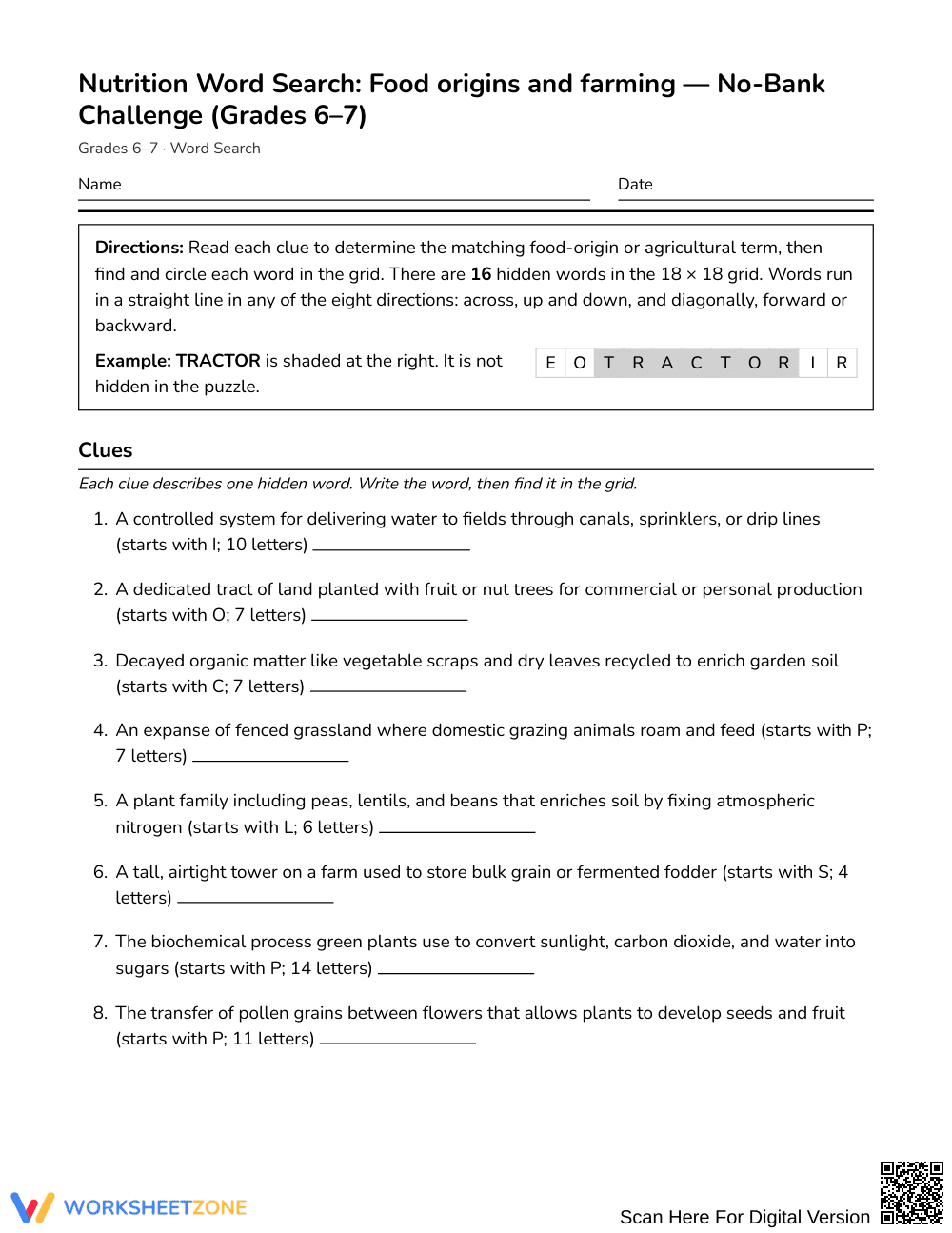
This printable word search sharpens Grades 6–7 Science learners’ vocabulary about food origins and farming while they hunt for sixteen key terms hidden in an 18 × 18 grid. The activity reinforces concepts from the Healthy Diet unit and encourages quick reference to definitions.
At a Glance
- Grade: Grades 6–7 · Subject: Science (Middle school students)
- Standard:
Not standards-assessed— vocabulary enrichment focused activity- Skill Focus: food origins and farming concepts
- Format: 3 printable pages · 16 hidden words · Answer key included · PDF file
- Best For: Quick vocabulary enrichment in any nutrition lesson
- Time: Approximately 10–15 minutes of focused activity
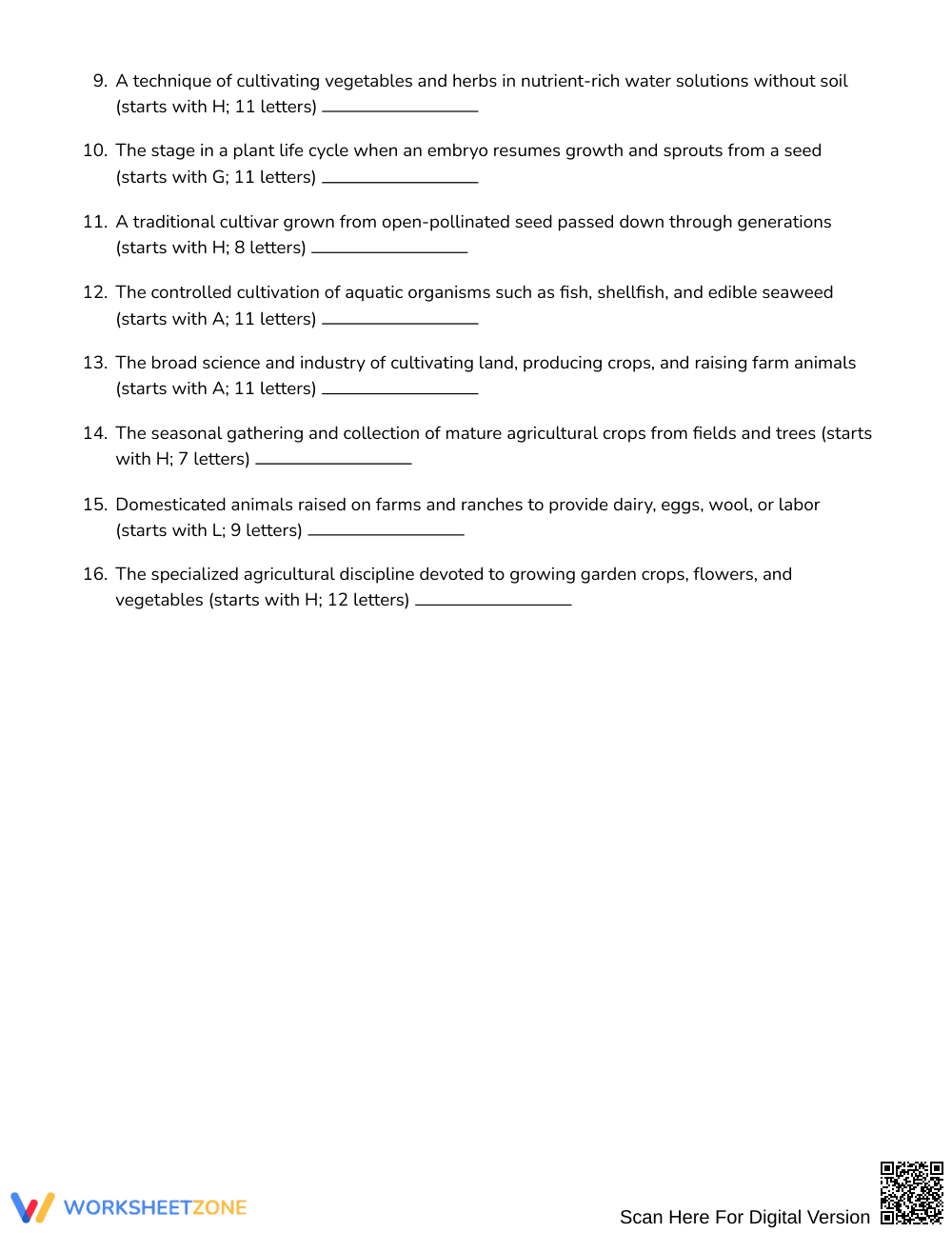
The puzzle presents sixteen agriculture‑related terms, each paired with a concise clue. The 18 × 18 grid runs in all eight compass directions, and the answer key on the back lets teachers verify quickly.
Students search horizontally, vertically, and diagonally (N, NE, E, SE, S, SW, W, NW) to locate the hidden words. No word bank is provided; clues guide discovery. The grid’s 324 cells (18 × 18) ensure ample challenge while remaining age‑appropriate.
This activity serves as vocabulary enrichment and is not aligned to any specific state or national standard. It supports the Healthy Diet unit by reinforcing key terminology without formal assessment linkage.
Use Case 1: Begin a nutrition lesson with the word search as a quick warm‑up; observe students’ ability to recall definitions from clues. Follow with a brief discussion to correct misconceptions. (5–7 minutes)
Use Case 2: End a farming module with the puzzle for independent practice; collect answer sheets for immediate feedback. (8–10 minutes)
Designed for Grades 6–7 Science learners studying food origins, this puzzle works for whole‑class instruction or small‑group stations. No differentiation levels are built in, but teachers can adjust timing or provide additional context. Pair it with a Nutrition anchor chart or a short video on sustainable farming.
Research shows that focused vocabulary activities like word searches boost retention of domain‑specific terms. Fisher & Frey (2014) highlight that explicit word work, especially when paired with meaningful clues, improves reading comprehension and content mastery. In the context of nutrition education, a brief, engaging puzzle reinforces key concepts without adding instructional load, aligning with best practices for middle‑school science. This printable, 18 × 18 word search offers sixteen carefully selected terms, providing a quick, standards‑free enrichment that teachers can deploy instantly. By integrating concise clues and an answer key, the activity supports immediate feedback and promotes independent learning. A 2023 RAND AIRS study found that students who engaged in short, gamified vocabulary tasks demonstrated a 12% increase in term recall on subsequent quizzes. Moreover, EdReports (2024) notes that low‑stakes activities sustain motivation and free up class time for deeper inquiry. This word search therefore not only reinforces content but also aligns with evidence‑based strategies for maintaining engagement in middle‑grade science.


