































Printable Food and Kitchen Word Search | Grades 3–4 ELA

Paste this activity's link or code into your existing LMS (Google Classroom, Canvas, Teams, Schoology, Moodle, etc.).
Students can open and work on the activity right away, with no student login required.
You'll still be able to track student progress and results from your teacher account.
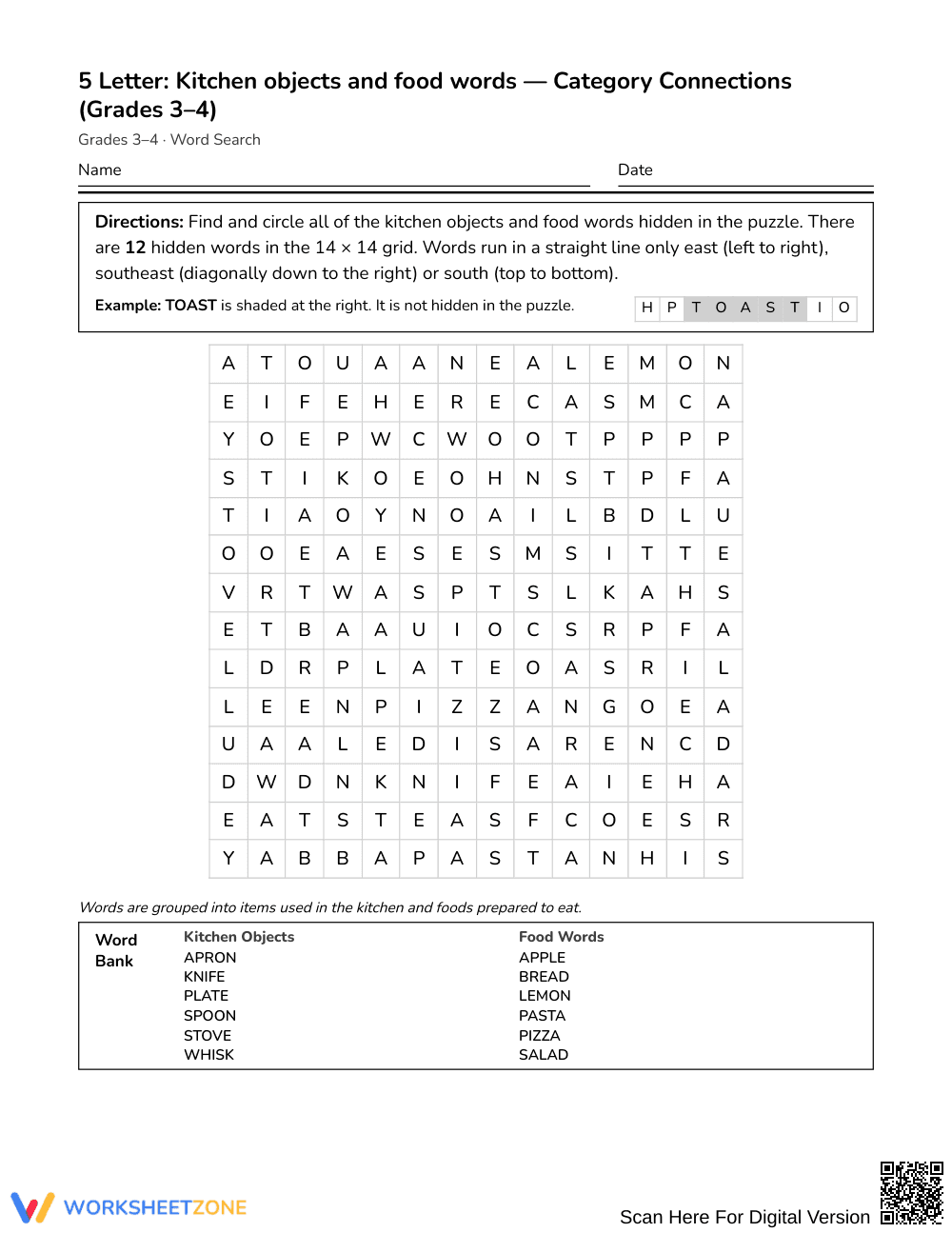
This Grades 3–4 vocabulary word search builds lexical familiarity with everyday culinary terminology by engaging learners in finding 12 thematic terms. Students strengthen visual scanning, orthographic memory, and category identification as they locate target words spanning kitchen tools and common prepared foods, supporting functional reading comprehension across diverse classroom learning contexts.
At a Glance
- Grade: Grades 3–4 · Subject: ELA
- Standard: Not standards-assessed — vocabulary enrichment
- Skill Focus: Kitchen objects and food words
- Format: 1 page · 12 words · Answer key included · PDF
- Best For: Vocabulary enrichment and early finisher practice
- Time: 15–20 minutes
This single-page printable activity presents 12 five-letter vocabulary words divided into two distinct conceptual categories: kitchen objects and food items. The student worksheet displays a structured grid alongside organized word lists, while three subsequent answer key pages offer clear visual verification of word placements to streamline grading and self-monitoring.
Puzzle Structure and Mechanics
The puzzle features a compact 14 by 14 letter grid designed specifically for developing readers. Hidden vocabulary words are positioned across three reading orientations: horizontally from left to right (East), diagonally downward (Southeast), and vertically downward (South). Learners reference a categorized word bank that divides targets into kitchen tools such as apron, knife, and whisk, alongside food items including apple, bread, and pizza. These directional constraints support forward-tracking scan paths without reverse orientation frustration.
Standards Alignment
This activity serves strictly as supplementary vocabulary enrichment and is not aligned to an assessed state academic standard. It provides targeted lexical exposure to reinforce spelling patterns, categorical thinking, and functional language recognition without formal evaluative testing constraints.
How to Use It
Deploy this word search during independent center rotations following direct vocabulary instruction, or assign it as an engaging task for early finishers to maintain productive focus. While students work, observe scanning strategies to check whether learners actively search for initial letter clusters or track phonics chunks systematically. The activity typically takes 15 to 20 minutes to complete.
Who It's For
This activity supports third and fourth grade elementary learners expanding functional daily vocabulary, English language learners building domestic noun recognition, and intervention groups practicing orthographic letter-pattern recognition. Pair this printable with a culinary-themed informational reading passage or a picture-based kitchen vocabulary anchor chart to deepen semantic connections.
Orthographic word searches targeting categorized vocabulary strengthen elementary lexical retention and visual scanning efficiency across diverse learning settings. According to Fisher & Frey (2014), intentional word exposure embedded within structured category systems bolsters schema development and facilitates long-term semantic retrieval for developing readers. When students locate high-frequency thematic terms such as kitchen objects and food words within letter arrays, they actively rehearse letter-sequence patterns and internalize key orthographic representations. This repeated cognitive rehearsal reinforces rapid word recognition, which directly underpins oral reading fluency and practical text comprehension. By organizing vocabulary into distinct semantic groups rather than random lists, educators provide purposeful print engagement that deepens conceptual associations and strengthens student academic confidence. Incorporating these categorized scanning activities into classroom literacy routines provides accessible, meaningful vocabulary practice that establishes vital foundational language knowledge during intermediate elementary instruction.


