


























Views
Downloads



Printable Family Trait Data Worksheet | Grade 9 Biology
Paste this activity's link or code into your existing LMS (Google Classroom, Canvas, Teams, Schoology, Moodle, etc.).
Students can open and work on the activity right away, with no student login required.
You'll still be able to track student progress and results from your teacher account.
This worksheet teaches Grade 9 Biology students to interpret family trait observations and draw genotype conclusions that follow from stated model assumptions. Students reason from alleles in two fictional cases, complete and incomplete dominance, then judge whether other students' conclusions are supported by the data.
At a Glance
- Grade: 9 · Subject: Biology
- Standard: Genetics & Heredity — Infer parent genotypes from offspring observations and test whether conclusions follow from model assumptions.
- Skill Focus: Interpret family trait observations under complete and incomplete dominance
- Format: 5 pages · 10 problems · Answer key included · PDF
- Best For: Practice after a dominance lesson
- Time: 40–50 minutes
What's Inside
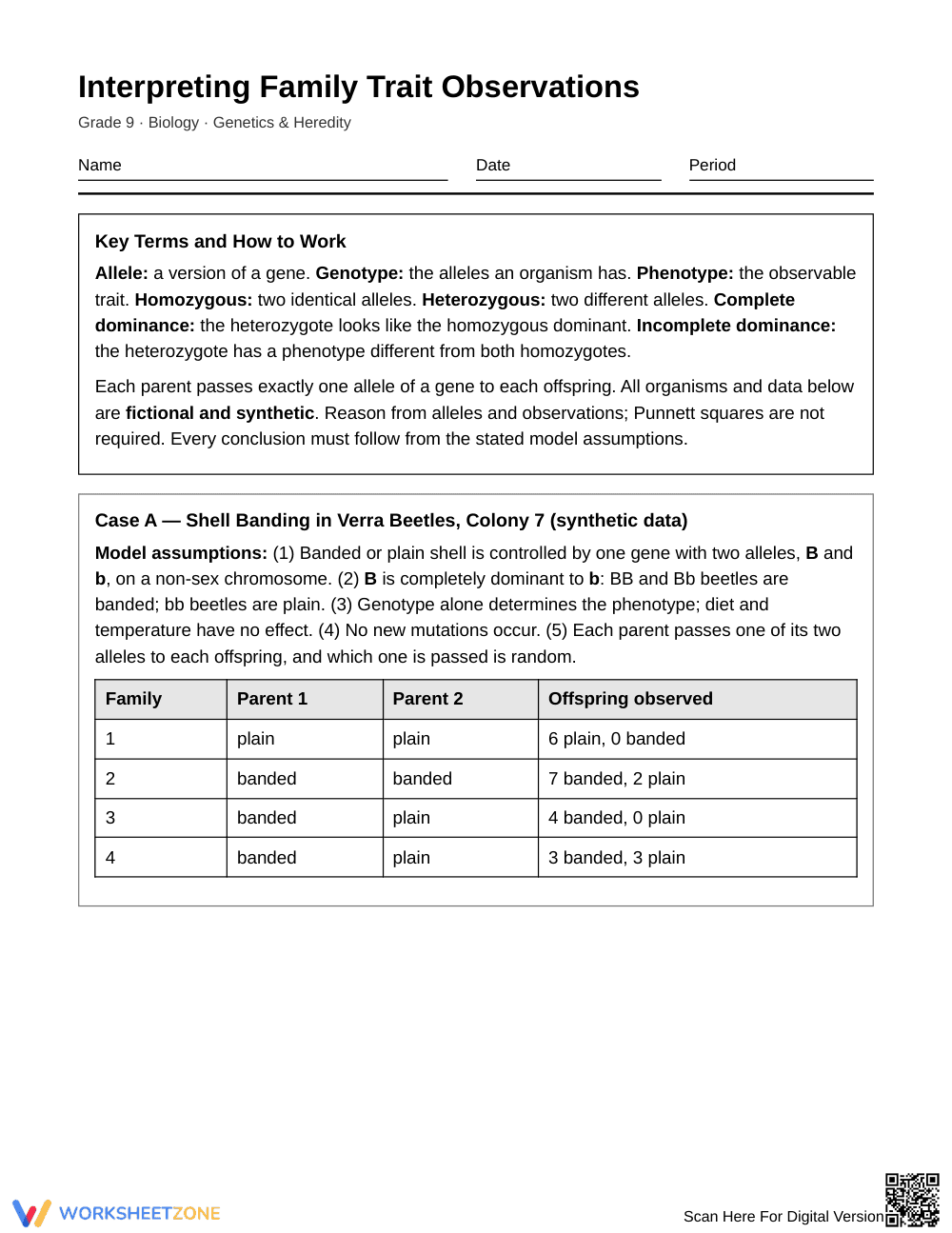
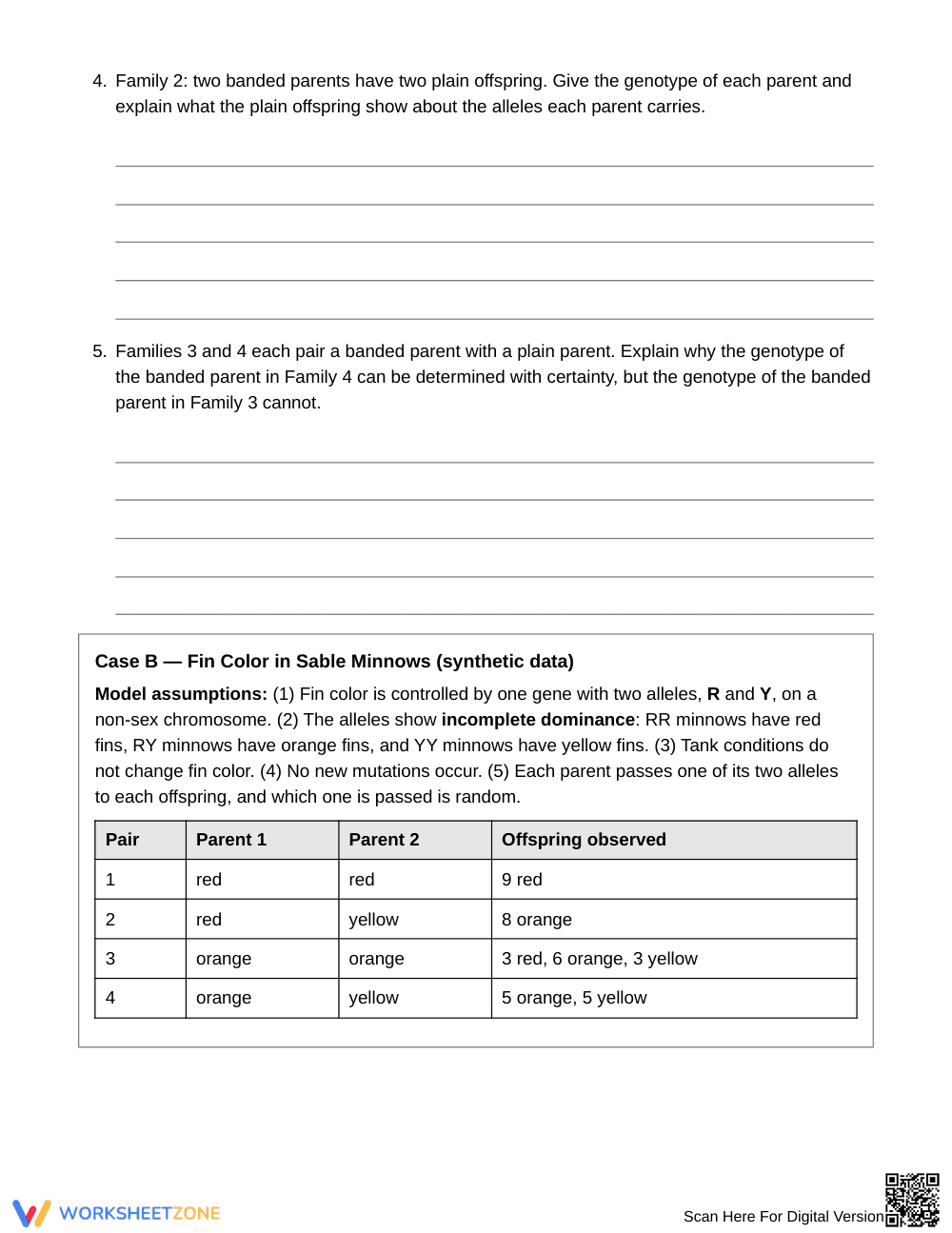
This 5-page worksheet opens with a key-terms box and a model-assumptions list for each of two fictional cases: beetle shell banding (complete dominance) and minnow fin color (incomplete dominance). Ten problems in four parts mix multiple choice, short explanations, and evaluation of student claims, using offspring-count tables. An answer key is included.
Skill Progression
- Guided practice (Items 1–2): Identify which observations the model forbids and which assumptions fail for a continuous trait.
- Supported practice (Items 3–8): Assign genotypes from the family and pair tables, with the key-terms box as a scaffold.
- Independent practice (Items 9–10): Evaluate student claims using specific observations, with no sentence frames.
The sequence follows gradual release: I Do, We Do, You Do.
Standards Alignment
Genetics & Heredity focus: use patterns in parent and offspring traits to infer genotypes and explain inheritance. No standard code was supplied for this worksheet, so none is listed. Add your state or district code when copying this skill into lesson plans, IEP goals, or curriculum mapping tools.
How to Use It
- During or after direct instruction on dominance: assign Parts A and B as partner practice.
- Formative check or homework: assign Parts C and D independently.
Observation tip: in Item 3, check whether students cite the recessive rule (plain means bb) rather than guessing. Expect 40–50 minutes.
Who It's For
Grade 9 Biology students in a first genetics unit. Support learners by reading the assumptions aloud and keeping the key-terms box visible. Extend strong students with the small-sample critique in Part D. Pair with an anchor chart comparing complete and incomplete dominance.
Interpreting Family Trait Observations is a Grade 9 Biology worksheet in the Genetics & Heredity unit that asks students to infer parent genotypes from offspring data and judge whether conclusions follow from stated model assumptions. Students work through 10 problems across two fictional cases, beetle shell banding under complete dominance and minnow fin color under incomplete dominance, without Punnett squares. The structure reflects the gradual release of responsibility described by Fisher & Frey (2014), which moves learners from guided to independent work. Students first identify constraints, then apply allele reasoning to family tables, then evaluate claims such as small-sample overgeneralization. The worksheet includes a key-terms box, five numbered model assumptions per case, and an answer key. It takes about 40 to 50 minutes and suits instruction after dominance patterns have been introduced.


