




























Views
Downloads



Printable Evidence & Inference Worksheet | Grade 8 ELA

Paste this activity's link or code into your existing LMS (Google Classroom, Canvas, Teams, Schoology, Moodle, etc.).
Students can open and work on the activity right away, with no student login required.
You'll still be able to track student progress and results from your teacher account.
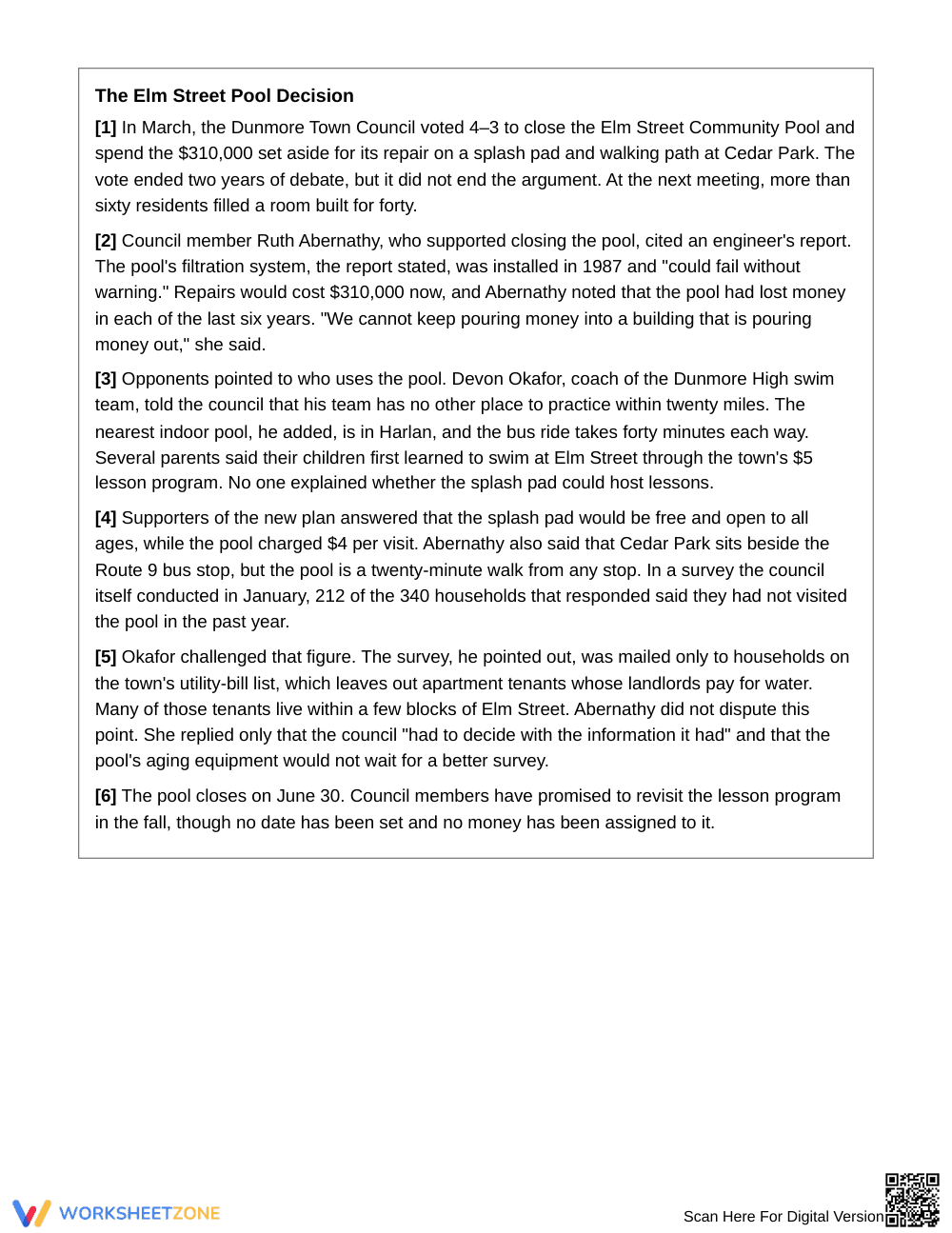
This Grade 8 worksheet teaches students to choose the strongest textual evidence and to back every inference with a reason from the text. Using a news-style article about a town council's pool closure, students move from recalling explicit facts to weighing competing evidence and defending a position in writing.
At a Glance
- Grade: 8 · Subject: ELA
- Standard:
RI.8.1— Cite the strongest text evidence for what a text says and implies- Skill Focus: Strongest evidence and supported inference
- Format: 5 pages · 12 problems · Answer key included · PDF
- Best For: Informational text evidence practice after instruction
- Time: 35–45 minutes
What's Inside
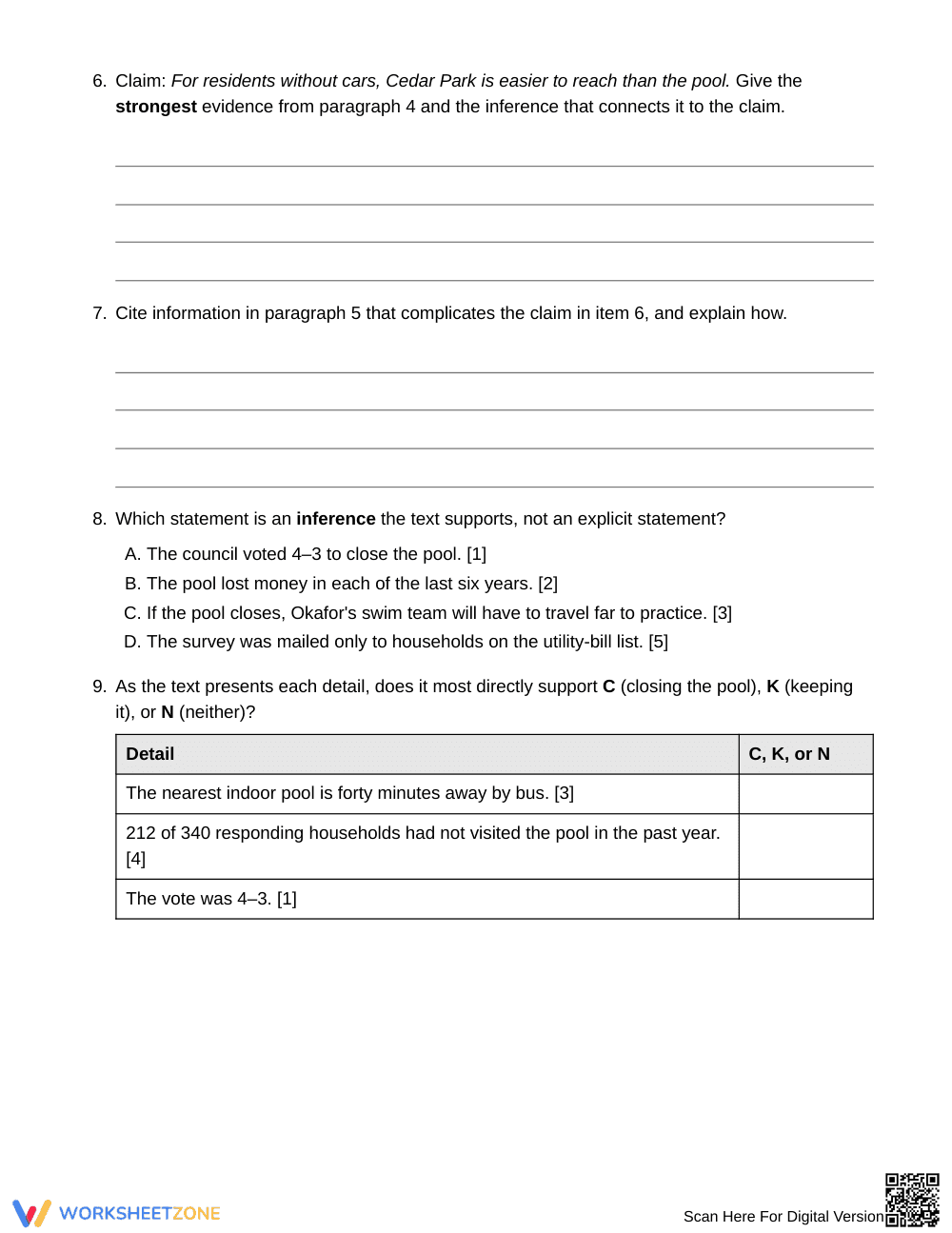
Students read one six-paragraph article, then complete 12 tasks: multiple choice, short response, a claim-and-evidence item, a close-or-keep sorting table, and three written responses. The 5-page PDF includes a 3-page answer key. A reminders box defines strongest evidence and paragraph citation.
Skill Progression
- Guided practice (Part A, 3 items): Locate explicit facts through two multiple-choice questions and one short response.
- Supported practice (Part B, 6 items): Choose the best-supported inference, rank evidence, and sort details. Paragraph citations are required.
- Independent practice (Part C, 3 items): Write a synthesis, compare two interpretations, and defend a position against a competing view.
The three parts follow gradual release: I Do, We Do, You Do.
Standards Alignment
RI.8.1: Cite the textual evidence that most strongly supports an analysis of what the text says explicitly as well as inferences drawn from the text. The standard code can be copied directly into lesson plans, IEP goals, or district curriculum mapping tools.
How to Use It
- During instruction: Model Part A together, then have pairs complete Part B.
- After instruction: Assign Part C as an independent check or exit task.
Formative tip: while students work, check whether each answer names a paragraph number and gives a reason, not just a copied detail. Expect 35–45 minutes for the full set, or 15–20 minutes for Part C alone.
Who It's For
Grade 8 students practicing informational reading. Part A alone supports students who need scaffolds, and Part C extends stronger readers. Pair it with an anchor chart on claim, evidence, and reasoning.
This Grade 8 ELA worksheet targets RI.8.1: citing the strongest textual evidence to support both explicit statements and inferences. Students read a six-paragraph article about a town council's decision to close a community pool, then complete 12 tasks that move from locating stated facts to ranking evidence, separating inference from explicit statement, and defending a position in writing with paragraph citations. The design reflects text-dependent questioning, which Fisher & Frey (2014) describe as a core practice for building close reading, because every answer must be grounded in numbered paragraphs rather than opinion. Answer choices include plausible distractors, so students must justify each selection rather than guess. The worksheet runs 5 pages, including a 3-page answer key, and takes about 35 to 45 minutes. It suits whole-class practice, small-group intervention, or independent review after instruction on evidence and inference in informational text.


