































Printable Electronegativity Worksheet | Grade 8-12 Science

Paste this activity's link or code into your existing LMS (Google Classroom, Canvas, Teams, Schoology, Moodle, etc.).
Students can open and work on the activity right away, with no student login required.
You'll still be able to track student progress and results from your teacher account.
This comprehensive electronegativity worksheet guides high school physical science and chemistry students through sequential models of periodic trends, dipole formation, and chemical bond classification. Learners trace how atomic structure drives electronegativity changes and practice predicting bond types through quantitative difference calculations.
At a Glance
- Grade: Grades 8–12 · Subject: Science
- Standard: Model periodic properties and predict bond types using electronegativity differences
- Skill Focus: Sequence stages of bond formation and explain structural changes
- Format: 4 pages · 30 problems · Answer key included · PDF
- Best For: Chemistry unit practice and review
- Time: 45–60 minutes
What's Inside
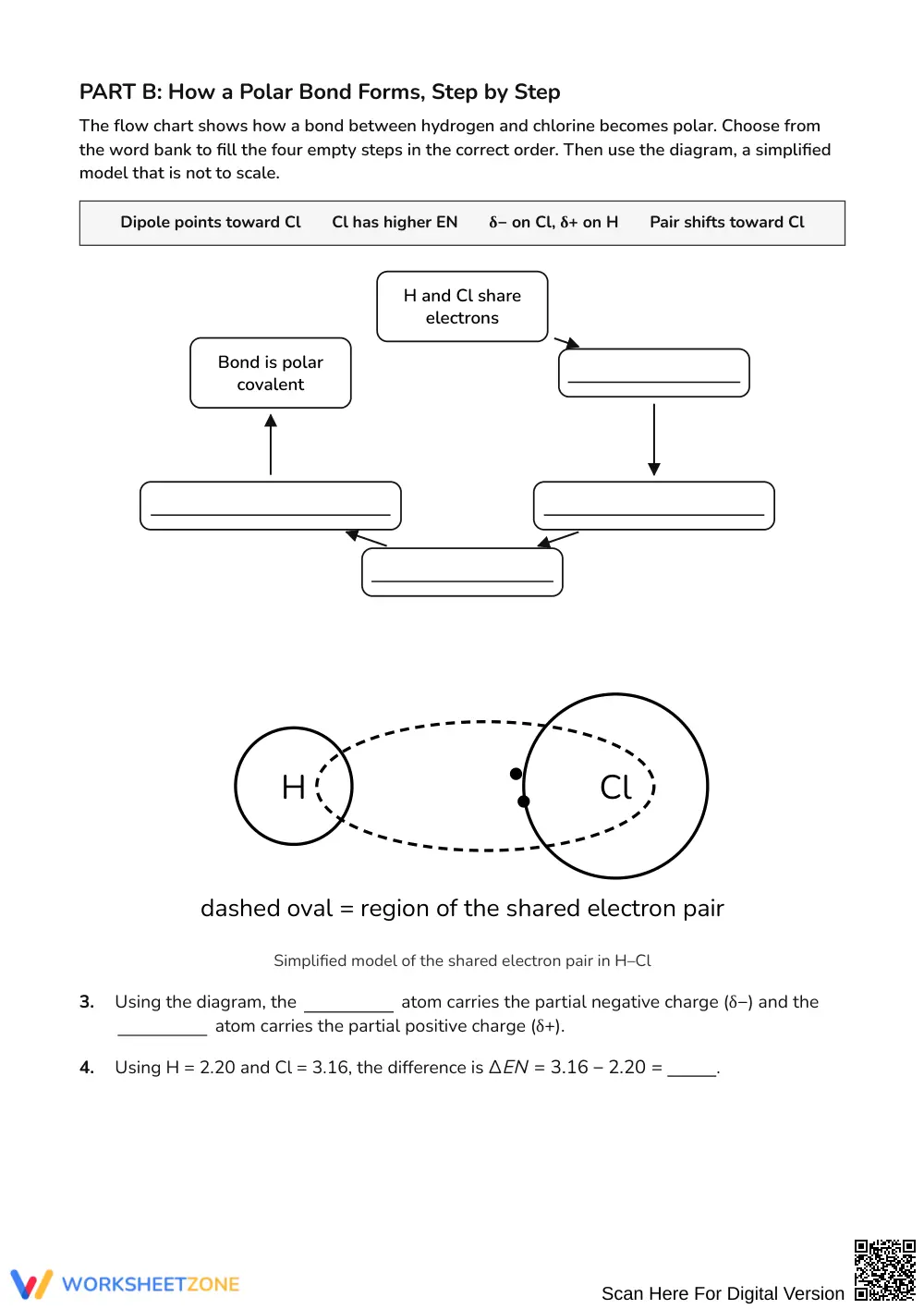
The four-page printable resource features 30 scaffolded tasks arranged into four distinct parts. Students analyze Period 3 electronegativity data tables, complete a step-by-step polar bond flow chart using a word bank, follow a four-step algorithm to classify chemical bonds, and interpret trend line graphs. A complete 4-page answer key provides full explanations and worked solutions for every question.
Skill Progression
- Guided Practice: Part A walks students through ranking elements across Period 3, linking increasing nuclear charge and constant shielding to atomic radius and electron attraction.
- Supported Practice: Parts B and C offer flowchart sequencing and algorithm-based bond predictions (ΔEN ranges) using word banks and structured reference tables.
- Independent Practice: Part D prompts students to interpret graphical data independently, justify rate changes between elements, and synthesize multi-step atomic explanations without prompts.
This structure follows an intentional gradual-release model (I Do, We Do, You Do) to build conceptual fluency before requiring autonomous synthesis.
Standards Alignment
This activity aligns with high school physical science standards addressing the structure and properties of matter, specifically how the periodic table predicts relative properties of atoms and chemical bond types. While no standalone code is assigned, the material directly supports foundational curricula across state frameworks. Both standard objectives and procedural skills can be copied directly into lesson plans, IEP goals, or district curriculum mapping tools.
How to Use It
Deploy this resource during direct instruction as guided notes or immediately following a lecture on chemical bonding to consolidate conceptual understanding. For formative assessment, examine student explanations in Part B to verify whether they understand that partial charges arise directly from asymmetrical electron density rather than full electron transfer. Completion time averages 45 to 60 minutes.
Who It's For
Designed for students in introductory chemistry or physical science courses in grades 8 through 12, this worksheet includes clear scaffolds for emerging learners and rigorous synthesis tasks for advanced students. Pair this activity with a physical periodic table and molecular modeling kits to reinforce abstract spatial concepts.
According to research highlighted in Fisher & Frey (2014), structured sequencing tasks coupled with explicit causal explanation prompts significantly improve student retention of complex scientific mechanisms compared to isolated factual recall. By requiring secondary science students to actively order the progressive steps of dipole development and connect mathematical electronegativity differences directly to physical electron distribution, this worksheet directly engages dual-coding and gradual-release pedagogical frameworks. Students transition from observing raw Pauling scale measurements to internalizing how unshielded nuclear charge drives macroscopic periodic patterns. The embedded flowcharts and visual models provide essential scaffolding that helps diverse learners articulate precise cause-and-effect relationships within chemical systems, ensuring deep mastery of atomic interactions and bond classification before advancing to complex molecular geometry and intermolecular force calculations.


