





























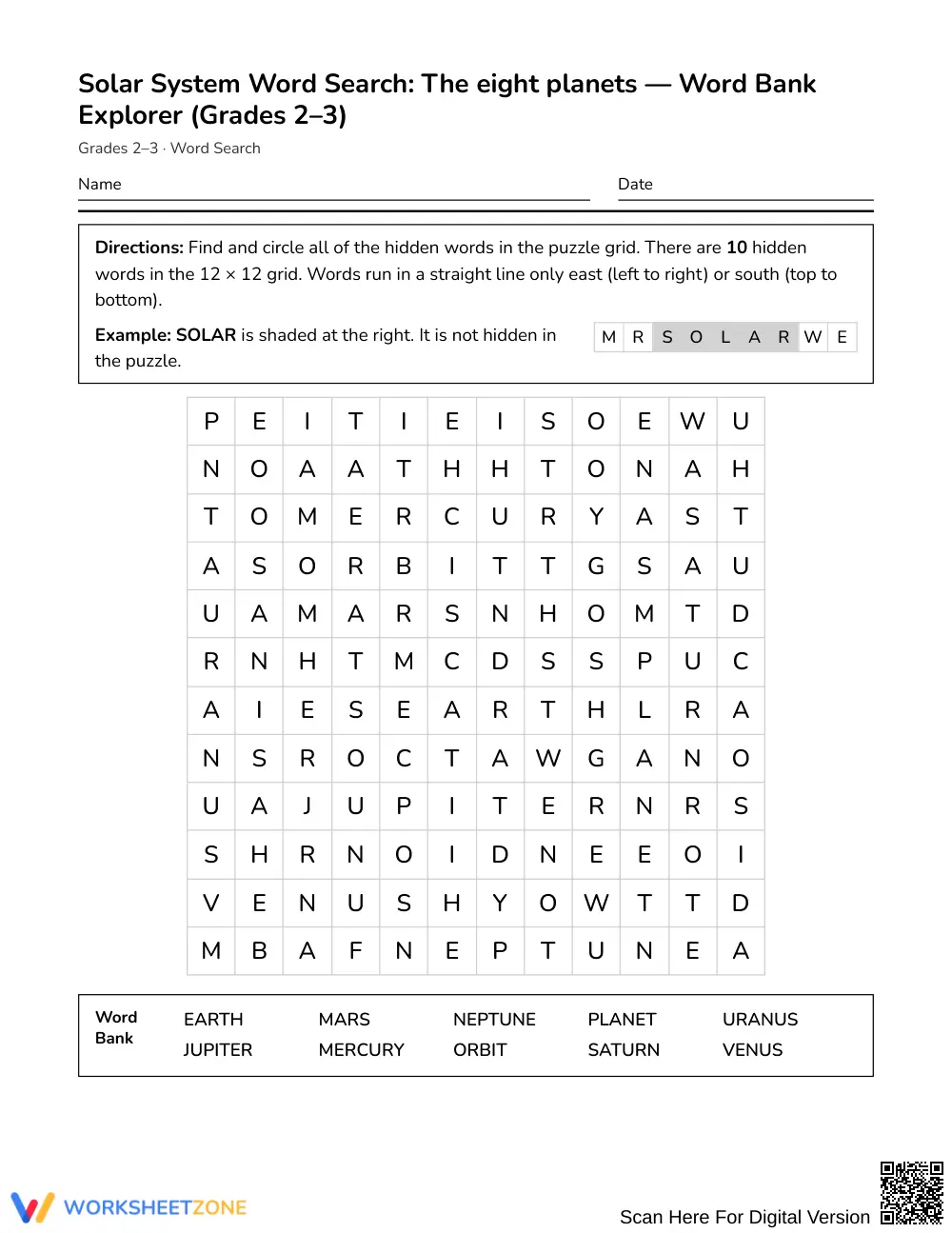


Printable Eight Planets Word Search | Grades 2–3 Science

Paste this activity's link or code into your existing LMS (Google Classroom, Canvas, Teams, Schoology, Moodle, etc.).
Students can open and work on the activity right away, with no student login required.
You'll still be able to track student progress and results from your teacher account.
This science word search introduces young astronomers in Grades 2–3 to the eight planets of our solar system through focused vocabulary identification. Students locate ten foundational astronomy terms within an approachable grid, strengthening their spelling recognition and planet-naming recall while engaging in self-directed science practice.
At a Glance
- Grade: Grades 2–3 · Subject: Science (Solar System)
- Standard: Not standards-assessed — targeted vocabulary enrichment for solar system science
- Skill Focus: The eight planets and planetary vocabulary
- Format: 1 page · 10 words · 3-page answer key included · PDF
- Best For: Science centers, morning warm-ups, or early finisher tasks
- Time: 15–20 minutes
What's Inside
This single-page science resource features a 12 by 12 letter grid containing 10 hidden vocabulary terms. An alphabetical word bank guides learners as they search for planetary names and core space concepts. The activity includes a 3-page answer key highlighting all word locations, allowing teachers or students to verify completed work immediately without extra preparation.
How the Puzzle Works
The puzzle is built around an accessible 12 by 12 grid formatted for early elementary learners. To keep visual tracking developmentally appropriate for Grades 2–3, all 10 words run in only two directions: horizontally from left to right (East) and vertically from top to bottom (South). There are no backwards or diagonal sequences. Students reference the alphabetical word bank, crossing off each term as it is discovered.
Standards Alignment
This activity serves strictly as vocabulary enrichment and is not aligned to a formal academic standard. It reinforces domain-specific science terminology, helping students recognize proper planet capitalization and spelling patterns before engaging in graded astronomy lessons.
How to Use It
Use this word search as an engaging hook before direct instruction to introduce planetary names, or assign it after a lesson as an independent reinforcement center. While students search the grid, observe their scanning habits; note whether they track initial letter sounds methodically or search randomly, providing insight into their visual decoding fluency. Most learners will complete the puzzle in 15 to 20 minutes.
Who It's For
This puzzle is tailored for Grade 2 and Grade 3 students building foundational space vocabulary. For students needing support, offer a highlighter to mark the first letter of each word bank term directly on the grid. Advanced learners can write one fact for each planet found. Pair this activity naturally with a classroom solar system anchor chart displaying planetary order.
Building science vocabulary through focused word searches gives elementary students low-stakes exposure to complex domain-specific terms. Although unaligned to formal assessment standards, this planetary word search establishes orthographic familiarity with the eight planets of the solar system. According to Fisher & Frey (2014), intentional exposure to academic vocabulary before and during content instruction supports reading comprehension by reducing cognitive load when students encounter unfamiliar multisyllabic terms in informational texts. Searching for words across structured horizontal and vertical axes reinforces visual discrimination, letter sequence recall, and phoneme-grapheme associations. By pairing an organized alphabetical bank with an accessible 12 by 12 grid, the task strengthens foundational literacy skills necessary for future science reading. Consequently, structured vocabulary enrichment tools offer valuable instructional utility in early elementary classrooms, providing an engaging entry point into introductory astronomy units while fostering student self-efficacy and print confidence.


