

































Printable DNA vs RNA Structure Worksheet | Grade 9 Biology

Paste this activity's link or code into your existing LMS (Google Classroom, Canvas, Teams, Schoology, Moodle, etc.).
Students can open and work on the activity right away, with no student login required.
You'll still be able to track student progress and results from your teacher account.
This worksheet helps Grade 9 Biology students compare the structure of DNA and RNA and explain what each molecule does in a cell. Students move from a completed reference table to base-pairing calculations, transcription, and data-based predictions, so they connect molecular structure to protein production.
At a Glance
- Grade: 9 · Subject: Biology
- Standard: Not specified — compare DNA and RNA structure and explain how each helps cells make proteins
- Skill Focus: Comparing DNA and RNA structure and cellular roles
- Format: 5 pages · 12 problems · Answer key included · PDF
- Best For: Practice after introducing nucleic acids
- Time: 35–45 minutes
What's Inside
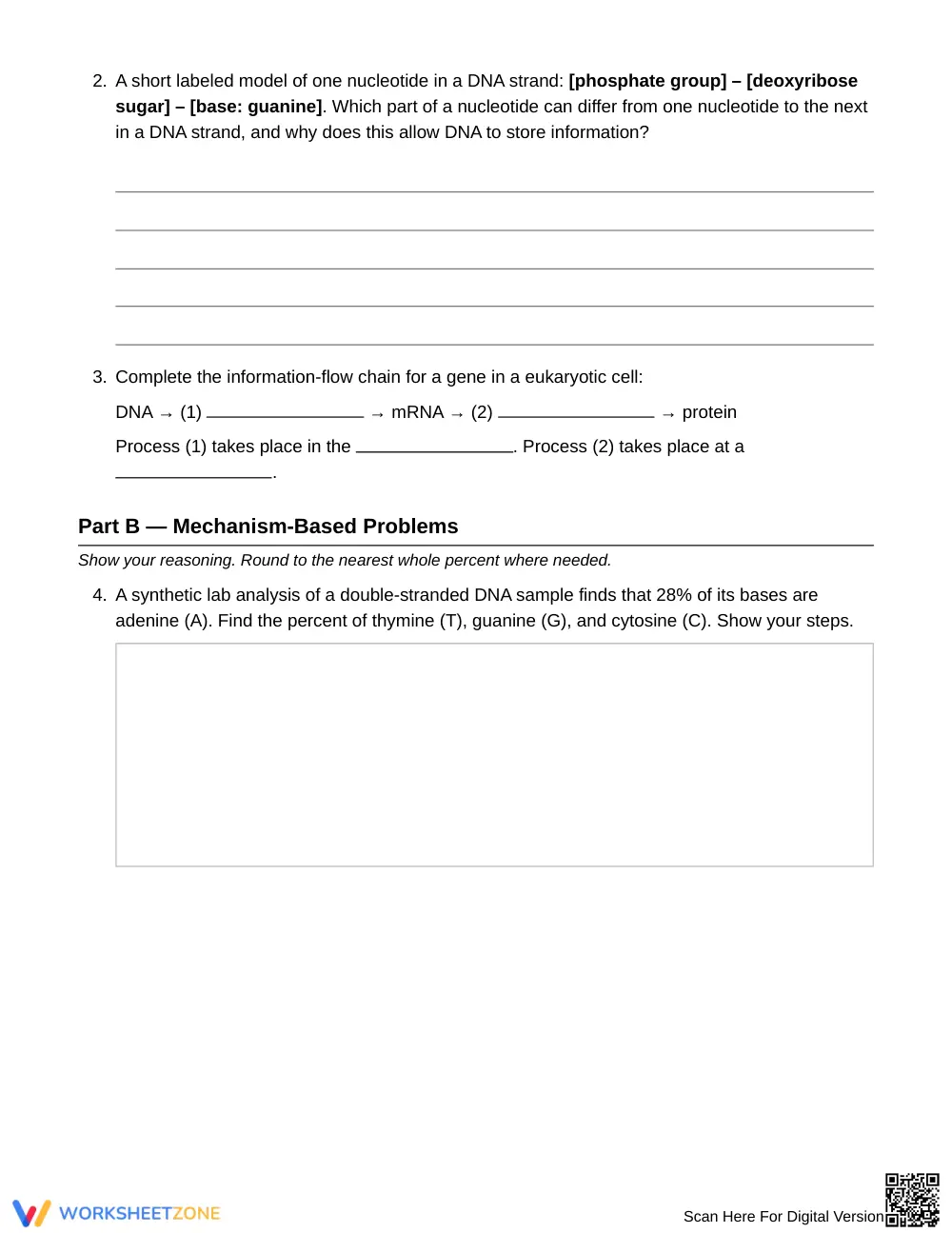
The packet has 5 student pages and a 3-page answer key. A reminder box on page one summarizes DNA and RNA features, base-pairing rules, and the flow from DNA to mRNA to protein. Task types include a fill-in comparison table, a nucleotide reasoning question, a flow-chain completion, percent calculations, a transcription problem, multiple choice, a hydrogen-bond calculation, a data interpretation task, an RNA-type matching table, and three short predictions. All data are synthetic.
Skill Progression
- Guided practice (Part A, 3 problems): Students complete a comparison table, explain nucleotide variation, and fill in the information-flow chain, using the reminder box as a strong scaffold.
- Supported practice (Part B, 6 problems): Students apply base-pairing percentages, transcribe a template strand, count hydrogen bonds, read mRNA data, and classify RNA types, with a prompt to show reasoning.
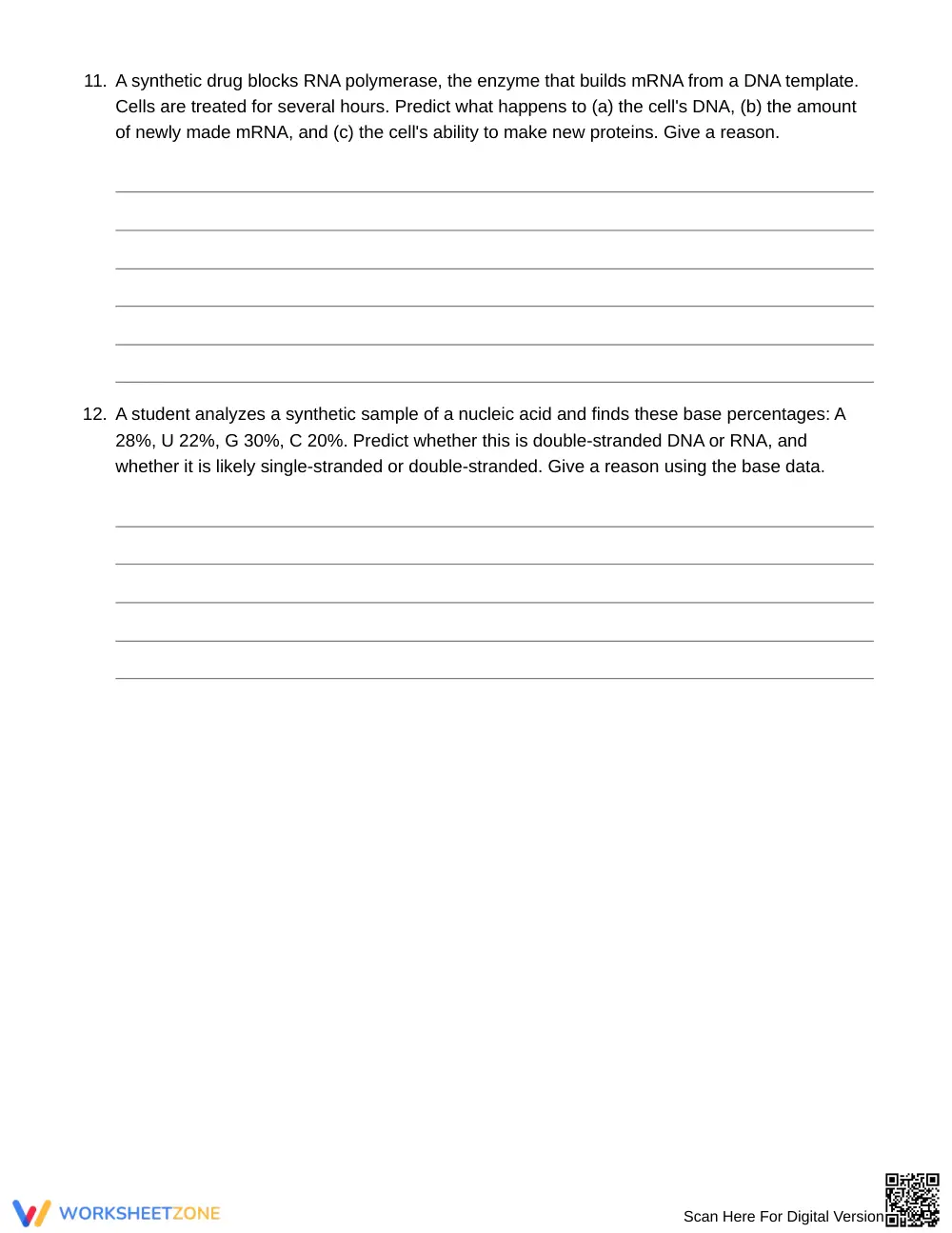
- Independent practice (Part C, 3 problems): Students predict the effects of a mutation, a drug that blocks RNA polymerase, and an unknown base-percentage sample, and justify each prediction with a relationship from the worksheet.
The sequence follows a gradual-release model: I Do (reminder box), We Do (Parts A and B), You Do (Part C).
Standards Alignment
No standard code was supplied for this worksheet, so none is listed. The tasks target a common Grade 9 life science expectation: students explain how the structure of DNA and RNA relates to their roles in storing genetic information and directing protein synthesis.
How to Use It
- After direct instruction: Assign Parts A and B as in-class practice once students have seen transcription and base pairing. Circulate during the transcription and hydrogen-bond items to check whether students flip the template strand correctly.
- Before a quiz: Use Part C as a review set or exit task, asking students to defend each prediction aloud with a stated relationship.
Who It's For
This worksheet suits Grade 9 Biology students in a first unit on nucleic acids. Struggling students can lean on the reminder box and complete Part A first. Advanced students can spend more time on the Part C justifications.
This Grade 9 Biology worksheet on DNA and RNA asks students to compare nucleic acid structure and explain cellular roles through 12 tasks across 5 pages, with a 3-page answer key. Students contrast sugars, bases, and strand number, apply base-pairing rules, transcribe a template strand into mRNA, compare hydrogen bonds in G-C and A-T pairs, and interpret synthetic mRNA data to explain why cells with identical DNA make different proteins. The sequence reflects the gradual release of responsibility model described by Fisher & Frey (2014), moving from modeled reference to guided, supported, and independent practice. By linking structure to function, the packet helps students reason about information flow from DNA to mRNA to protein rather than memorize isolated facts. The answer key lets teachers check reasoning quickly and give targeted feedback. No standard code was supplied.


