































Printable DNA Copying & Mitosis Worksheet | Grade 9 Biology

Paste this activity's link or code into your existing LMS (Google Classroom, Canvas, Teams, Schoology, Moodle, etc.).
Students can open and work on the activity right away, with no student login required.
You'll still be able to track student progress and results from your teacher account.
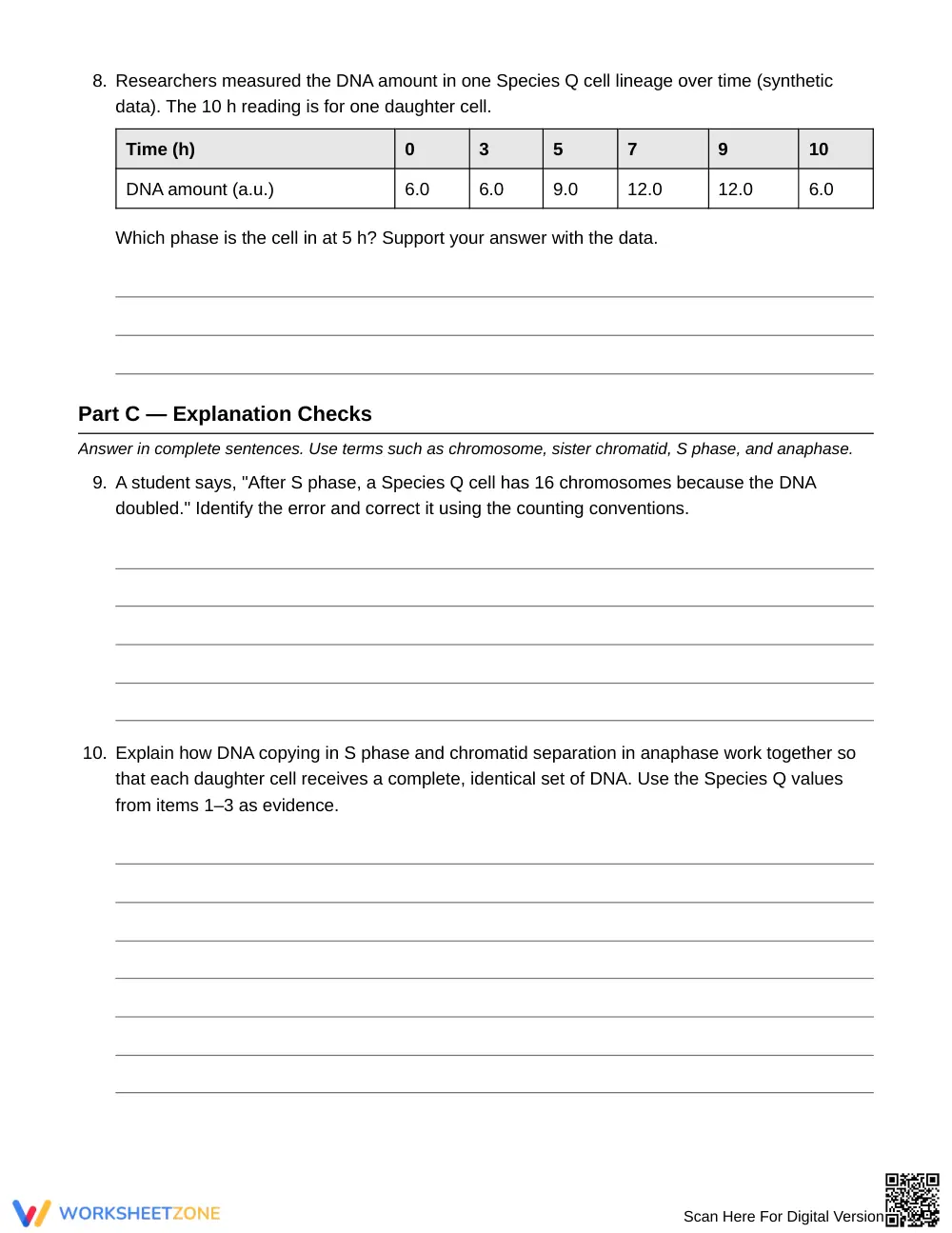
This Grade 9 Biology worksheet helps students track how DNA is copied in S phase and divided during mitosis. Students count chromosomes, DNA molecules, and DNA amount at each stage of the cell cycle, then explain why each daughter cell receives a complete, identical set of DNA.
At a Glance
- Grade: 9 · Subject: Biology
- Standard: Cell cycle and mitosis — count chromosomes and DNA at each stage and explain division.
- Skill Focus: Tracking DNA copying and division
- Format: 4 pages · 10 problems · Answer key included · PDF
- Best For: Mitosis unit practice or review
- Time: 30–40 minutes
What's Inside
The worksheet opens with a counting-conventions box and two modeled cases that show every calculation. Ten tasks follow in three parts: fill-in-the-blank steps, applications with a stage-count table, a population-growth item, and a DNA time-series table, and two written explanation checks. All organisms and data are synthetic. A 2-page answer key shows the reasoning for each item.
Skill Progression
- Guided practice (Part A, 3 problems): Step blanks and a hint walk students through one Species Q cell from S phase to cytokinesis.
- Supported practice (Part B, 5 problems): Students work with the counting conventions box to find chromosomes, DNA molecules, and DNA amount, calculate percentages and time in a stage, and read a DNA time-series table.
- Independent practice (Part C, 2 problems): Students correct a misconception and write a full explanation using their own earlier results as evidence.
This sequence follows gradual release: I do, we do, you do.
Standards Alignment
No standard code was supplied for this worksheet, so none is listed. The content addresses the core cell cycle idea in high school biology: cells copy their DNA during interphase and then distribute identical sets of chromosomes to two daughter cells through mitosis and cytokinesis. Teachers can map the tasks to their own state or district standard.
How to Use It
After direct instruction: assign the full set as in-class practice once students have seen the phases of mitosis. Before a quiz: use Part B and Part C as a review. While students work, watch Part A, item 2. Students who write 16 DNA molecules instead of 16 for the correct count of 8 chromosomes with 2 molecules each, or who recopy DNA after S phase, need another look at the counting rules. Expect 30–40 minutes.
Who It's For
Grade 9 Biology students in a cell cycle and mitosis unit. Students who need more support can complete the modeled cases and Part A first, then continue to Part B on a second day. Students ready for more can focus on the explanation items. It pairs well with a labeled mitosis diagram or an anchor chart of the cell cycle phases.
Tracking DNA Copying and Division is a Grade 9 Biology worksheet that teaches students to follow DNA through the cell cycle and mitosis. Across 10 tasks, students count chromosomes, DNA molecules, and DNA amount in synthetic organisms, interpret a stage-count table and a DNA time series, and explain how S phase copying and anaphase separation give each daughter cell a complete, identical set of DNA. The key counting rule is that joined sister chromatids count as one chromosome, while separated chromatids each count as their own chromosome. The task sequence follows the gradual release model described by Fisher & Frey (2014): modeled cases, scaffolded steps, independent applications, and written explanation. Because every organism and data set is invented, students practice reasoning from rules instead of recalling facts. A two-page answer key supports quick checking and error analysis.


