































Printable Digestive System Worksheet | Grades 6–10 Science

Paste this activity's link or code into your existing LMS (Google Classroom, Canvas, Teams, Schoology, Moodle, etc.).
Students can open and work on the activity right away, with no student login required.
You'll still be able to track student progress and results from your teacher account.
Students master claim‑evidence‑reasoning while labeling the human digestive system, using data from hands‑on experiments to construct scientific arguments. This worksheet guides them from model labeling to interpreting experimental results, reinforcing the connection between structure and function and prepares them for future lab investigations.
At a Glance
- Grade: Grades 6–10 · Subject: Science (Life Science)
- Standard:
— Conduct claim‑evidence‑reasoning investigations on digestive system concepts- Skill Focus: Claim‑Evidence‑Reasoning with labeling of organs
- Format: 4 pages • 29 problems • Answer key included • PDF printable, easy‑to‑use
- Best For: Small‑group lab stations or independent practice sessions, quickly engaging
- Time: 30–45 minutes
What's Inside
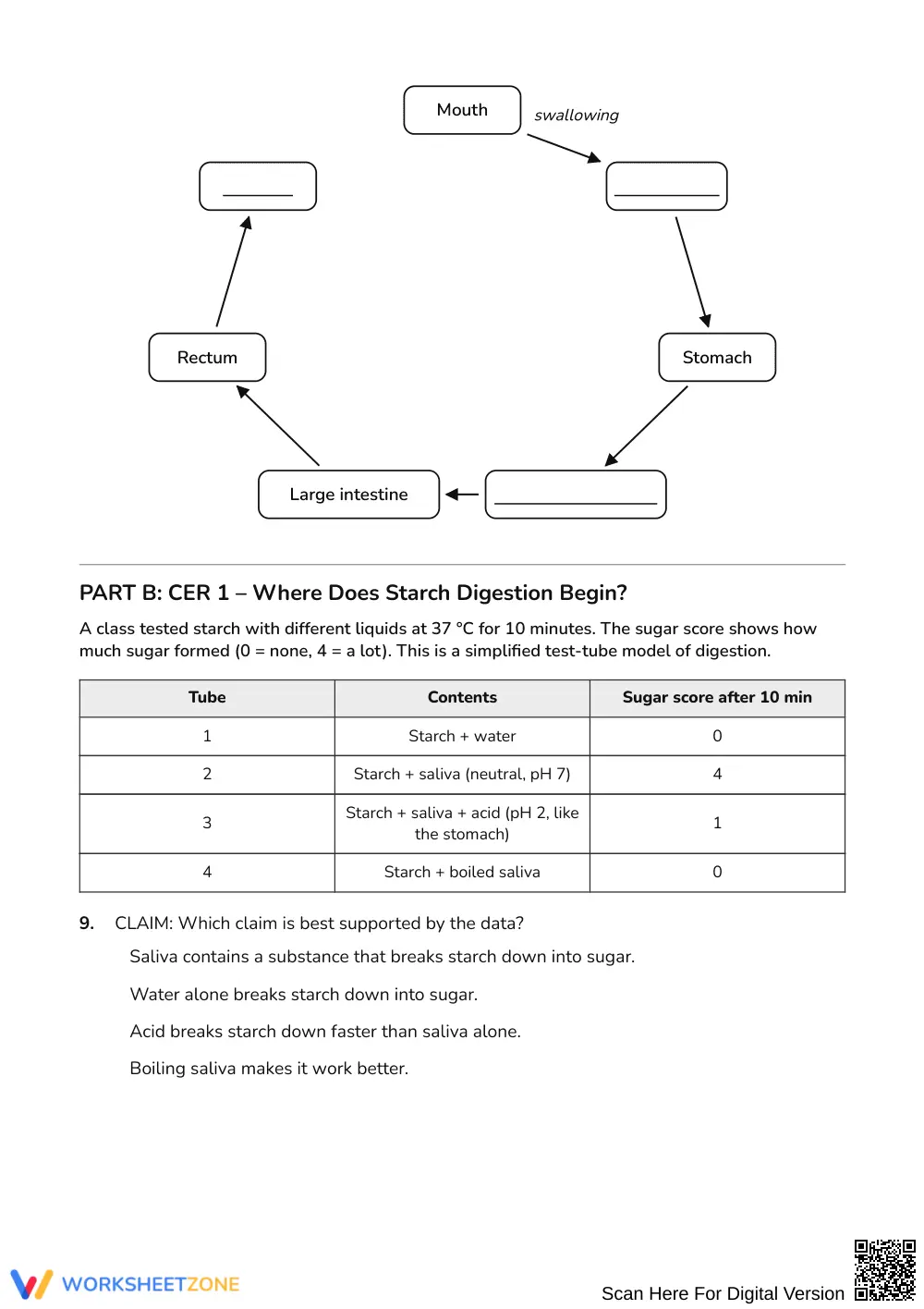
The packet spans four double‑sided pages and contains 29 distinct tasks. Part A asks students to label a front‑view diagram using a provided word bank and to trace the food pathway. Parts B and C present authentic experimental data tables, prompting claim‑evidence‑reasoning statements, multiple‑choice applications, and short‑answer explanations. An answer key on the final page mirrors each problem for quick grading.
Skill Progression
- Guided practice (9 problems): Students label the diagram with the word bank and complete the food‑path chart, receiving sentence frames and a worked example.
- Supported practice (10 problems): Learners construct CER statements for the starch‑digestion experiment, using a claim scaffold and a two‑column evidence table.
- Independent practice (10 problems): Students analyze the small‑intestine surface‑area data, write a full CER, and answer higher‑order multiple‑choice items without prompts.
The progression follows the classic I Do, We Do, You Do release.
Standards Alignment
` ` This worksheet aligns with the practice of constructing scientific arguments using claim, evidence, and reasoning while connecting anatomical labeling to function. It also supports the NGSS crosscutting concept of Structure and Function. Both standard references can be copied directly into lesson plans, IEP goals, or district curriculum mapping tools.
How to Use It
Use Case 1 – Before a unit on human anatomy, have students complete Part A as a quick labeling warm‑up; observe accuracy to gauge prior knowledge and inform the depth of the upcoming lesson. Use Case 2 – During a lab on digestion, assign Parts B and C for data‑driven CER practice; collect responses for immediate formative feedback. Expect each session to last 15–20 minutes.
Who It's For
Designed for middle‑school learners in Grades 6‑10, the worksheet supports diverse learners through built‑in word banks, sentence frames, and optional challenge questions. Teachers can pair it with a textbook chapter on the digestive system or an anchor chart illustrating organ functions for seamless integration.
The claim‑evidence‑reasoning framework embedded in this Digestive System worksheet reflects research showing that explicit argumentation scaffolds improve scientific understanding (Fisher & Frey 2014). By requiring students to link anatomical labels with experimental data, the tasks promote deeper conceptual connections and align with NGSS expectations for evidence‑based explanations. The inclusion of word banks and sentence frames provides the gradual release needed for emerging writers, while the data‑driven CER sections mirror authentic laboratory inquiry. Educators can confidently assign this resource knowing it supports both content mastery and the development of critical reasoning skills essential for future STEM success. Moreover, the hands‑on labeling activity aligns with visual‑spatial learning theories, which suggest that manipulating representations enhances retention (RAND AIRS 2024). The worksheet’s four‑page design also fits typical class periods, allowing teachers to complete the entire sequence in a single lesson without additional preparation.


