




























Printable Digestive Process Worksheet | Grades 6-10 Science
Paste this activity's link or code into your existing LMS (Google Classroom, Canvas, Teams, Schoology, Moodle, etc.).
Students can open and work on the activity right away, with no student login required.
You'll still be able to track student progress and results from your teacher account.
This comprehensive human body systems worksheet equips middle and early high school students to trace the path of food, order critical physiological events, and analyze chemical and physical changes during digestion. Through anatomical labeling, sequential reasoning, and pH data interpretation, learners master how organs interact across each stage of the digestive tract.
At a Glance
- Grade: Grades 6–10 · Subject: Science
- Standard: Life Science — Sequence physiological events and explain chemical transformations in body systems
- Skill Focus: Ordering digestive stages and explaining structural and chemical changes
- Format: 4 pages · 27 problems · Answer key included · PDF
- Best For: Human body systems practice or review
- Time: 40–55 minutes
What's Inside
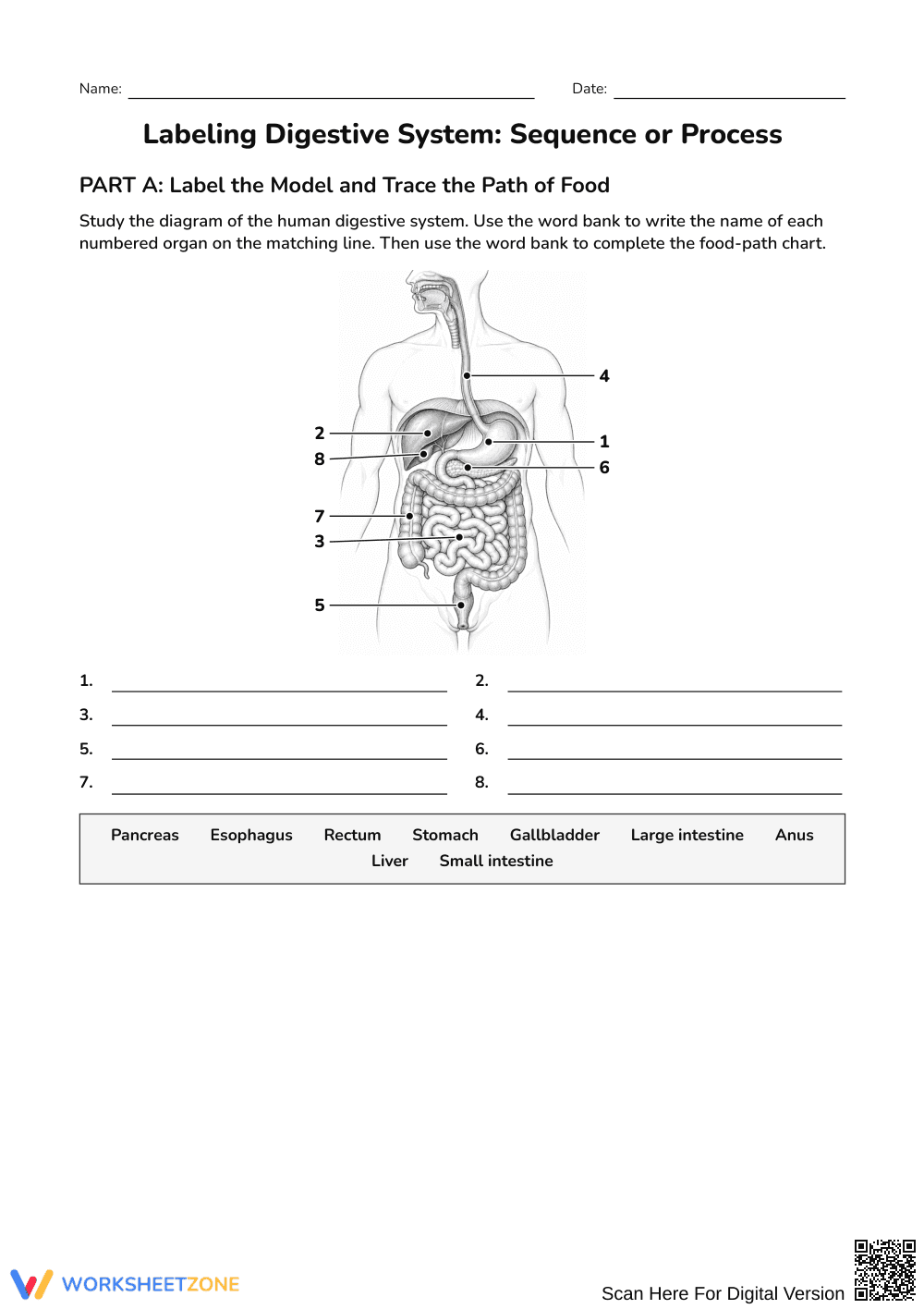
Across 4 focused pages, students complete 27 structured items organized into three targeted sections. The packet includes an anatomical diagram with an integrated word bank, a sequencing matrix tracking physical and chemical changes, and an adult pH profile dataset. A complete 4-page teacher answer key provides sample explanations, structural classifications, and biochemical rationales for immediate feedback.
Skill Progression
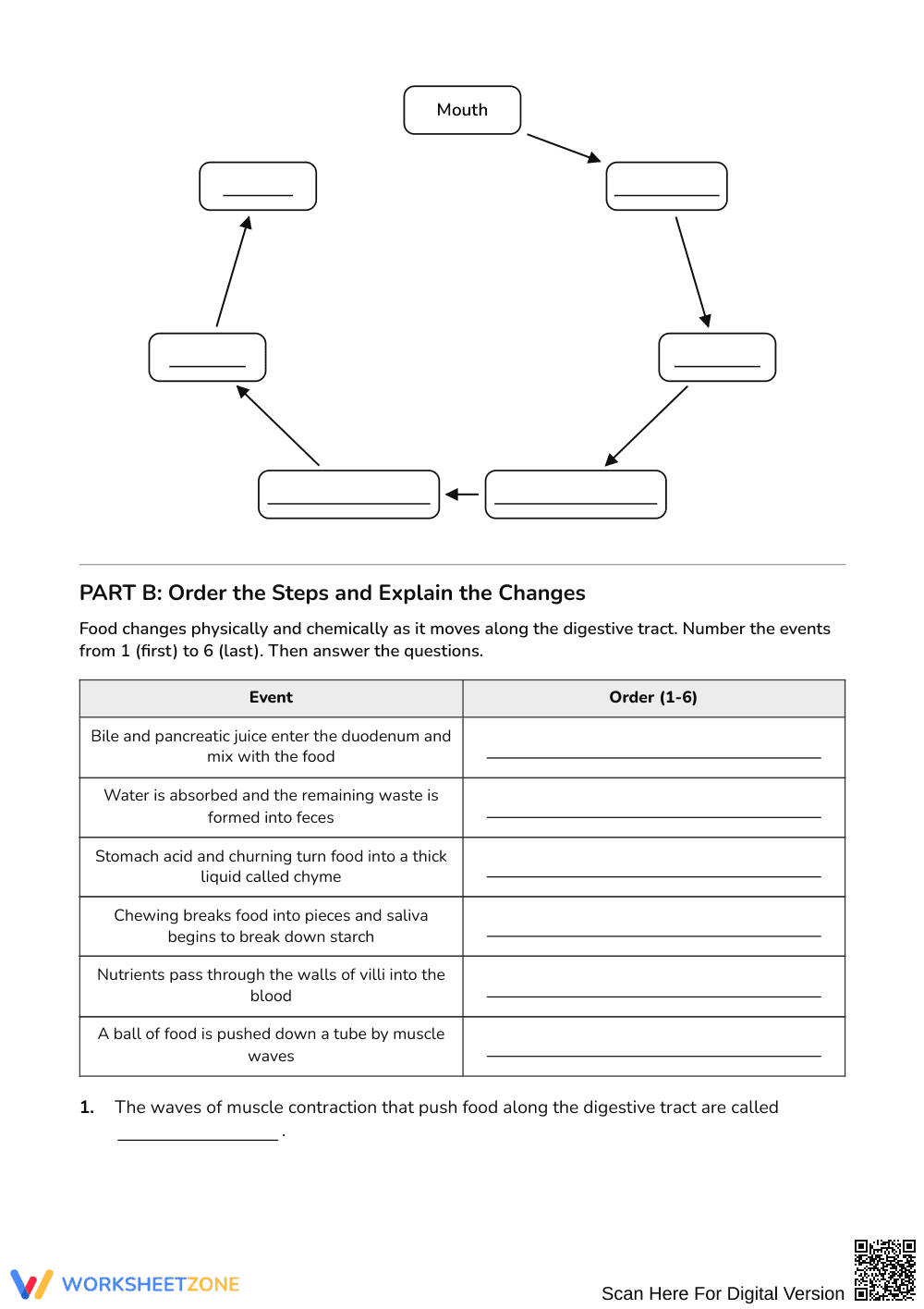
- Guided Practice (Part A): Students examine an anatomical diagram of the digestive tract, utilizing a word bank to identify major organs and map the continuous pathway of ingested food from mouth to anus.
- Supported Practice (Part B): Learners sequence six core physiological events, differentiate accessory organs like the liver from alimentary canal structures, and construct written comparisons distinguishing mechanical churning from enzymatic breakdown.
- Independent Practice (Part C): Working with real-world pH data along the gastrointestinal tract, students evaluate neutralization in the duodenum and formulate evidence-based predictions regarding enzyme denaturation and pepsin function.
This structured progression mirrors the gradual-release framework, moving intentional learners from anatomical recall toward rigorous biochemical analysis.
Standards Alignment
This resource aligns with secondary Life Science standards covering human body systems, multicellular organization, and matter transformation. Students trace how specialized organs interact to break down macromolecules and maintain homeostasis. These core concepts support curricular frameworks emphasizing system interactions and cellular energy acquisition, fitting directly into lesson plans or curriculum mapping tools.
How to Use It
Introduce this worksheet after direct instruction on digestive anatomy to reinforce nutrient absorption mechanisms. Alternatively, assign Part C as a mid-unit formative assessment to check how students interpret numerical models and enzyme pH sensitivity. Plan for a 40- to 55-minute session, monitoring responses in Part B to verify that learners distinguish physical mastication from chemical hydrolysis.
Who It's For
This activity serves general science students in grades 6 through 8 and introductory high school biology learners studying macromolecule metabolism. The integrated organ word bank supports developing readers, while open-ended chemical comparison items challenge advanced thinkers. Pair this printable with a physical digestive model or enzyme kinetics mini-lesson for maximized retention.
Secondary science instruction demands that learners bridge macro-level anatomical structures with micro-level biochemical processes. According to Fisher and Frey (2014), scaffolded instructional shifts that transition from concrete labeling tasks to data interpretation significantly improve student mastery of complex biological systems. This 4-page worksheet guides middle and high school students through that precise pedagogical trajectory. By sequencing 27 structured items across anatomical pathway tracking, event chronological ordering, and pH data analysis, the resource directly supports systemic thinking in life science. Students do not simply memorize organ names; they analyze how bicarbonate neutralization, muscular peristalsis, and villi-mediated nutrient absorption function in concert. This scaffolded approach ensures durable concept retention, effectively preparing students for upper-level biology coursework while reinforcing fundamental scientific literacy, rigorous inquiry habits, and analytical writing skills across diverse secondary science classroom learning environments.


