




























Views
Downloads




Printable Continental Drift Worksheet | Grade 8 Science

Paste this activity's link or code into your existing LMS (Google Classroom, Canvas, Teams, Schoology, Moodle, etc.).
Students can open and work on the activity right away, with no student login required.
You'll still be able to track student progress and results from your teacher account.
This Grade 8 science worksheet helps students evaluate the evidence for continental drift and Pangaea. Learners classify fossil, rock, climate, and coastline clues, interpret three data packets, calculate plate-motion rates, and defend a claim against the land-bridge hypothesis. It builds evidence-based reasoning across 12 tasks.
At a Glance
- Grade: 8 · Subject: Science
- Standard: Continental drift evidence — use fossil, rock, and climate data to support a claim
- Skill Focus: Evaluating continental-drift evidence
- Format: 5 pages · 12 problems · Answer key included · PDF
- Best For: Wegener unit practice and formative checks
- Time: 40–50 minutes
What's Inside
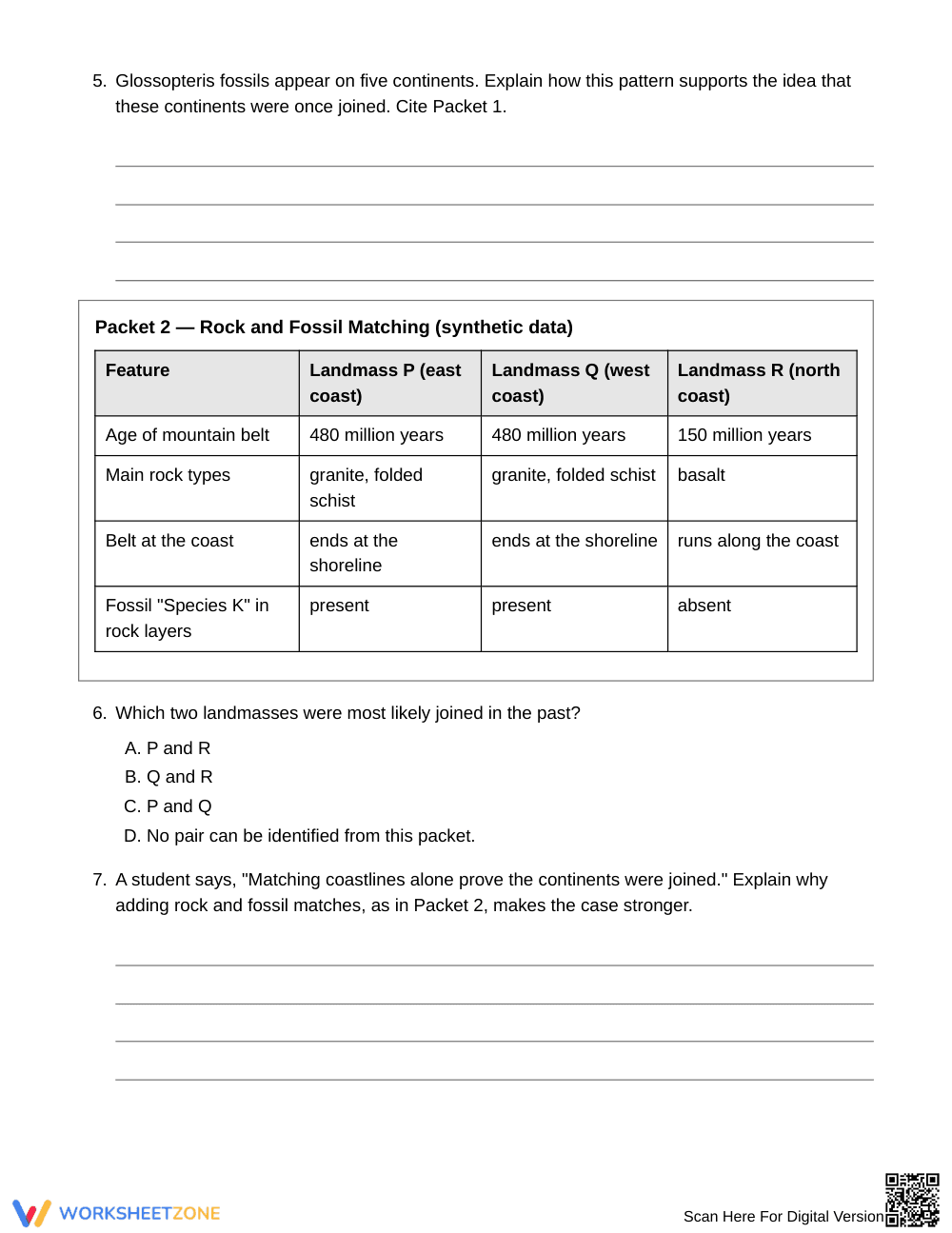
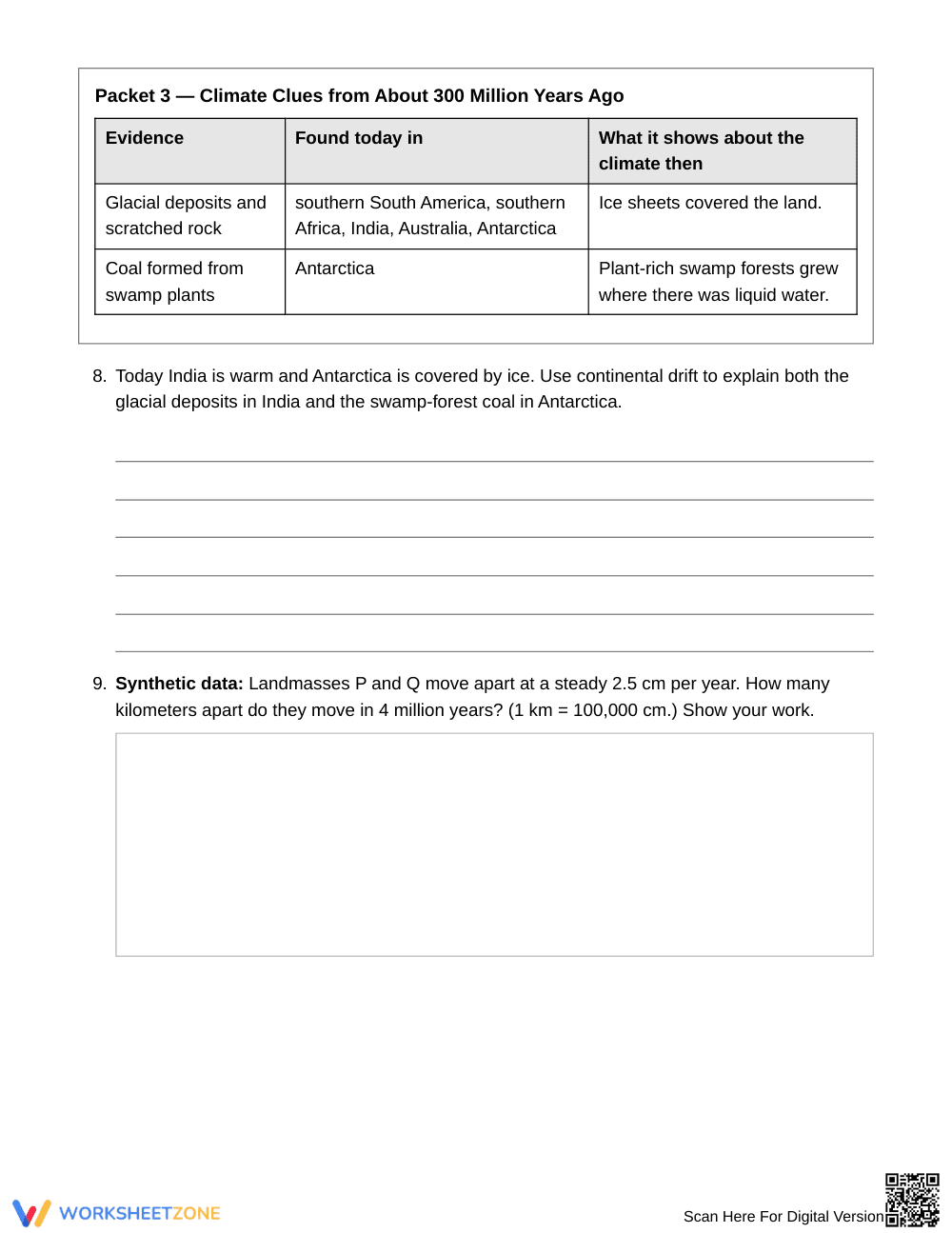
The worksheet has three parts across 5 pages. Part A uses two multiple-choice items and a classification table. Part B gives three evidence packets (fossil distribution, rock matching, climate clues) with multiple-choice, short-explanation, and calculation items. Part C adds a rate calculation, a critique analysis, and a claim–evidence–reasoning response. A 2-page answer key is included.
Skill Progression
- Guided practice: 3 items in Part A, with answer choices and an F, R, C, S classification code.
- Supported practice: 6 items in Part B, with data packets, stated assumptions, and a unit-conversion hint.
- Independent practice: 3 items in Part C, requiring calculation, critique, and a full claim–evidence–reasoning response.
The sequence follows gradual release: I Do, We Do, You Do.
Standards Alignment
No standard code was supplied for this worksheet, so none is listed. The tasks address the Grade 8 Earth science expectation that students use evidence from fossils, rock formations, climate records, and continental shape to explain how continents have moved. Add your state's code when mapping to lesson plans or curriculum tools.
How to Use It
Use it after direct instruction on Wegener as a review, or assign Part A before class and Parts B and C during class. While students work, listen for whether they cite packet data by name, which shows real evidence use. Expect 40–50 minutes.
Who It's For
Designed for Grade 8 science students studying Pangaea and plate tectonics. Part A scaffolds students who need support, while Part C extends stronger writers. Pair it with a Pangaea reconstruction map or anchor chart.
The Continental-Drift Evidence Check is a Grade 8 science worksheet in which students use fossil, rock, climate, and coastline evidence to evaluate Wegener's hypothesis that the continents were once joined as Pangaea. Its 12 tasks move from classifying evidence types to interpreting three data packets, calculating plate-motion rates at 2.5 cm per year, and writing a claim–evidence–reasoning response that weighs continental drift against the land-bridge idea. Packets 1 and 3 summarize real findings, while Packet 2 and all rates are synthetic practice data. The sequence follows the gradual-release model described by Fisher & Frey (2014), in which teachers shift responsibility from guided to independent work. A two-page answer key supports quick scoring and feedback. The resource fits units on Pangaea, fossil distribution, and the development of plate tectonics theory. Teachers can assign it in class or as review.


