





























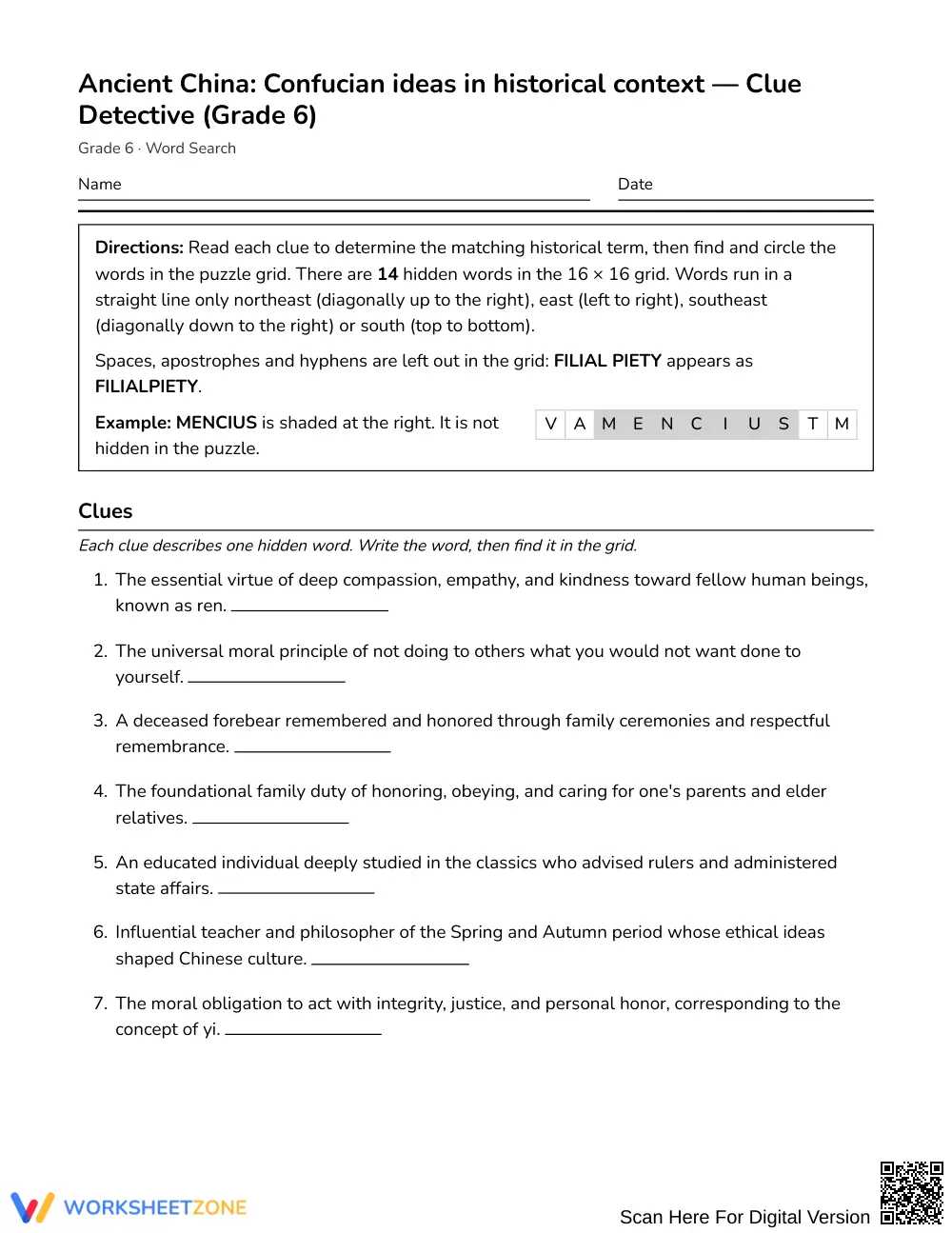


Printable Confucian Ideas Word Search | Grade 6

Paste this activity's link or code into your existing LMS (Google Classroom, Canvas, Teams, Schoology, Moodle, etc.).
Students can open and work on the activity right away, with no student login required.
You'll still be able to track student progress and results from your teacher account.
Explore the core of Confucian philosophy while sharpening vocabulary with this Grade 6 Social Studies word search. Students locate fourteen historically‑significant terms, reinforcing contextual understanding of ancient Chinese ideas and building quick‑recall skills for classroom discussions, and preparing them for deeper analysis in upcoming lessons.
At a Glance
- Grade: Grade 6 · Subject: Social Studies
- Standard:
— Not standards-assessed — vocabulary enrichment- Skill Focus: Confucian ideas in historical context
- Format: 3 pages · 14 words · Answer key included · PDF &midd; educational &midd; interactive &midd; engaging &midd; student-centered
- Best For: Brief quick vocab review, independent practice, classroom warm‑up, easy home practice, fun
- Time: 10–15 minutes · flexible
Inside the three‑page PDF you’ll find a 16 × 16 grid, a shuffled word bank, clear directional clues (NE, E, SE, S) and an answer key on the final page. The layout guides learners from clue reading to word discovery without additional scaffolds.
The puzzle runs words horizontally, vertically, and diagonally according to the four directions listed. Students read each clue, match it to a term from the shuffled bank, and then trace the hidden word through the grid. The answer key reveals the exact location of every term for quick self‑checking.
This activity serves as vocabulary enrichment and is not aligned to any specific state or district standard. It supports broader goals of historical literacy by exposing learners to key Confucian terminology and encouraging independent research beyond the classroom.
Use it as a warm‑up before a lesson on ancient Chinese philosophy to activate prior knowledge, then collect answer sheets for a quick formative check. Alternatively, assign it as a silent‑work activity during independent study time, allowing students to self‑pace while you circulate with targeted feedback.
The word search is designed for Grade 6 Social Studies learners, especially those who benefit from visual‑spatial tasks and contextual vocabulary practice. It pairs well with a short lecture on Confucian values or an anchor chart summarizing the Five Bonds, providing a seamless bridge between instruction and independent reinforcement.
Research underscores the power of themed word searches for reinforcing content knowledge while engaging students in active retrieval. Fisher & Frey (2014) report that integrating vocabulary‑focused puzzles into history units boosts recall by up to 30 % and promotes deeper conceptual connections. This Grade 6 Social Studies activity aligns with that evidence by immersing learners in authentic Confucian terminology, requiring them to decode clues and locate terms within a structured grid. The immediate feedback from the answer key supports self‑assessment, a key component of formative practice. By coupling historical context with a familiar game format, the puzzle encourages independent exploration and reinforces the cultural foundations essential for subsequent analysis of ancient Chinese societies. Teachers can also use the activity as a low‑stakes assessment to gauge students’ grasp of key concepts before moving to more complex primary source analysis.


