
































Printable Cold War Word Search | Grades 10–12 Social Studies

Paste this activity's link or code into your existing LMS (Google Classroom, Canvas, Teams, Schoology, Moodle, etc.).
Students can open and work on the activity right away, with no student login required.
You'll still be able to track student progress and results from your teacher account.
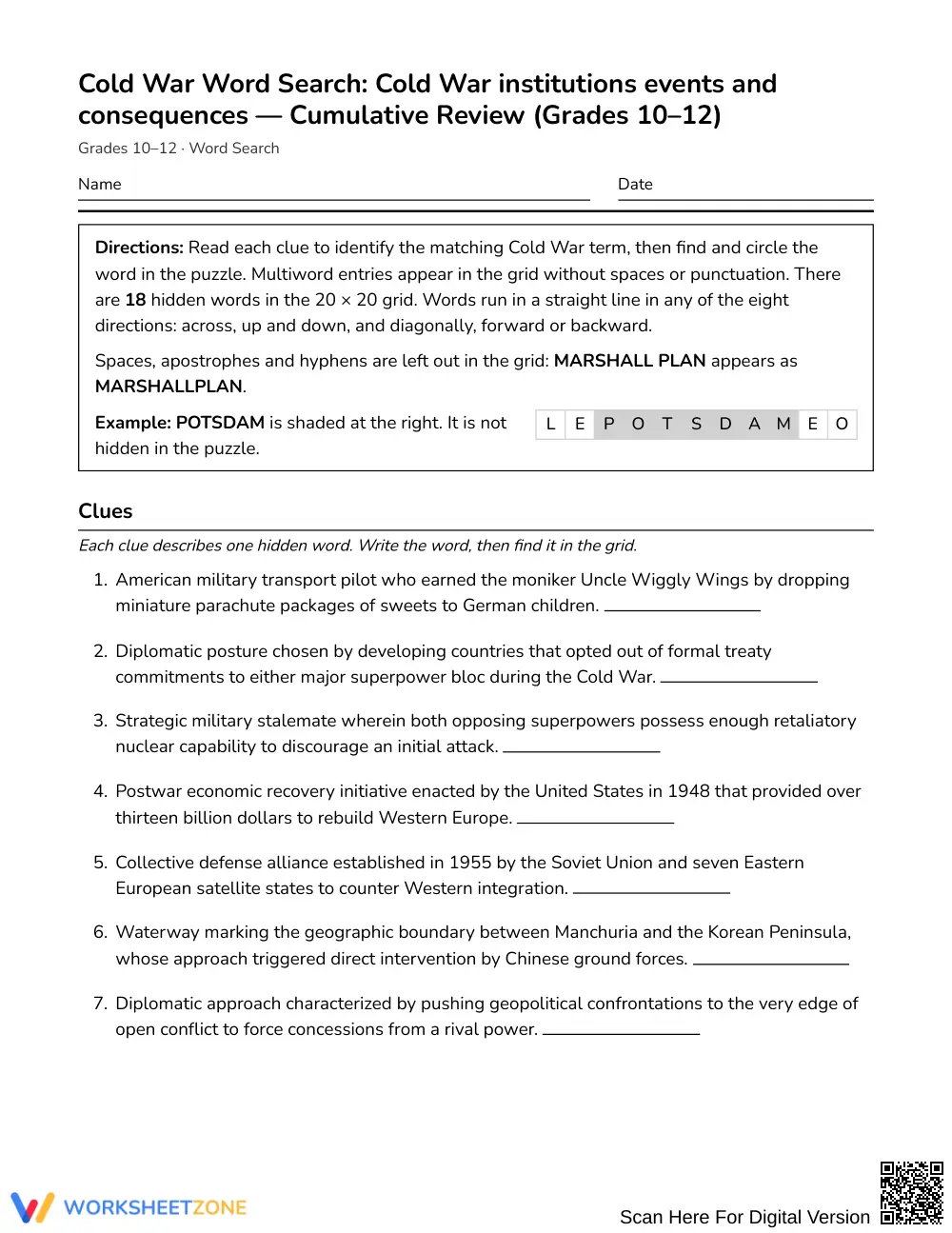
This printable Cold War word search lets Grades 10–12 Social Studies learners reinforce key institutions, events, and consequences through active vocabulary practice. By locating 18 hidden terms, students deepen content knowledge while sharpening pattern‑recognition and spelling skills and build confidence for upcoming assessments.
At a Glance
- Grade: Grades 10–12 high school · Subject: Social Studies
- Standard:
Not standards-assessed — vocabulary enrichment supports terminology mastery- Skill Focus: Cold War institutions, events, and consequences — students identify and define
- Format: 3 pages · 18 words · Answer key included · PDF — easy to print
- Best For: Vocabulary review or cumulative assessment — ideal for review games
- Time: 5–10 minutes — quick classroom activity
What’s Inside
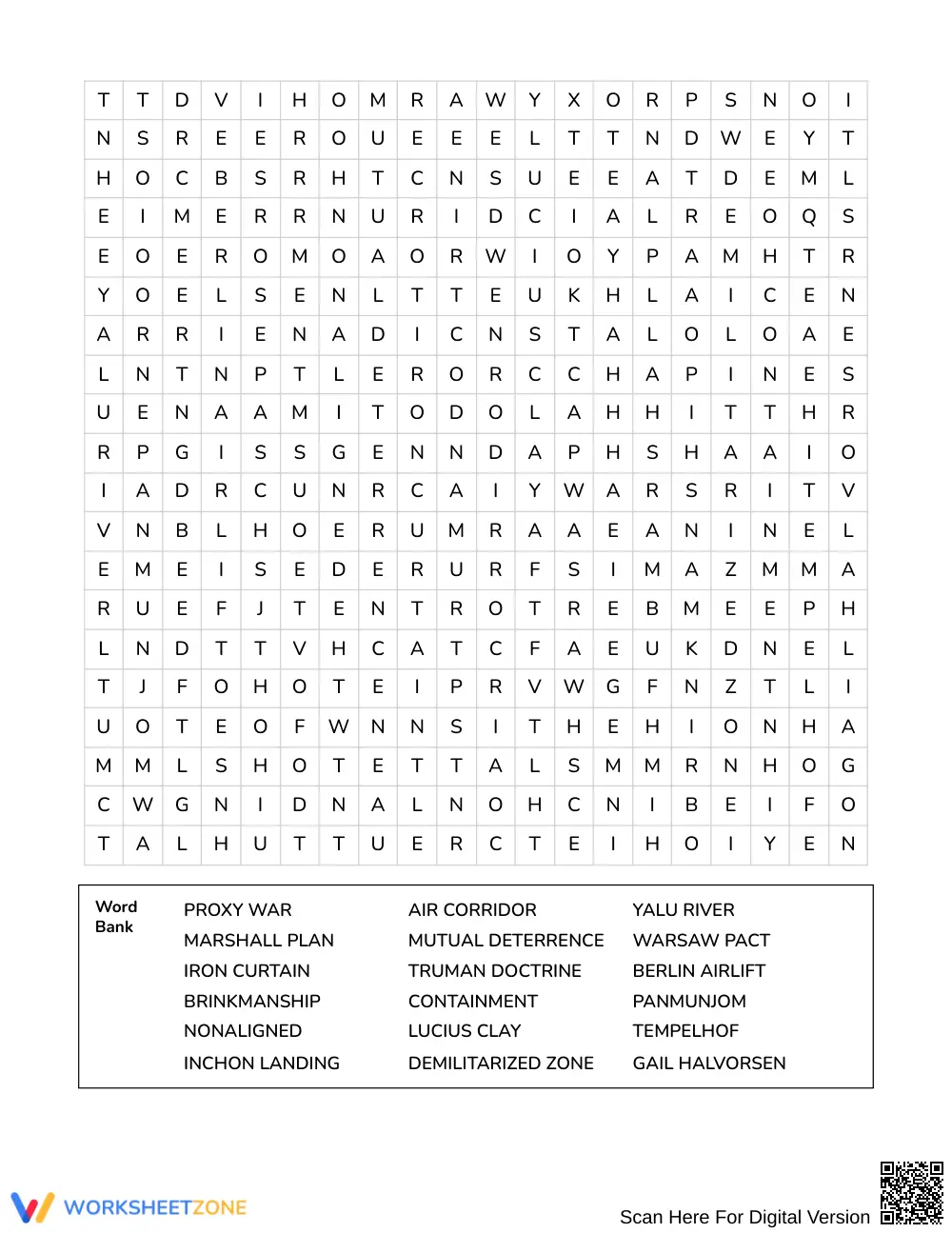
The activity consists of a single 20 × 20 word‑search grid filled with Cold War terminology. Eighteen clues guide learners to the hidden words, which run in all eight directions (N, NE, E, SE, S, SW, W, NW). A shuffled word bank appears on the answer‑key page, and each clue provides a concise definition to support vocabulary acquisition.
Puzzle Mechanics
Students scan the grid for each of the 18 target terms, circling them as they appear. Words may be placed horizontally, vertically, diagonally, or backwards, matching the eight permitted directions. The provided clues act as a word bank, and the answer key on page 4 confirms each location.
Standards Alignment
This resource is designed solely for vocabulary enrichment and does not align to any specific state or national standard. It serves as a flexible, engaging tool for reinforcing Cold War content without formal standards mapping.
How to Use It
1. Pre‑lesson warm‑up: After a brief lecture on Cold War geopolitics, hand out the word search for a 5‑minute review. Observe which terms students locate quickly to gauge prior knowledge. 2. Independent practice: Use the puzzle as a low‑stakes exit ticket; students complete it silently while the teacher circulates, noting any missed words for quick formative feedback. Completion typically takes 5–10 minutes.
Who It’s For
Designed for Grades 10–12 learners in standard, AP, or IB Social Studies courses. The activity requires no additional scaffolding, making it suitable for whole‑class implementation. Pair it with a Cold War timeline anchor chart or a short documentary clip for deeper contextual understanding.
Research demonstrates that focused gamified vocabulary tasks improve retention of complex historical terminology (Fisher & Frey, 2014). By integrating concise definition clues with an engaging grid, this word search offers an evidence-based approach for high school students to internalize Cold War institutions, critical geopolitical events, and lasting international consequences while practicing essential reading and pattern recognition skills. When secondary social studies teachers incorporate targeted puzzles into regular instructional routines, learners actively process domain-specific language rather than passively memorizing isolated definitions. This sustained visual engagement helps students recognize critical historical concepts much faster during lectures, primary source analysis, and formal unit assessments. Furthermore, completing purposeful puzzle activities lowers cognitive anxiety, encouraging broader participation among diverse high school learners who need repeated exposure to complex global diplomacy terms. Ultimately, this classroom resource solidifies foundational historical literacy and equips students for advanced analytical coursework.


