































Printable Cold War Word Search | Grades 10–12 Social Studies

Paste this activity's link or code into your existing LMS (Google Classroom, Canvas, Teams, Schoology, Moodle, etc.).
Students can open and work on the activity right away, with no student login required.
You'll still be able to track student progress and results from your teacher account.
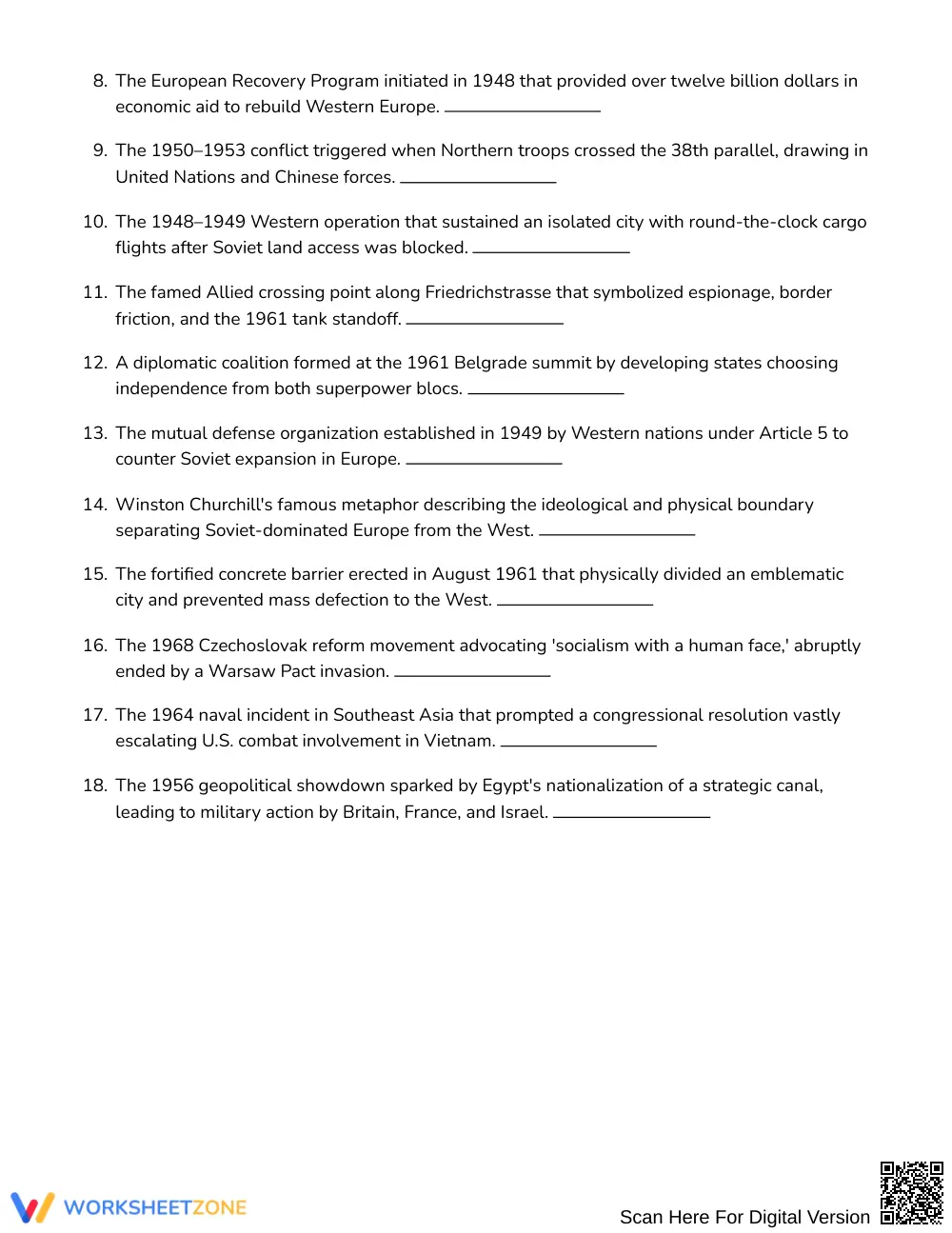
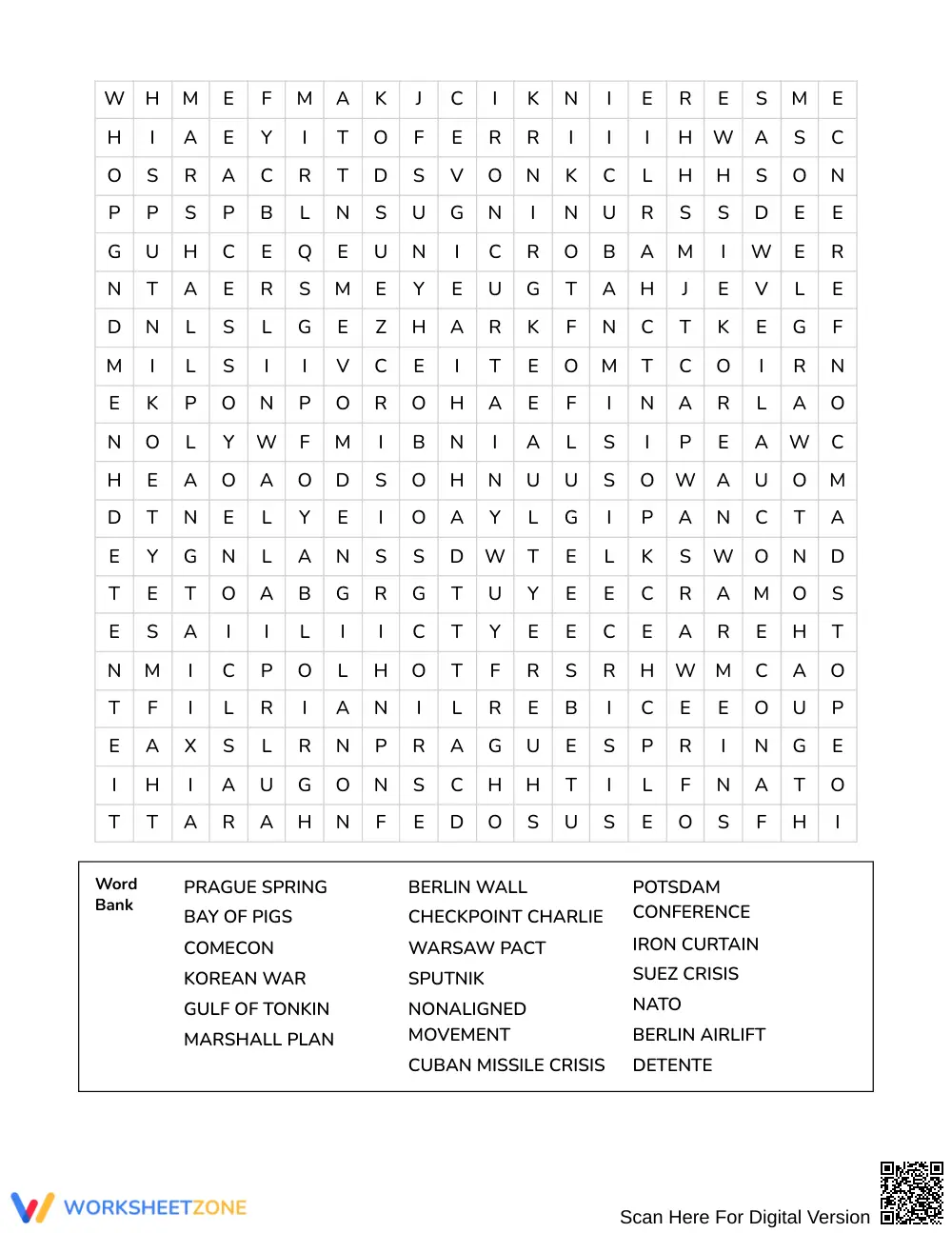
Students explore Cold War chronology by searching for 18 key terms in a 20 × 20 grid, reinforcing vocabulary and historical sequencing while building decoding stamina. The activity requires reading concise clues, identifying the correct phrase, and locating it among intersecting letters, which promotes close reading and contextual understanding.
At a Glance
- Grade: Grades 10–12 · Subject: Social Studies
- Standard:
Not standards-assessed — vocabulary enrichment— students locate and label Cold War terms- Skill Focus: events in chronological context
- Format: 3 pages · 18 words · Answer key included · PDF
- Best For: review, quick homework, test prep, independent study, or enrichment
- Time: 15–20 minutes
What’s Inside
The packet contains a 20 × 20 letter grid, a shuffled word bank of 18 Cold War terms, and detailed historical clues. An answer key on a separate page confirms each hidden phrase, and the layout is printer‑friendly for immediate classroom use.
Skill Progression
- Guided practice: Teacher models one clue, demonstrates locating the word, and students complete 4 terms together (≈5 min).
- Supported practice: Learners work independently on 8 remaining clues while the teacher circulates for help (≈8 min).
- Independent practice: Students finish the final 6 terms, reinforcing chronology without assistance (≈7 min).
This gradual‑release structure moves from I Do to We Do to You Do, ensuring mastery of vocabulary and sequence.
Standards Alignment
This activity is designed for vocabulary enrichment and does not map to a specific state or national standard. It supports the broader goal of building historical literacy through contextual word identification.
How to Use It
- Before a unit review, assign the word search as a quick warm‑up to activate prior knowledge of Cold War events.
- During a lesson on chronological reasoning, have students complete the puzzle, then discuss how each term fits the timeline; observe accuracy as a formative cue.
Typical completion time ranges from 15 to 20 minutes.
Who It’s For
Grades 10–12 learners studying World History benefit from this focused vocabulary drill. No differentiation layers are needed, though teachers can pair the search with a Cold War timeline anchor chart for visual support.
Citation Capsule
Research shows that word‑search puzzles enhance recall of factual information by engaging students in active decoding and contextual association (Fisher & Frey 2014). This Cold War word search targets events in chronological context, offering 18 historically accurate terms that reinforce key vocabulary while promoting sequencing skills. Teachers can integrate the activity into review sessions to boost retention and support vocabulary growth. The puzzle’s 20 × 20 grid requires students to scan horizontally, vertically, and diagonally, reinforcing visual‑spatial processing. By matching each clue to its term, learners practice summarizing historical significance, a skill linked to higher-order thinking. Evidence from literacy studies indicates that such interactive tasks increase motivation and improve long‑term memory retention. When used as a formative check, the word search provides immediate feedback; teachers can quickly note which concepts are mastered and which require reteaching. Its printable format also supports remote learning environments, allowing students to complete the activity at home with minimal setup.


