































Printable Codon Investigation Worksheet | Grade 8–12 Science

Paste this activity's link or code into your existing LMS (Google Classroom, Canvas, Teams, Schoology, Moodle, etc.).
Students can open and work on the activity right away, with no student login required.
You'll still be able to track student progress and results from your teacher account.
Students use this 4‑page, 27‑item worksheet to plan, conduct, and analyze a codon‑focused investigation. They formulate a testable question, identify independent, dependent, and controlled variables, predict outcomes, and evaluate evidence, building a solid foundation in scientific inquiry while connecting molecular concepts to real‑world protein function.
At a Glance
- Grade: 8–12 · Subject: Science
- Standard:
— Conduct investigations using models to explore genetic coding and protein synthesis in cells during development- Skill Focus: Investigation and variables related to codons
- Format: 4 pages · 27 problems · Answer key included · PDF
- Best For: Inquiry labs, genetics units, test prep
- Time: 30–45 minutes
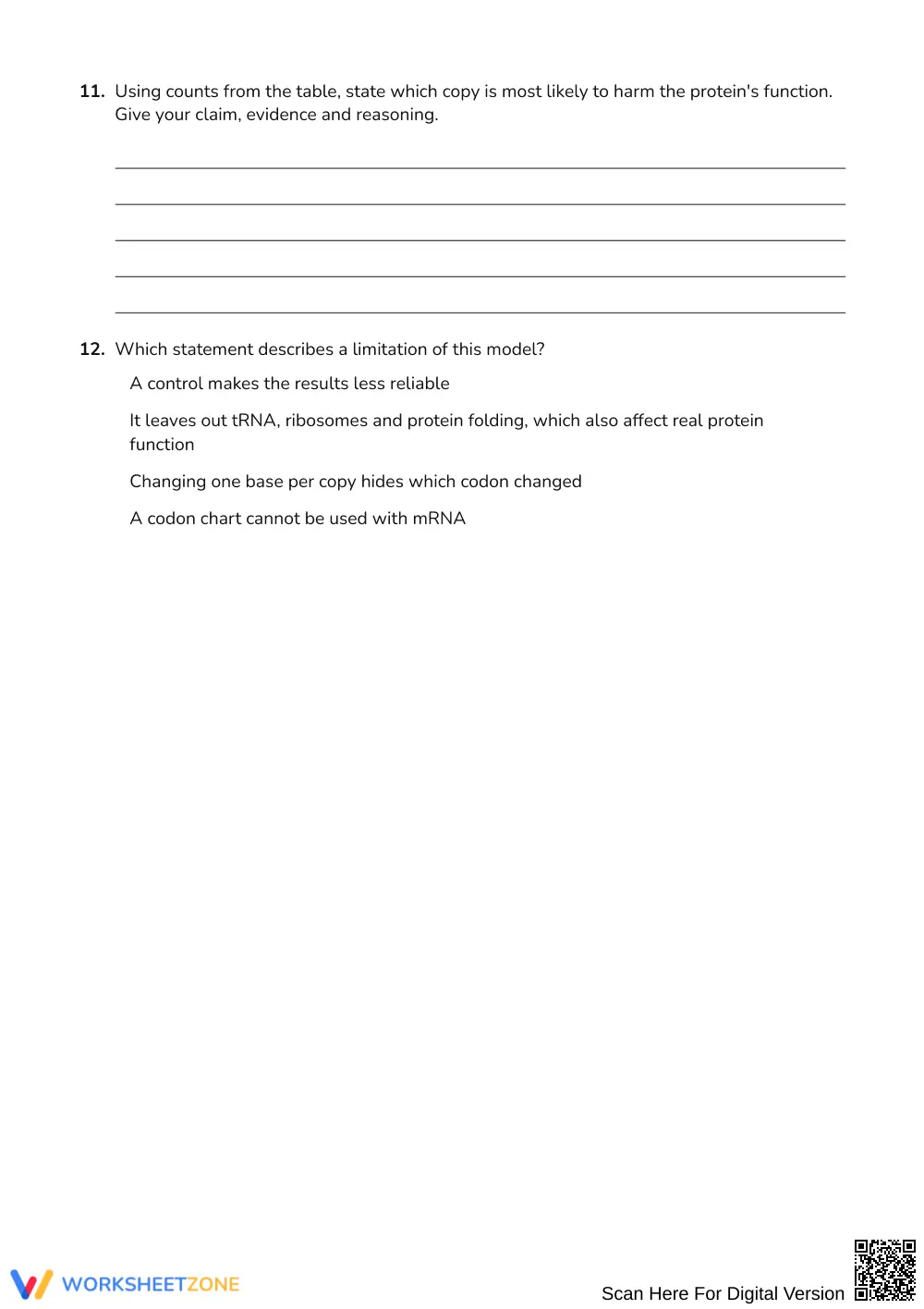
Part A guides students through planning the investigation with a model scenario, prompting them to write a hypothesis, select variables, and predict results. Part B provides a codon chart and data table for translating mRNA sequences and counting differences. Part C asks for analysis, evidence‑based explanations, and reflection on model limitations. The worksheet includes a word bank, sentence frames, and a full answer key.
Skill Progression
- Guided practice (9 problems): Students follow a worked example and use sentence frames to identify variables and write predictions.
- Supported practice (9 problems): Partial word bank and cue cards help students translate sequences and compare results.
- Independent practice (9 problems): Open‑ended analysis questions require students to construct claims, evidence, and reasoning without scaffolds.
The progression follows the classic I Do, We Do, You Do release.
Standards Alignment
`` – Aligns with NGSS practice of using models to explain how DNA sequences determine protein structure (e.g., MS‑LS1‑4). It also supports the related standard MS‑LS3‑2, which emphasizes developing and using models to describe genetic variation. Both standard concepts can be copied directly into lesson plans, IEP goals, or district curriculum mapping tools.
How to Use It
Before a genetics unit, teachers can assign Part A as a pre‑lab activity to activate prior knowledge and set up the investigation. During the unit, Part B serves as a hands‑on data‑collection exercise, and Part C can be used for a post‑lab reflection or exit ticket. Observe students’ ability to articulate variables and justify predictions as formative evidence of understanding.
Who It's For
This worksheet targets middle‑ to high‑school science students (grades 8‑12) who are developing inquiry skills. It works well alongside a textbook chapter on DNA transcription, an anchor chart of codon tables, and a teacher‑led demonstration of protein synthesis. Differentiation is built into the scaffolded practice levels.
Research shows that explicit instruction in scientific inquiry, paired with structured practice, improves students’ ability to design experiments and interpret data (Fisher & Frey, 2014). The Codon Investigation Worksheet operationalizes the skill “investigation and variables related to codons” by giving learners repeated, scaffolded opportunities to formulate questions, select variables, predict outcomes, and evaluate evidence. By integrating model‑based reasoning with hands‑on data analysis, the resource aligns with evidence‑based practices that boost conceptual understanding and procedural fluency. Teachers can confidently assign this printable resource to deepen genetic inquiry skills.


