































Printable Codon Compare Worksheet | Grade 8‑12 Science

Paste this activity's link or code into your existing LMS (Google Classroom, Canvas, Teams, Schoology, Moodle, etc.).
Students can open and work on the activity right away, with no student login required.
You'll still be able to track student progress and results from your teacher account.
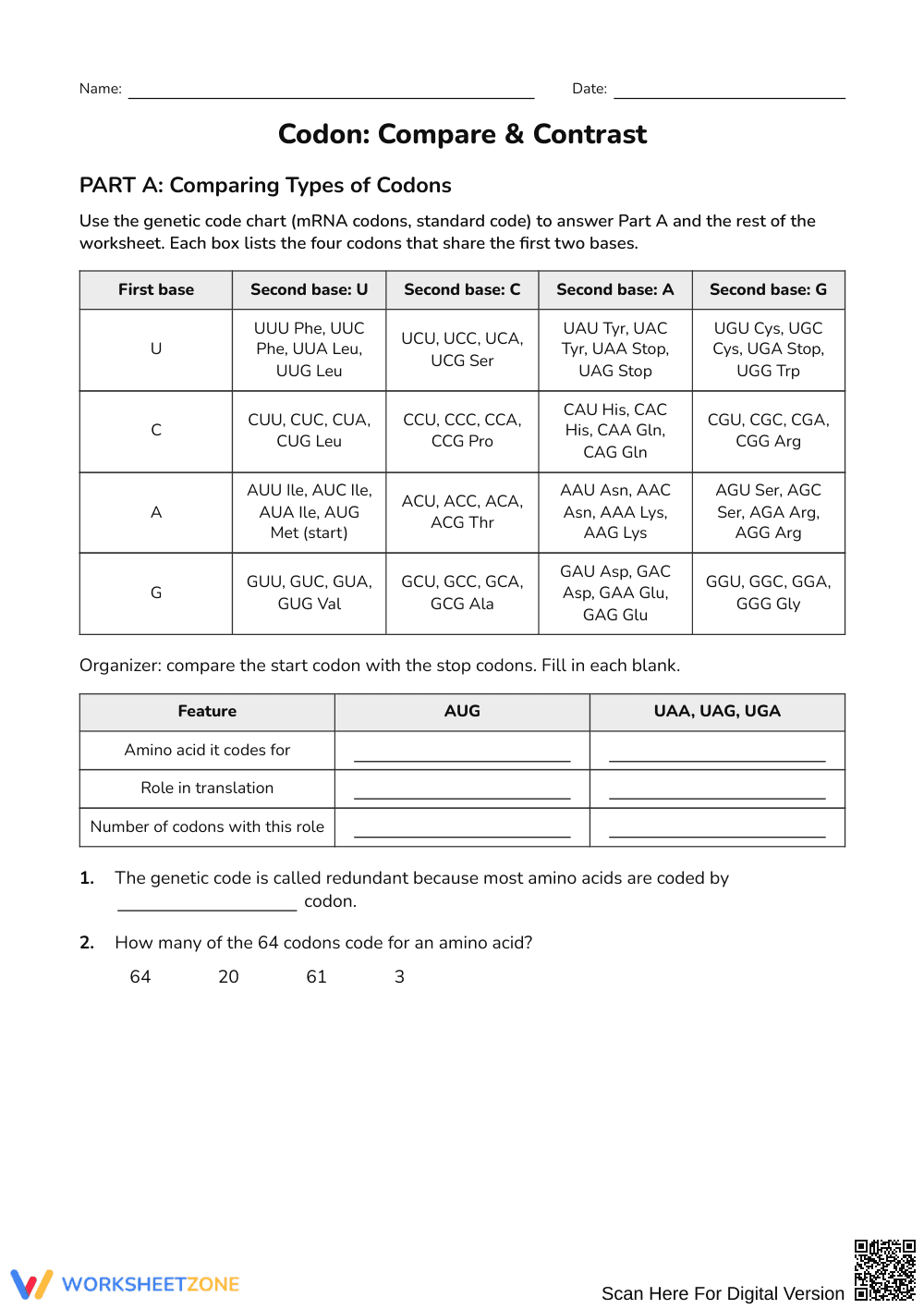
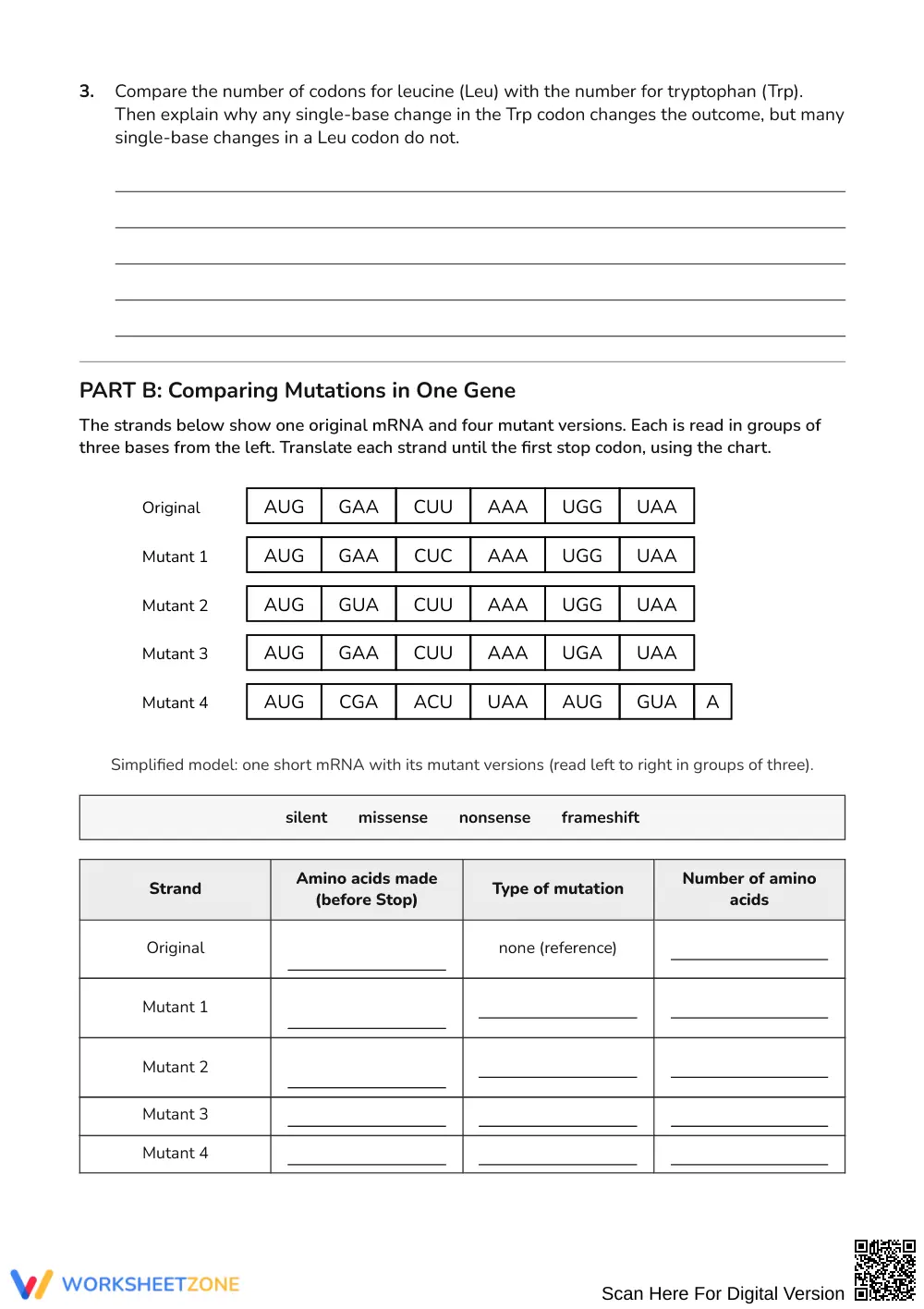
Students use this worksheet to compare and contrast codon types, mutation scenarios, and their biological consequences, developing clear written explanations supported by tables and Venn-style organizers. The activities guide learners from data interpretation to reasoning, reinforcing molecular genetics concepts while building analytical writing skills.
At a Glance
- Grade: Grades 8‑12 · Subject: Science
- Standard: General curriculum — Compare codon functions and mutation effects using systematic detailed tables and brief reasoning
- Skill Focus: compare two relevant cases with a table or Venn organizer and clear concise short explanation
- Format: 4 pages · 40 problems · Answer key included · digital PDF
- Best For: classroom genetics unit review or mutation lesson
- Time: 45–60 minutes
What's Inside
Inside are four pages of mixed-format tasks: multiple‑choice codon tables, mutation translation charts, Venn‑style organizers, and short‑answer explanations. An answer key mirrors each problem, and sentence frames guide reasoning.
Skill Progression
- Guided practice – 12 problems with a worked example and sentence frames to model table comparisons.
- Supported practice – 14 problems with a word bank and partial organizer prompts.
- Independent practice – 14 problems requiring students to construct their own Venn diagrams and concise explanations.
Standards Alignment
This activity provides general curriculum support for introductory and advanced biology units. It helps learners analyze genetic variations, model protein synthesis changes, and evaluate mutation outcomes. Educators can adapt the comparison prompts to match local science scope and sequence frameworks, lesson objectives, or district biology learning targets.
How to Use It
Before a genetics lecture, have students complete the Part A table tasks as a quick warm‑up (10‑12 minutes). During the lesson, use Part B mutation translation as guided practice, then assign Part C organizers for independent work (20‑25 minutes). Observe students’ written explanations to gauge formative understanding.
After direct instruction, use the worksheet as a review activity; collect completed organizers to assess each student’s ability to compare cases and justify their reasoning.
Who It's For
Designed for high‑school biology learners (Grades 8‑12). The scaffolded tasks serve both regular and honors classes, and the worksheet pairs well with a standard genetics textbook chapter or an online codon chart anchor.
Educational research by Fisher and Frey (2014) underscores that structured comparison tasks significantly strengthen analytical comprehension in foundational science courses. When secondary learners evaluate paired biological concepts using systematic visual organizers, they move beyond simple memorization into rigorous evaluation of molecular structures and mechanisms. This worksheet operationalizes that instructional research by requiring biology students to compare codon functions, translation processes, and mutation effects across parallel scenarios. By filling out structured comparison tables and targeted graphic organizers, pupils examine contrasting nucleotide sequences, identify immediate biochemical consequences, and synthesize their observations through concise explanations. This intentional routine transforms abstract genetic concepts into concrete visual comparisons, enabling students to articulate exact differences between silent, missense, nonsense, and frameshift mutations. Consequently, pupils acquire essential scientific thinking routines that reinforce durable content mastery across modern molecular genetics curricula while building lasting disciplinary literacy.


