




























Views
Downloads




Printable Checkpoint Explanation Worksheet | Grade 9 Biology

Paste this activity's link or code into your existing LMS (Google Classroom, Canvas, Teams, Schoology, Moodle, etc.).
Students can open and work on the activity right away, with no student login required.
You'll still be able to track student progress and results from your teacher account.
This Grade 9 Biology worksheet teaches students to defend an explanation of cell cycle checkpoints using data. Learners choose relevant evidence, link numbers to mechanisms such as the G2/M and spindle checkpoints, and weigh competing claims, building the evidence-based reasoning that mitosis units demand.
At a Glance
- Grade: 9 · Subject: Biology
- Standard:
None assigned— students use data tables to justify checkpoint explanations- Skill Focus: Defending checkpoint explanations with evidence
- Format: 5 pages · 8 problems · Answer key included · PDF
- Best For: Mitosis unit evidence-based reasoning practice
- Time: 40–50 minutes
What's Inside
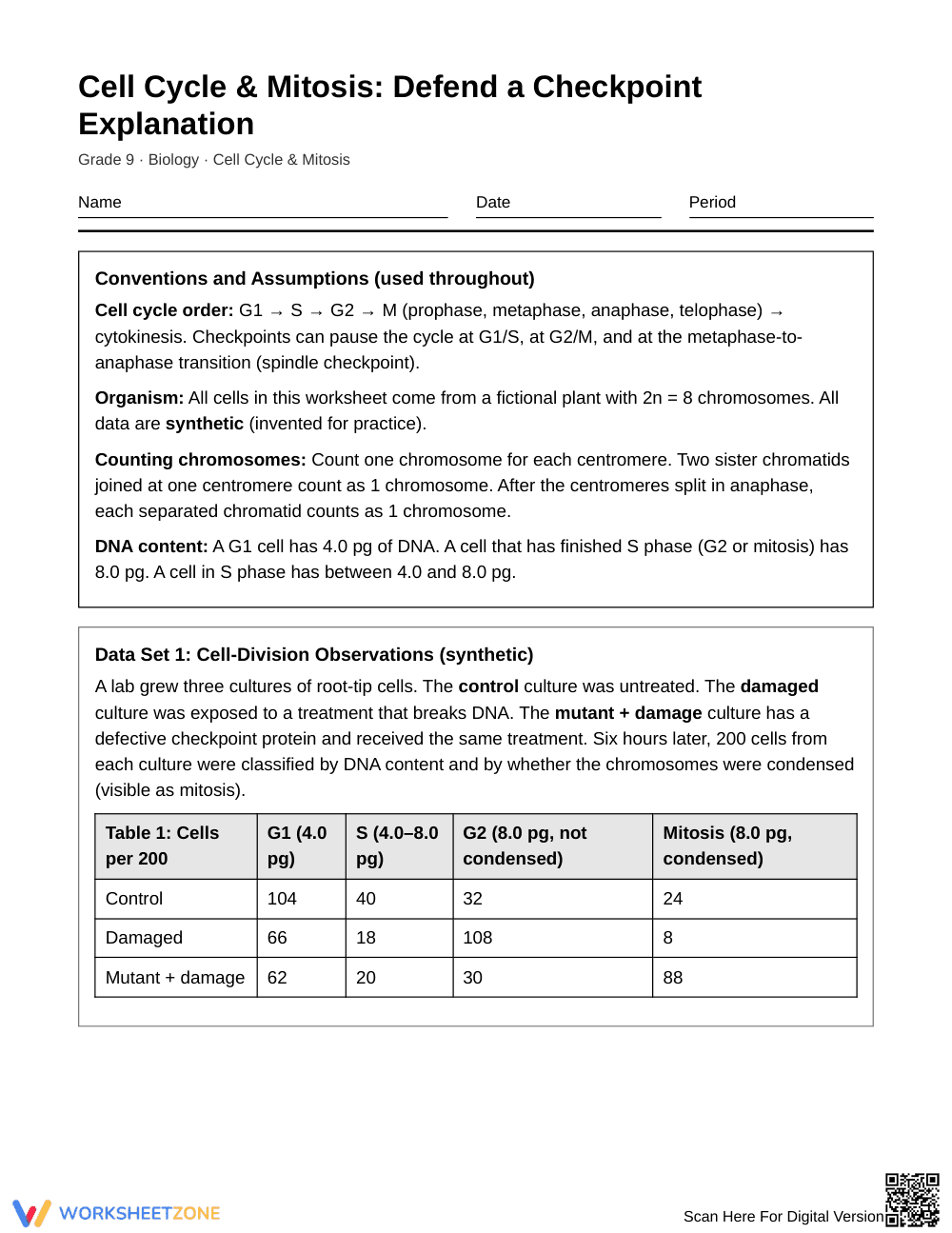
Five pages hold eight tasks in three parts, with an answer key included. A conventions box fixes the cell-cycle order, the chromosome-counting rules for a fictional plant with 2n = 8, and the DNA content values. Two synthetic data sets (cell-division counts and 48-hour growth records), a spindle-inhibitor table, and a six-statement evidence list supply the data students cite.
Skill Progression
- Guided practice (Part A, 2 tasks): Students pick the two most relevant statements from six and choose which cultures to compare. The evidence list limits their choices.
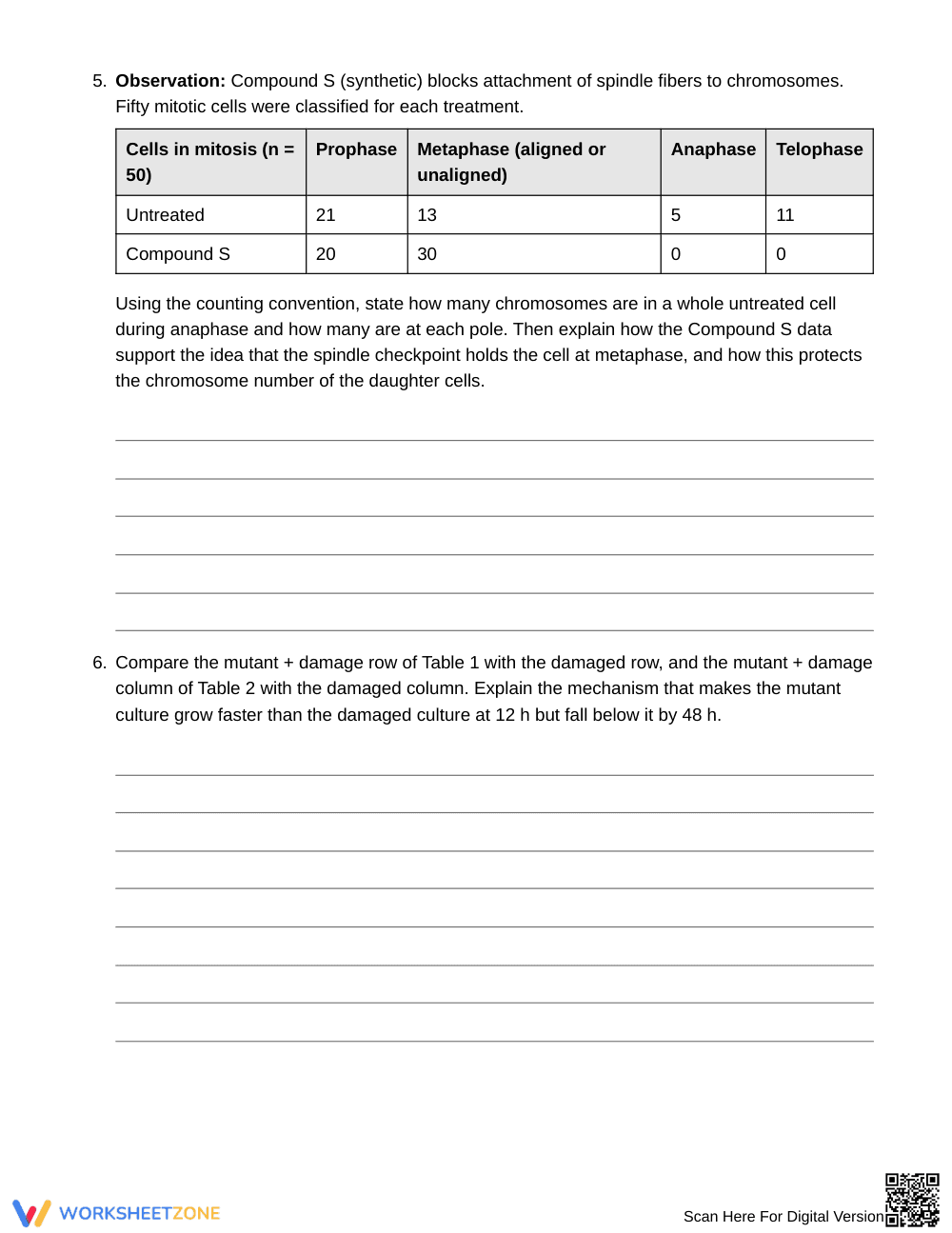
- Supported practice (Part B, 4 tasks): Students turn numbers into mechanisms, including 8.0 pg of DNA, doubling time, spindle-checkpoint counts, and mutant growth. The conventions box supports each calculation.
- Independent practice (Part C, 2 tasks): Students choose between competing claims and defend their choice with at least two or three data values.
The sequence follows gradual release: I Do, We Do, You Do.
Standards Alignment
No standard code is listed for this worksheet. The work fits the high school life science practice of constructing explanations from evidence, applied to cell cycle regulation: checkpoints at G1/S, G2/M, and metaphase-to-anaphase control division and protect chromosome number. Teachers can map it to their own state or district standards for mitosis and cell regulation.
How to Use It
Assign Parts A and B after direct instruction on checkpoints, as a guided check on whether students can connect data to mechanisms. Use Part C as a closing discussion or exit assessment after a mitosis lab or video. While students work, listen for whether they cite specific table values, such as 108 of 200 cells at G2, or only restate the claim. Expect 40–50 minutes in total.
Who It's For
Grade 9 Biology students in a cell cycle and mitosis unit who can read data tables. Students who need support can start with Part A and one Part B task, while advanced students can spend more time on Part C. Pair it with a cell-cycle anchor chart or a lesson on the stages of mitosis.
This Grade 9 Biology worksheet on the cell cycle and mitosis teaches students to defend a checkpoint explanation with data. Over five pages and eight tasks, students select relevant evidence, connect values such as 8.0 pg of DNA and 108 of 200 cells held at G2 to the G2/M checkpoint, and judge competing claims about growth in control, damaged, and checkpoint-mutant cultures. The tasks follow a gradual-release structure from guided evidence selection to independent argumentation, consistent with Fisher & Frey (2014), who describe gradual release of responsibility as a way to move learners from teacher-supported to independent performance. The data are synthetic and use a fictional plant with 2n = 8 chromosomes, so students practice reasoning rather than recalling facts. An answer key is included, and no standard code is assigned, so teachers can align the worksheet to local mitosis and cell regulation standards.


