




























Views
Downloads
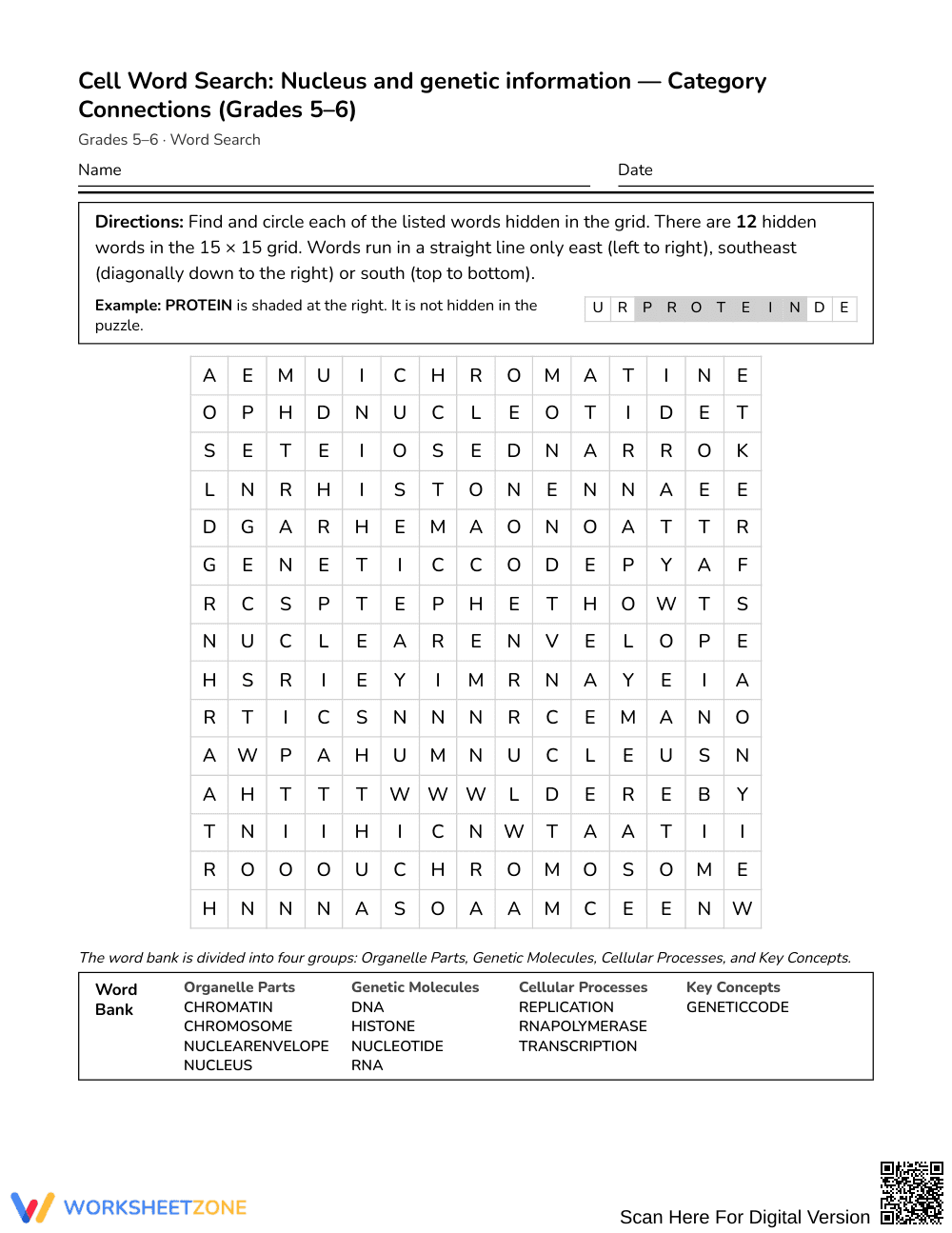

Printable Cell Nucleus Word Search | Grades 5–6 Science

Paste this activity's link or code into your existing LMS (Google Classroom, Canvas, Teams, Schoology, Moodle, etc.).
Students can open and work on the activity right away, with no student login required.
You'll still be able to track student progress and results from your teacher account.
This Grades 5–6 science word search reinforces foundational cellular biology vocabulary focused on the cell nucleus and genetic information. Students locate 12 essential terms organized into meaningful biological categories, solidifying their scientific spelling and recognition of key cellular structures, molecules, and hereditary processes during independent study or unit review.
At a Glance
- Grade: Grades 5–6 · Subject: Science (Life Science)
- Standard: Not standards-assessed — vocabulary enrichment
- Skill Focus: Nucleus structure, molecules, and genetic information
- Format: 1 printable page · 12 hidden words · 3-page answer key · PDF
- Best For: Independent vocabulary review, sub plans, and fast finishers
- Time: 15–20 minutes of focused work
What's Inside
This resource features a clean, single-page student puzzle accompanied by a comprehensive three-page solution set. Students search for 12 essential biological terms embedded across a structured grid. To promote cognitive organization rather than rote searching, the word bank is divided into four conceptual categories: Organelle Parts, Genetic Molecules, Cellular Processes, and Key Concepts. The multi-page solution packet illustrates letter coordinates and word paths clearly for rapid verification.
Puzzle Mechanics and Structure
The activity is built around an approachable 15 × 15 letter grid configured specifically for upper-elementary and middle school science learners. Words are hidden strictly in three forward reading orientations: East (horizontal left-to-right), Southeast (diagonal downward-right), and South (vertical downward). By excluding backward placements, the puzzle maintains an accessible, low-frustration threshold while reinforcing proper orthography. Learners scan the categorized bank to identify target vocabulary, linking organelle components to molecular genetics concepts.
Standards Alignment
This learning resource serves as targeted vocabulary enrichment rather than a formal standards-assessed measurement tool. It is designed without alignment to specific state performance expectations to give teachers maximum flexibility across general life science curricula, supplemental genetics lessons, or introductory cell biology units.
How to Use It
Deploy this word search during independent seatwork directly after introducing cellular anatomy or as an engaging warm-up before a genetics laboratory investigation. For formative assessment, observe whether students identify terms by recognizing full morphemes and structural roots rather than hunting randomly for single letters. The puzzle typically requires 15 to 20 minutes to complete.
Who It's For
This activity is designed for Grades 5–6 science students exploring cell theory, chromosomes, and molecular biology. It offers accessible enrichment for diverse learners, English language learners acquiring technical vocabulary, and fast finishers who benefit from structured word recognition. Pair this activity with an illustrated cell organelle anchor chart or an interactive notebook diagram of the nucleus.
Academic vocabulary acquisition in middle-grade life science demands repeated, contextual exposure to technical terms. While classified as not standards-assessed vocabulary enrichment, this puzzle targets nucleus and genetic information concepts by organizing 12 specialized terms into distinct conceptual categories. According to Fisher & Frey (2014), intentional word-learning tasks that require students to categorize domain-specific terminology strengthen long-term retention and reading comprehension in informational texts. By focusing on essential structures such as chromatin, nucleotides, and replication enzymes across a 15 by 15 letter matrix, learners reinforce biological spelling patterns and morphological awareness without cognitive overload. This targeted activity bridges the gap between initial direct instruction and advanced content mastery, providing educators with an efficient tool for low-stakes vocabulary consolidation. Teachers can reliably implement this exercise during introductory genetics units to ensure all students establish secure familiarity with foundational cellular terminology.


