
































Printable Cell Division Models Worksheet | Grade 9 Biology

Paste this activity's link or code into your existing LMS (Google Classroom, Canvas, Teams, Schoology, Moodle, etc.).
Students can open and work on the activity right away, with no student login required.
You'll still be able to track student progress and results from your teacher account.
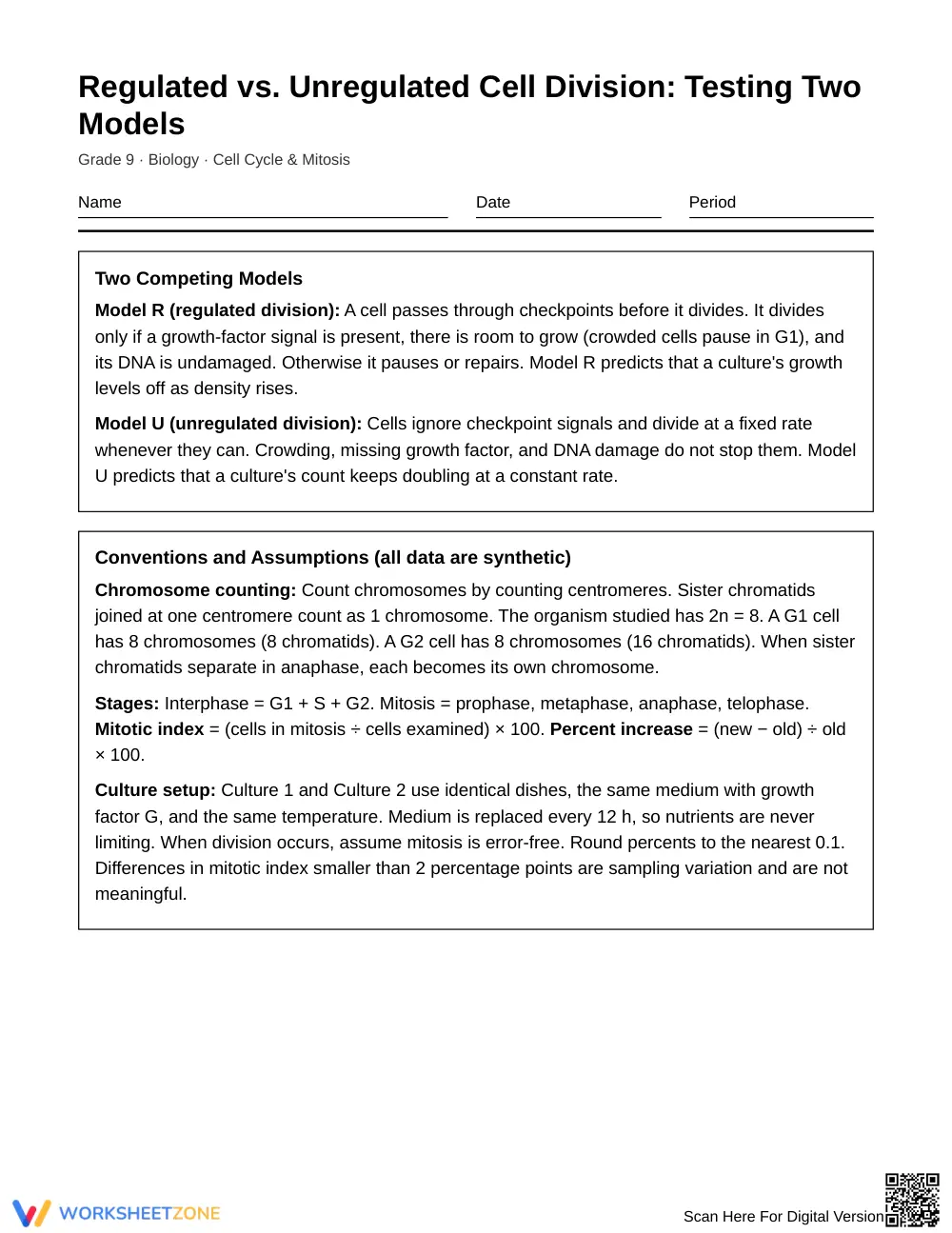
This worksheet helps Grade 9 biology students compare a regulated and an unregulated model of cell division using synthetic culture data. Students predict outcomes, choose controls, calculate mitotic index and percent increase, and judge which evidence actually separates the two models, building the reasoning behind checkpoints in the cell cycle.
At a Glance
- Grade: 9 · Subject: Biology
- Standard: No code assigned — compare two division models using data and checkpoint rules
- Skill Focus: Comparing regulated and unregulated division models
- Format: 5 pages · 10 problems · Answer key included · PDF
- Best For: Cell cycle regulation unit review
- Time: 40–50 minutes
What's Inside
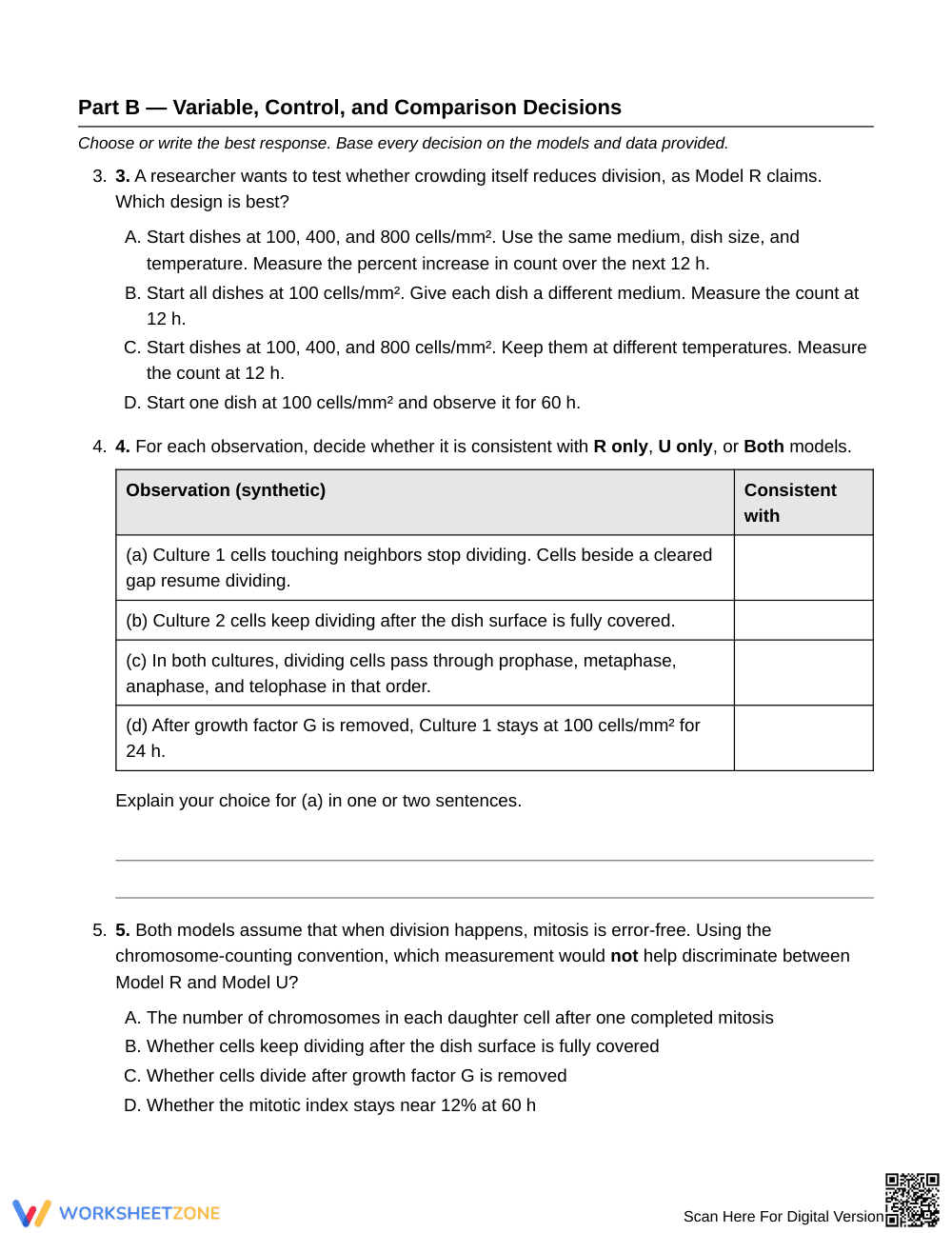
Five student pages open with a two-model summary, a conventions box (chromosome counting, formulas, culture setup), and a cell count table. Tasks include predictions, multiple choice, a classification table, a mitotic index table, variable identification, and short explanations. A 3-page answer key is included.
Skill Progression
- Guided practice (Tasks 1–2): Students predict culture counts using the pattern in the table and the stated model rules.
- Supported practice (Tasks 3–8): Students choose designs, classify observations, complete tables, name variables, and calculate percent increase with formulas provided.
- Independent practice (Tasks 9–10): Students judge which evidence discriminates between models and evaluate a student claim.
The sequence follows gradual release: I Do, We Do, You Do.
Standards Alignment
No standard code is attached to this worksheet. It targets the skill of using evidence to evaluate competing models of cell cycle regulation, including checkpoints, mitotic index, and experimental design. Skill descriptions can be copied directly into lesson plans, IEP goals, or district curriculum mapping tools.
How to Use It
- After direct instruction: Assign it as a unit review once students have met checkpoints and the stages of mitosis.
- During small-group work: Pairs complete Part B, then compare answers before Part C.
Formative tip: during Task 9, listen for students who confuse evidence that fits both models with evidence that separates them. Expect 40–50 minutes.
Who It's For
Grade 9 biology students in a cell cycle and mitosis unit. Students who need support can use the conventions box and work Tasks 1–4 first. Pair it with a checkpoint anchor chart.
The Grade 9 Biology worksheet Regulated vs. Unregulated Cell Division: Testing Two Models teaches students to compare two competing explanations of cell division using evidence. Across 10 tasks and 5 pages, students predict culture growth, identify independent and dependent variables, calculate mitotic index and percent increase, and decide which observations discriminate between a checkpoint-controlled model and an unchecked model. The data are synthetic, and the worksheet states its chromosome-counting and error-free-mitosis assumptions so students reason from stated rules. The task sequence follows the gradual release approach described by Fisher & Frey (2014), moving from guided prediction to independent evaluation of evidence. A 3-page answer key supports quick scoring and feedback. Teachers can use it after instruction on the cell cycle and checkpoints to check whether students understand that evidence discriminates only when two models predict different results. No standard code is assigned to this worksheet.


