




























Views
Downloads


Printable Cell Cycle Stages Worksheet | Grade 9 Biology

Paste this activity's link or code into your existing LMS (Google Classroom, Canvas, Teams, Schoology, Moodle, etc.).
Students can open and work on the activity right away, with no student login required.
You'll still be able to track student progress and results from your teacher account.
This Grade 9 Biology worksheet helps students distinguish the stages of the cell cycle and explain why cells divide. Students move from concept comparisons to data calculations and justified predictions, connecting chromosome and DNA counts to growth, repair, and maintenance.
At a Glance
- Grade: 9 · Subject: Biology
- Standard: Cell cycle and mitosis — compare stages, count chromosomes and DNA, and explain mitosis purposes
- Skill Focus: Cell-cycle stages and purposes
- Format: 5 pages · 12 problems · Answer key included · PDF
- Best For: Cell cycle unit practice and review
- Time: 40–50 minutes
What's Inside
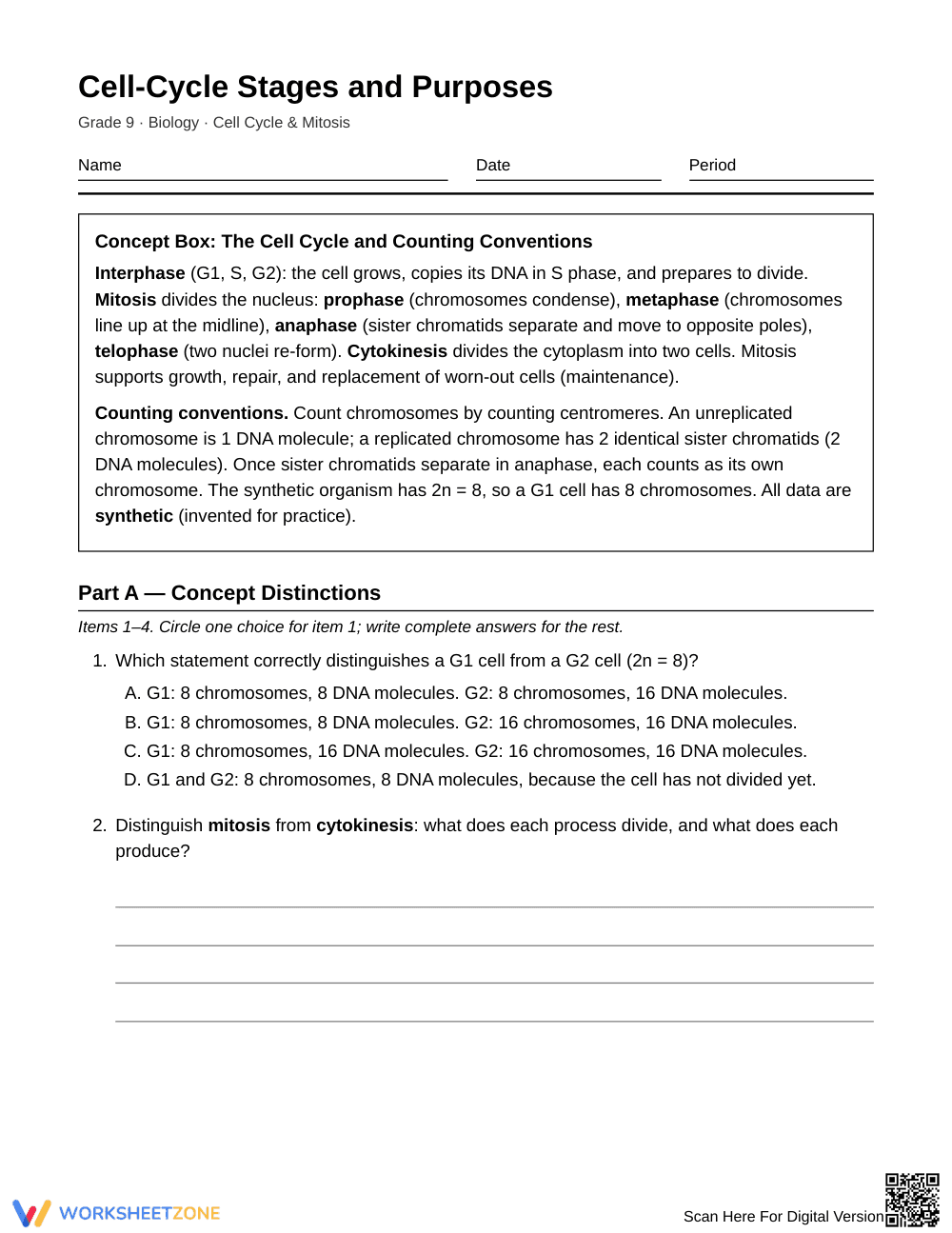
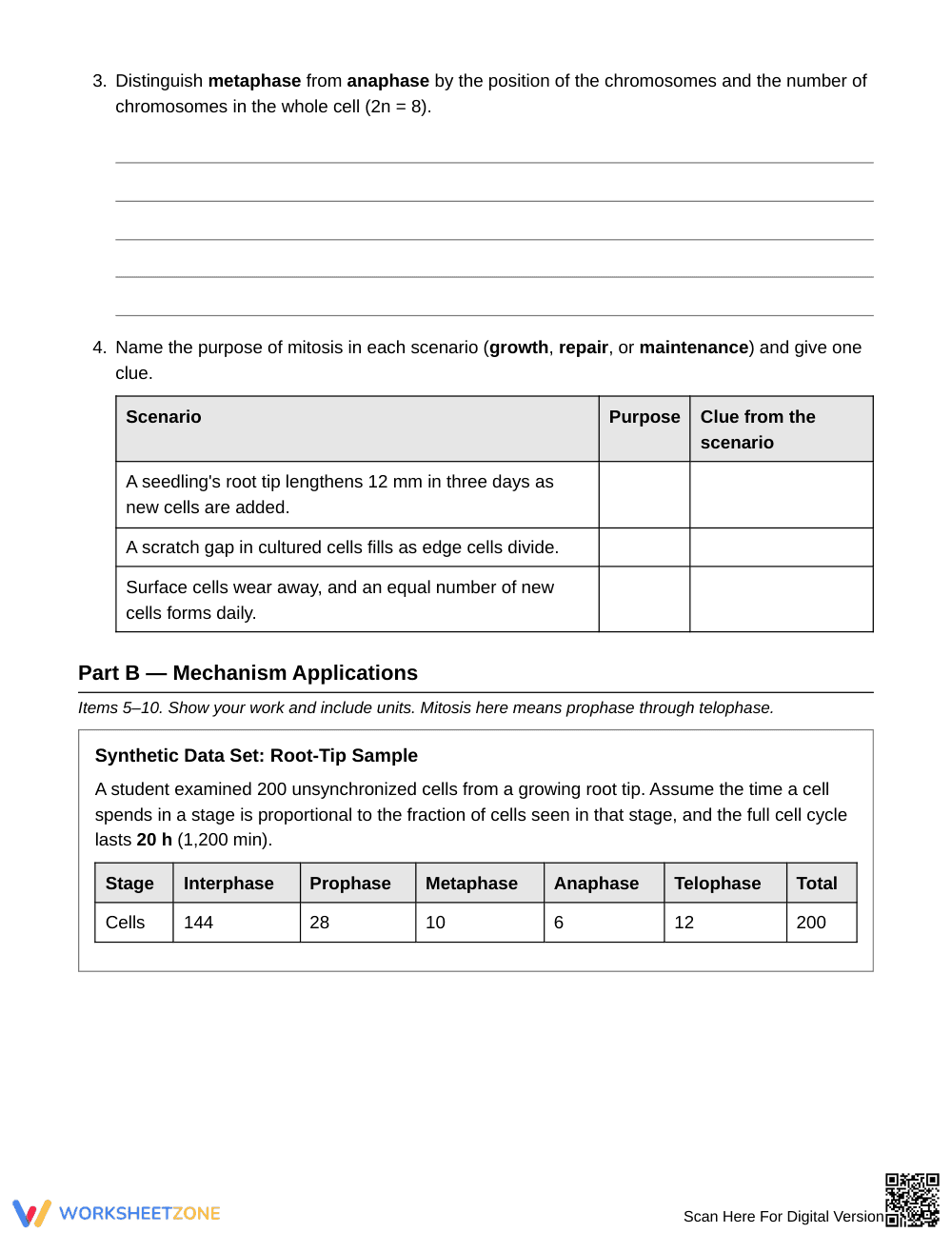
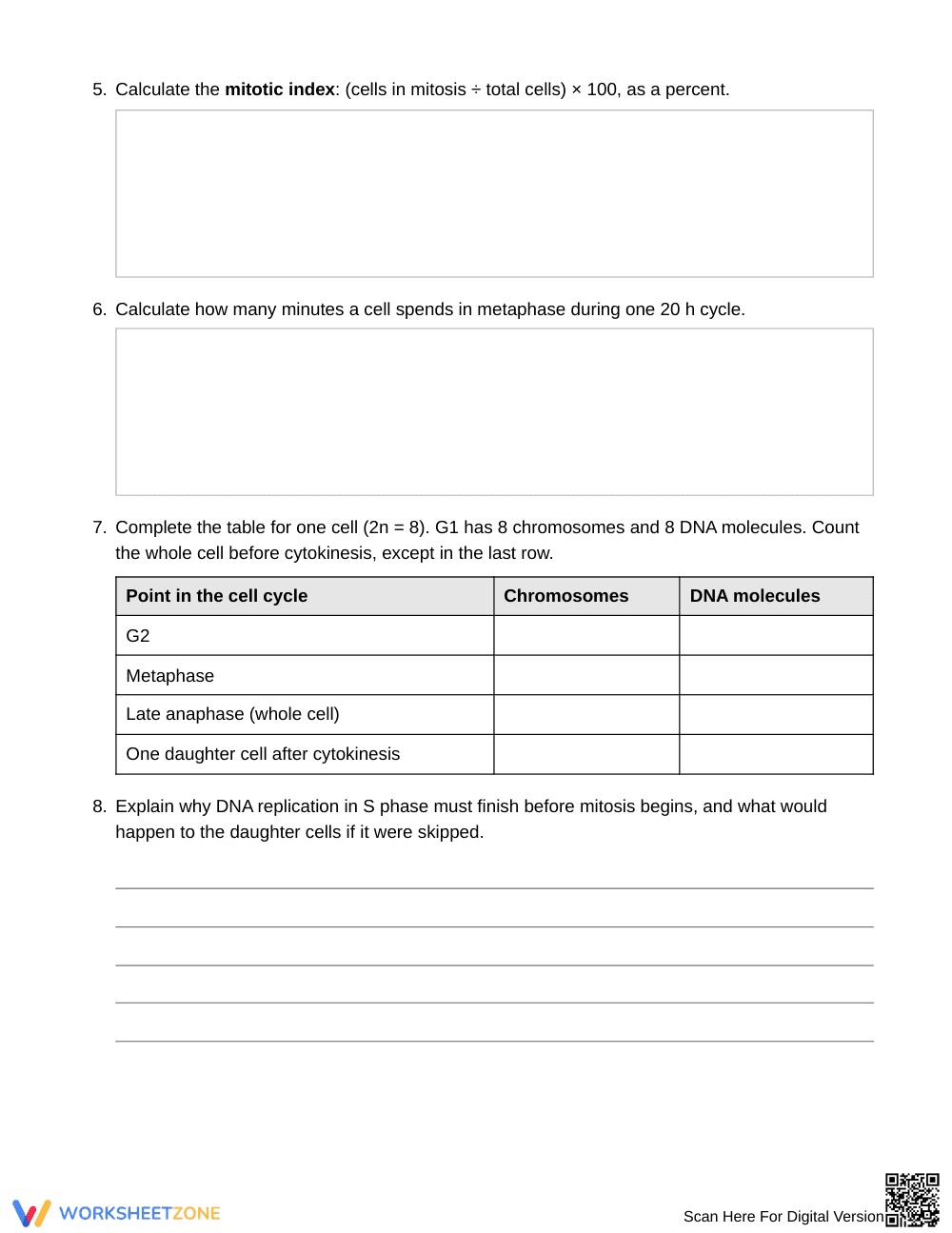
The worksheet has 12 tasks in three parts, on 5 pages with a 3-page answer key. A concept box states the counting conventions for a synthetic organism with 2n = 8: count centromeres, and treat sister chromatids as separate chromosomes after anaphase. Part A has a multiple-choice item, written distinctions, and a scenario table. Part B uses a 200-cell root-tip data set and a chromosome and DNA count table. Part C asks for predictions with justification.
Skill Progression
- Guided practice (items 1–4): concept distinctions with the concept box open, including G1 versus G2, mitosis versus cytokinesis, and metaphase versus anaphase.
- Supported practice (items 5–10): mitotic index, time in metaphase, chromosome and DNA counts, and culture growth, with data and formulas provided.
- Independent practice (items 11–12): predictions about two fictional treatments and two tissues, justified with stages and data.
This sequence follows gradual release: I Do, We Do, You Do.
Standards Alignment
No standard code was supplied for this worksheet. The tasks target the cell cycle: describing interphase, mitosis, and cytokinesis, and explaining how mitosis supports growth, repair, and maintenance. Add your own state or district standard code when you build lesson plans, IEP goals, or curriculum maps.
How to Use It
- After direct instruction: assign Parts A and B as in-class practice, about 30 minutes.
- As review before a quiz: assign Part C alone as a short written task, then discuss the predictions.
While students work, watch the G2 and late-anaphase rows of the count table. Errors there show whether students confuse chromosomes with DNA molecules. Expect 40–50 minutes for the full set.
Who It's For
Grade 9 Biology students in a cell cycle and mitosis unit. Students who need support can start with Part A and the concept box. Students ready for more can focus on the Part C justifications. It pairs well with a labeled diagram of the mitosis stages.
The Grade 9 Biology worksheet Cell-Cycle Stages and Purposes teaches students to distinguish interphase, mitosis, and cytokinesis and to explain why cells divide. Twelve tasks use a synthetic organism with 2n = 8 so students count chromosomes by centromeres and DNA molecules by chromatids, calculate a mitotic index from a 200-cell root-tip sample, and predict how drugs that block cytokinesis or spindle formation change cell number. The structure follows the gradual release of responsibility model described by Fisher & Frey (2014), moving from guided concept distinctions to supported calculations to independent justified predictions. Students connect mitosis to growth, repair, and maintenance while practicing quantitative reasoning. The packet runs 5 pages and includes a 3-page answer key, so teachers can check both numerical answers and written explanations. It suits first-year high school biology units on the cell cycle and mitosis.


