


























Views
Downloads
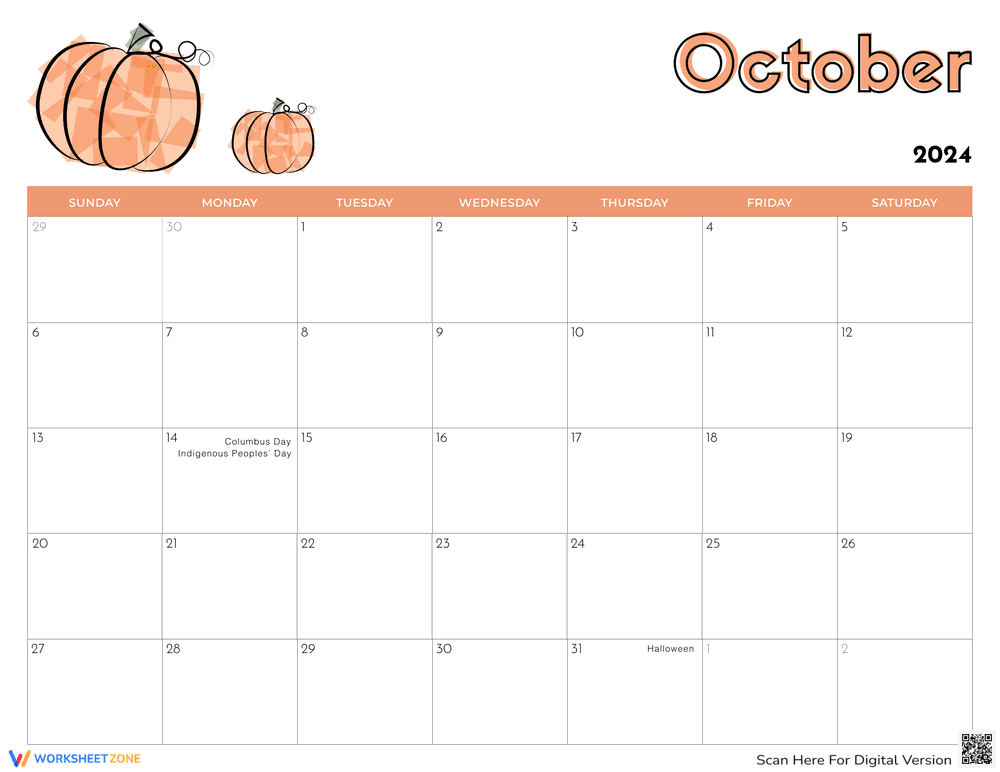

Printable October 2024 Calendar | Grade 1-5 Essential
Paste this activity's link or code into your existing LMS (Google Classroom, Canvas, Teams, Schoology, Moodle, etc.).
Students can open and work on the activity right away, with no student login required.
You'll still be able to track student progress and results from your teacher account.
This October 2024 calendar worksheet helps students master time management and date identification through daily scheduling. By tracking holidays and personal events, learners develop a concrete understanding of monthly cycles and chronological order. It provides a structured layout for students to organize their academic and extracurricular commitments effectively.
At a Glance
- Grade: 1-5 · Subject: Math / Life Skills
- Standard:
CCSS.MATH.CONTENT.2.MD.C.7— Tell and write time and understand calendar concepts for daily organization- Skill Focus: Calendar reading and scheduling
- Format: 1 page · 31 tasks · Answer key N/A · PDF
- Best For: Morning work or daily organizational habits
- Time: 5–10 minutes
What's Inside
This single-page PDF features a clean, October-themed layout with pumpkin graphics. It includes pre-marked holidays such as Indigenous Peoples' Day and Halloween to provide context. The large, open squares offer ample space for students to write in assignments, birthdays, or weather observations, making it a versatile tool for classroom management without the need for a separate answer key.
Zero-Prep Workflow
This resource is designed for immediate classroom implementation with minimal teacher oversight:
- Print: Send the October 2024 PDF to the printer for your entire class (20 seconds).
- Distribute: Pass out the sheets during your morning routine or transition period (40 seconds).
- Review: Briefly highlight the month's holidays and any upcoming school-wide events (40 seconds).
Total teacher preparation time is under 2 minutes, making this an excellent choice for emergency sub plans or last-minute organizational needs.
Standards Alignment
This resource aligns with CCSS.MATH.CONTENT.2.MD.C.7: "Tell and write time from analog and digital clocks to the nearest five minutes, using a.m. and p.m." While the standard focuses on clocks, calendar literacy is the essential prerequisite for understanding temporal intervals and chronological sequencing. This standard code can be copied directly into lesson plans, IEP goals, or district curriculum mapping tools.
How to Use It
Use this worksheet as a "Morning Meeting" anchor during the first week of the month. Have students find the current date and count how many days remain until Halloween to practice subtraction and interval counting. Alternatively, use it as a formative assessment tool to observe if students can correctly locate specific days of the week or identify the date of the third Monday. Expected completion time for daily updates is 5–10 minutes.
Who It's For
This worksheet is designed for elementary students in Grades 1 through 5 who are developing organizational skills. It is particularly helpful for students with executive functioning needs who benefit from visual schedules. Pair this with a daily weather chart or a "Days in School" anchor chart for a comprehensive morning routine that builds consistency.
According to the RAND AIRS 2024 report, integrating organizational tools like calendars into daily instruction significantly improves student self-regulation and time-awareness. This October 2024 calendar supports CCSS.MATH.CONTENT.2.MD.C.7 by providing a practical application for time-related concepts. Research from Fisher & Frey (2014) emphasizes that visual organizers help bridge the gap between abstract time concepts and concrete daily experiences. By engaging with 31 distinct date entries, students build the cognitive stamina required for long-term planning. This resource serves as a foundational element in a gradual release model of responsibility, where students eventually manage their own schedules independently. The inclusion of seasonal graphics and holidays increases student engagement, ensuring that the repetitive nature of calendar work remains interesting and relevant to their lives outside the classroom.


