































Printable Bread Comparison Word Search | Grades 7–8 ELA

Paste this activity's link or code into your existing LMS (Google Classroom, Canvas, Teams, Schoology, Moodle, etc.).
Students can open and work on the activity right away, with no student login required.
You'll still be able to track student progress and results from your teacher account.
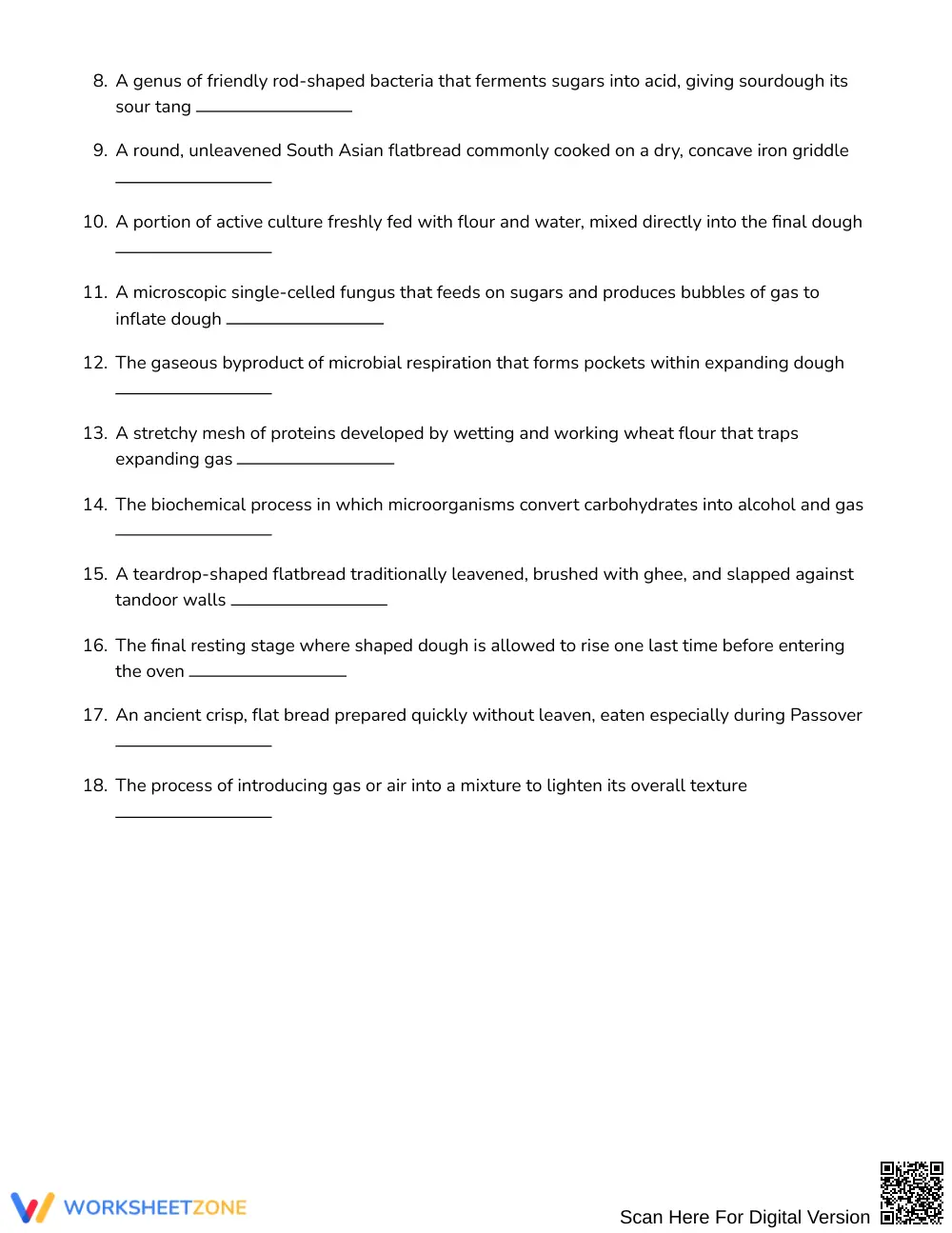
Students work through a focused vocabulary word search that reinforces the key differences between leavened and unleavened breads. By locating 18 culinary terms, learners solidify definitions, compare processes, and build language‑arts fluency while preparing for upcoming assessments in the classroom.
At a Glance
- Grade: Grades 7–8 · Subject: English Language Arts
- Standard:
Not standards-assessed — vocabulary enrichment— Identify and compare bread‑making terms to enrich culinary vocabulary- Skill Focus: Comparing leavened and unleavened breads
- Format: 3 pages · 18 words · Answer key included · PDF
- Best For: Quick vocabulary review in language arts
- Time: 5–10 minutes
Inside the three‑page packet you’ll find a 20 × 20 grid, eight directional options (N, NE, E, SE, S, SW, W, NW), a shuffled word bank, and clear clues for each term. An answer key on a separate page shows the exact locations of all 18 hidden words.
- Print: Open the PDF and print the 3‑page packet (under 30 seconds).
- Distribute: Hand copies to students and give the clue sheet (about 1 minute).
- Review: After completion, collect answer sheets and quickly check using the answer key (1–2 minutes).
Total teacher preparation time is typically under two minutes, making it ideal for a sub‑plan or spontaneous review.
This activity serves as a vocabulary enrichment exercise and is not aligned to any specific educational standard. It focuses on building academic language related to culinary concepts, supporting broader literacy goals.
Use the word search as a warm‑up before a lesson on food science to activate prior knowledge, or as a closing activity after a reading about cultural breads to reinforce terminology. While students work, note which terms they locate quickly for a quick formative snapshot; completion typically takes 5–10 minutes.
Designed for Grades 7–8 ELA learners, this word search supports both native‑English speakers and English‑language learners who need visual context for new vocabulary. Pair it with a short video on bread‑making or an anchor chart of leavening processes for added depth.
Research shows that targeted vocabulary activities boost content comprehension and retention. Fisher & Frey (2014) emphasize the power of explicit word study combined with contextual clues to deepen students’ academic language. This word search aligns with that approach by presenting 18 bread‑related terms, each paired with a concise definition that prompts learners to compare leavened and unleavened breads. The activity’s visual grid and directional search reinforce pattern recognition, while the answer key enables immediate feedback. By integrating culinary vocabulary into an engaging puzzle, teachers can enrich language arts instruction without adding extra instructional time. The concise format also supports English‑language learners, who benefit from repeated exposure to new terminology in a meaningful context. Additionally, the activity can be reused across semesters, allowing for cumulative review and reinforcing interdisciplinary connections between science and social studies.


