




























Views
Downloads
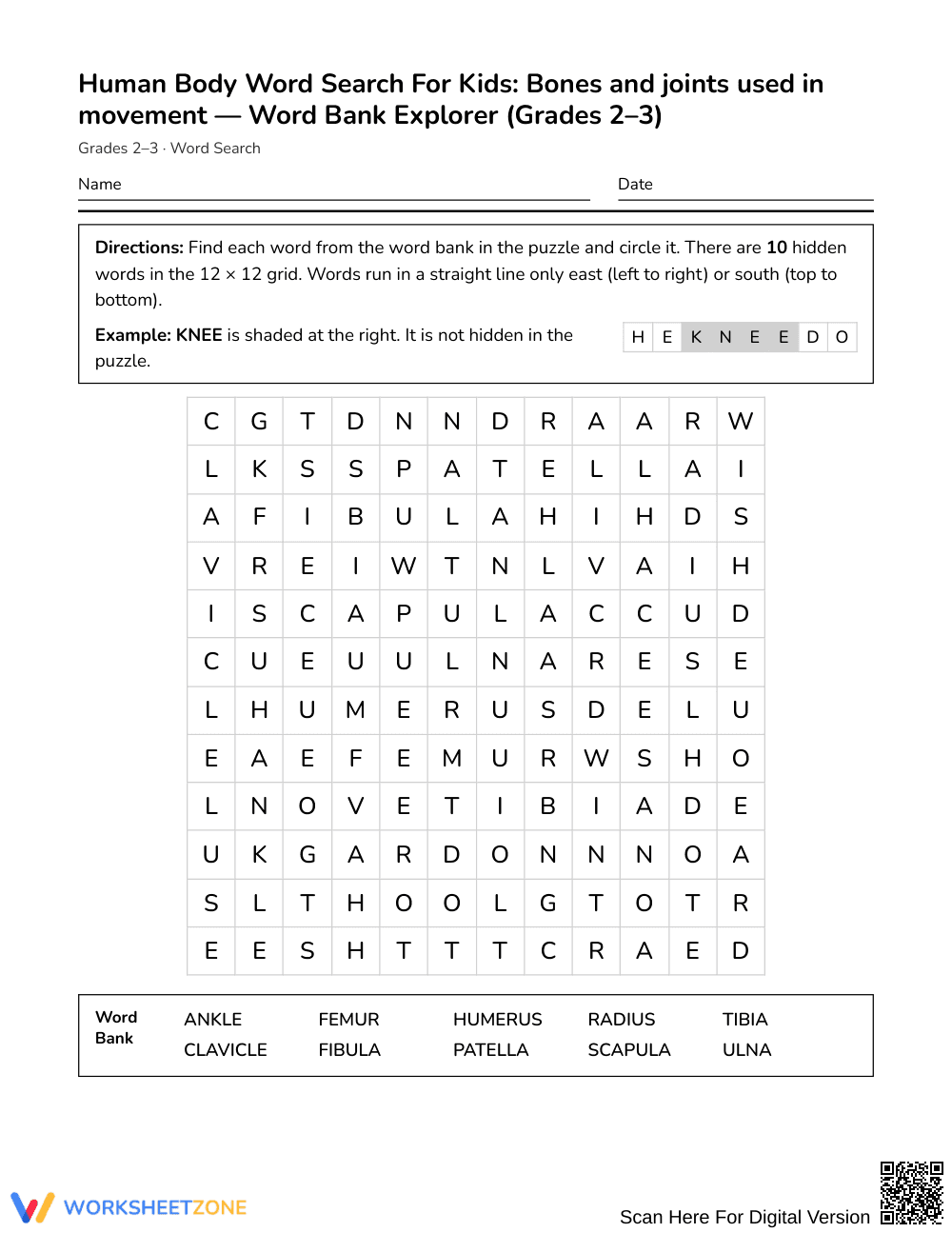

Printable Bones and Joints Word Search | Grades 2–3 Science

Paste this activity's link or code into your existing LMS (Google Classroom, Canvas, Teams, Schoology, Moodle, etc.).
Students can open and work on the activity right away, with no student login required.
You'll still be able to track student progress and results from your teacher account.
This skeletal system word search helps students master key vocabulary for bones and joints used in movement. Young learners identify and reinforce ten anatomical terms—including the femur, patella, and clavicle—solidifying scientific spelling and recognition. By connecting foundational terminology to bodily movement, students build the academic vocabulary necessary for elementary human biology units.
At a Glance
- Grade: Grades 2–3 · Subject: Science
- Standard: Not standards-assessed — vocabulary enrichment
- Skill Focus: Identifying major bones and joints used in human body movement
- Format: 1 printable student page · 10 hidden vocabulary words · 2-page answer key included · PDF document
- Best For: Skeletal system science vocabulary reinforcement and review
- Time: 15–20 minutes
What's Inside
This resource includes a 1-page student word search paired with a 2-page answer key featuring complete letter coordinates. The activity presents 10 target vocabulary words displayed in an alphabetical word bank to support visual scanning and tracking. Students locate anatomical terms within a clearly formatted puzzle grid, reinforcing word recognition without visual clutter. The accompanying answer key provides highlighted solutions for every target term, making self-checking and grading straightforward.
Puzzle Structure and Mechanics
The puzzle is built on an accessible 12 × 12 letter grid designed specifically for early elementary learners. All 10 hidden terms run exclusively in two beginner-friendly directions: East (left-to-right) and South (top-to-bottom). By omitting backwards and diagonal orientations, the activity reduces visual frustration while maintaining cognitive focus on orthographic patterns. Students reference an alphabetical word bank to systematically locate each bone and joint term across the grid.
Standards Alignment
This word search serves strictly as science vocabulary enrichment and is not aligned to a formal state or national content standard. It is designed to supplement elementary life science instruction by reinforcing core anatomical terms rather than assessing conceptual standards or performance expectations.
How to Use It
Use this word search during independent practice after direct instruction on the human skeleton, giving students an engaging way to reinforce anatomical vocabulary. Alternatively, assign it as a low-stakes warm-up before a lesson on joints and locomotion to activate prior knowledge. During the activity, circulate and observe whether students cross-reference the alphabetical bank systematically or struggle with left-to-right scanning, which provides formative insight into visual tracking and spelling fluency. The activity typically takes 15 to 20 minutes to complete.
Who It's For
This activity is designed for students in Grades 2–3 studying life science and the human body. It is particularly effective for emerging readers and English language learners who benefit from orthographic repetition and clean grid layouts. For differentiated support, pair this printable with an illustrated skeletal system anchor chart so students can connect bone names to their anatomical positions.
This Grades 2–3 science word search strengthens foundational biology vocabulary by guiding students to locate and identify 10 key terms representing bones and joints used in movement. Because the activity focuses on orthographic familiarization and spelling retention, it is categorized as vocabulary enrichment rather than a standards-assessed task. Research by Fisher & Frey (2014) emphasizes that intentional exposure to domain-specific terminology across varied print formats solidifies academic language acquisition and supports reading comprehension in early elementary science contexts. By navigating a simplified 12 × 12 grid featuring East and South orientations alongside an alphabetical word bank, students practice systematic visual scanning and letter analysis in a structured, accessible format. The included 2-page answer key enables immediate verification, ensuring that young learners develop anatomical fluency while reinforcing foundational literacy habits essential for future biological studies.


