





























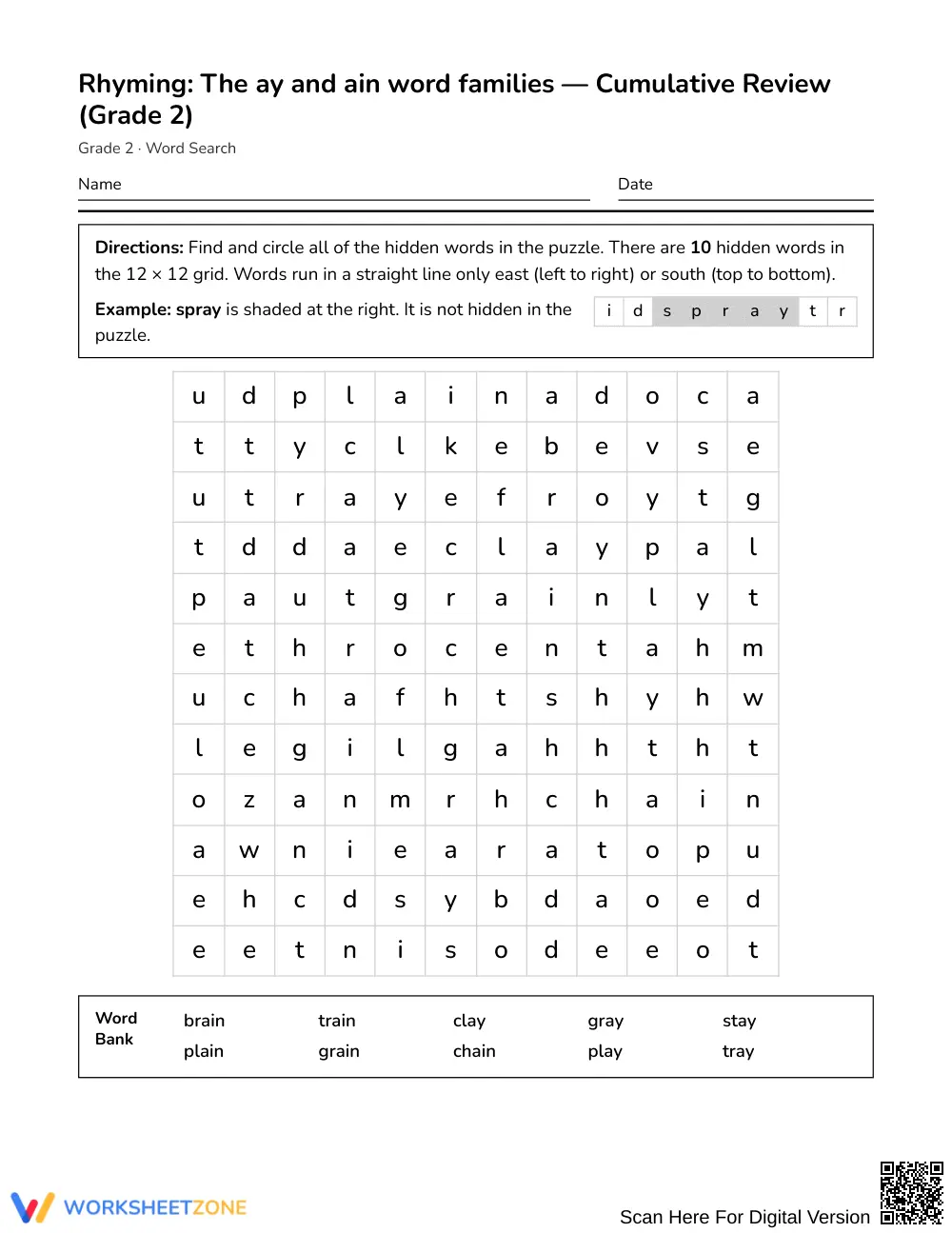


Printable ay and ain Word Search | Grade 2 ELA

Paste this activity's link or code into your existing LMS (Google Classroom, Canvas, Teams, Schoology, Moodle, etc.).
Students can open and work on the activity right away, with no student login required.
You'll still be able to track student progress and results from your teacher account.
This Grade 2 English Language Arts word search builds phonics familiarity by guiding students through target rhyming patterns in the ay and ain word families. Learners identify and locate 10 rhyming words within a structured letter grid, reinforcing long vowel spelling patterns without requiring teacher preparation.
At a Glance
- Grade: Grade 2 · Course: English Language Arts (ELA)
- Standard: Not standards-assessed — vocabulary enrichment and spelling practice
- Skill Focus: Long vowel sounds in ay and ain rhyming word families
- Format: 1 page · 10 hidden words · Full answer key included · PDF
- Best For: Independent phonics centers and morning review
- Time: 15–20 minutes
What's Inside
This single-page puzzle contains 10 target vocabulary words alongside a two-page answer key for rapid verification. Students work with five -ay words (clay, gray, play, stay, tray) and five -ain words (brain, chain, grain, plain, train). Each word includes a concise definition clue, connecting orthographic patterns to word meaning.
Puzzle Mechanics and Structure
The puzzle features a 12 x 12 letter grid tailored for Grade 2 readers. Words run only left-to-right (East) and top-to-bottom (South), avoiding backward or diagonal directions. The word bank lists all 10 terms with kid-friendly definition clues, supporting visual scanning and print tracking across each line.
Standards Alignment
This word search serves as a vocabulary enrichment activity and is not aligned to a specific standard. While it reinforces long vowel recognition, it is designed for low-stakes practice rather than formal mastery assessment.
How to Use It
Assign this activity after direct instruction on vowel teams as an independent reinforcement center. Alternatively, use it as a calm morning warm-up before spelling lessons. During completion, observe whether students scan sequentially by consonant blends or search unsystematically, giving quick pointers on tracking. Most students finish within 15 to 20 minutes.
Who It's For
This resource is built for Grade 2 students practicing rhyming patterns and vowel team decoding. English language learners also benefit from the paired definition clues. For students needing differentiation, highlight the starting letters first. Pair this puzzle with an interactive vowel team anchor chart.
Orthographic mapping and word family recognition provide crucial support for early elementary reading automaticity. According to research synthesized by Fisher & Frey (2014), purposeful word study that couples visual letter search with semantic cues reinforces phoneme-grapheme correspondences without imposing extraneous cognitive load on developing decoders. This Grade 2 vocabulary enrichment resource focuses specifically on the rhyming ay and ain word families, presenting ten high-frequency target words across a structured twelve-by-twelve grid. By directing search trajectories exclusively from left to right and top to bottom, the activity reinforces foundational print tracking while embedding vocabulary definitions for every term. Rather than functioning as a high-stakes assessment, this zero-prep puzzle delivers low-anxiety practice that strengthens orthographic familiarity and rime identification. Teachers can readily incorporate this independent review task into literacy rotations, intervention blocks, or morning work to support ongoing phonics development.


