




























Views
Downloads
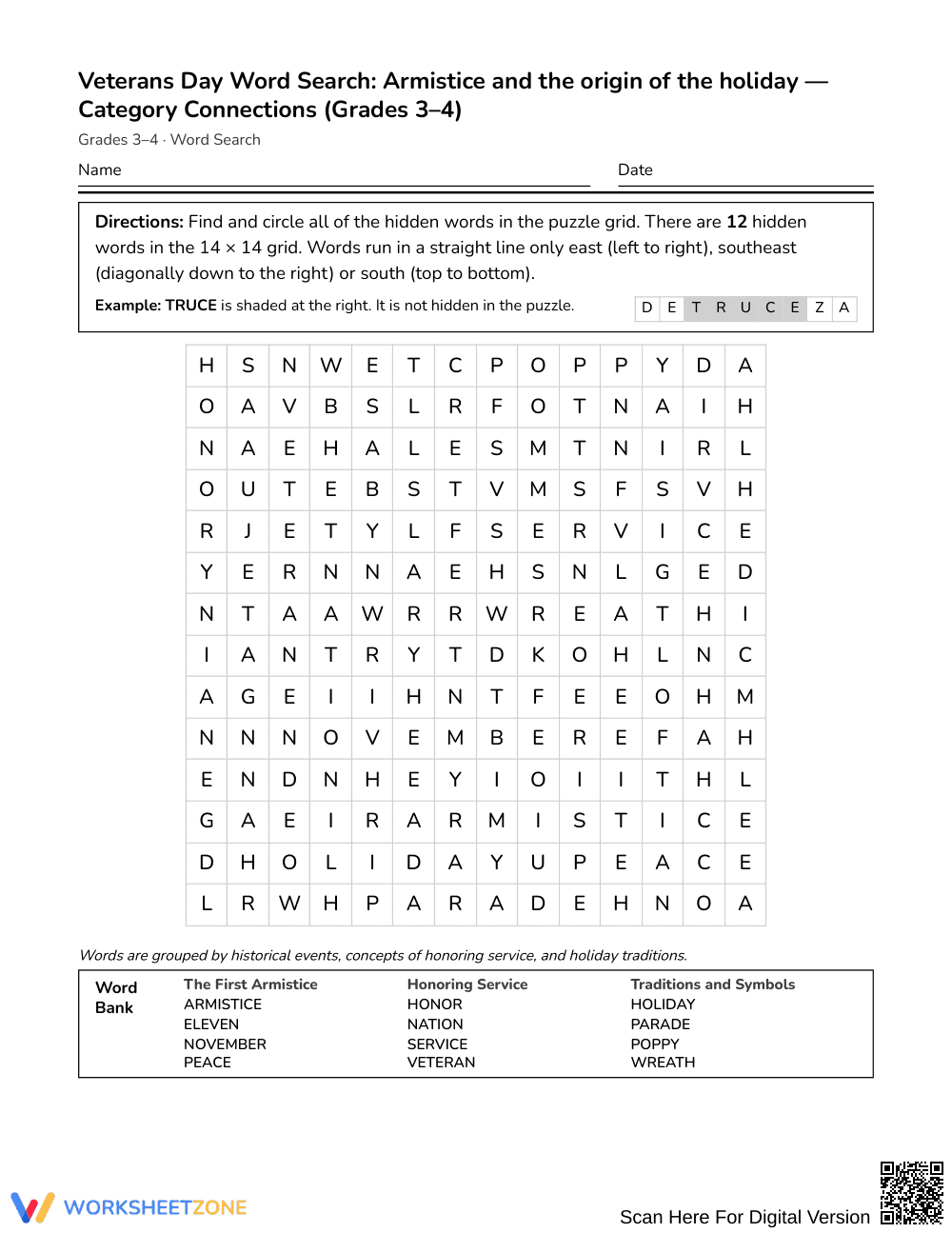

Printable Armistice Word Search | Grades 3–4 Social Studies

Paste this activity's link or code into your existing LMS (Google Classroom, Canvas, Teams, Schoology, Moodle, etc.).
Students can open and work on the activity right away, with no student login required.
You'll still be able to track student progress and results from your teacher account.
This Grades 3–4 social studies word search reinforces foundational vocabulary surrounding the historic 1918 armistice and the modern origin of Veterans Day. Learners locate 12 essential terms organized into thematic categories, helping them connect World War I armistice events, traditions of remembrance, and civic concepts of honoring military service through engaging word recognition.
At a Glance
- Grade: Grades 3–4 · Subject: Elementary Social Studies
- Standard: Not standards-assessed — targeted vocabulary enrichment and historical concept review
- Skill Focus: Armistice history and the origin of the holiday
- Format: 1 student page · 12 hidden words · Full answer key included · PDF format
- Best For: Veterans Day historical vocabulary review, morning work, or substitute lesson plans
- Time: 15–25 instructional minutes
What's Inside
The activity provides a single-page word search featuring 12 historical terms alongside a three-page answer key. The word bank arranges terms into three thematic clusters: historical armistice events, concepts of honoring service, and holiday traditions. Each term includes a concise clue definition clarifying key historical concepts such as the eleventh-hour armistice truce and the remembrance poppy.
Puzzle Structure and Mechanics
This puzzle is constructed on a 14 by 14 letter grid designed for elementary learners. Hidden words run in three directions: east (horizontal), southeast (diagonal), and south (vertical). Students use the categorized word bank to locate each term across the grid without encountering reverse or upward placements, making the search accessible and rewarding.
Standards Alignment
This activity serves as supplemental vocabulary enrichment and is not aligned to a specific state or national content standard. It is designed to reinforce essential domain-specific historical terminology during social studies instruction, Veterans Day observances, or World War I units without requiring formal standards-based reporting.
How to Use It
Integrate this word search immediately following direct instruction on the 1918 armistice to reinforce new terms. Alternatively, assign it as a morning warm-up during Veterans Day week. During work time, observe whether students connect thematic groupings, such as linking the word eleven to the historic armistice date. Most students finish within 15 to 25 minutes.
Who It's For
This resource is designed for Grades 3–4 students studying American history or civic holidays. It supports developing readers and multilingual learners through categorized word banks and concise definitions. Pair this puzzle with a Veterans Day read-aloud or a classroom anchor chart detailing the 1918 armistice timeline.
Vocabulary enrichment activities that categorize domain-specific words support conceptual retention in elementary social studies. Fisher & Frey (2014) demonstrate that structured word exposure paired with thematic organization accelerates content-area language acquisition and reading comprehension among developing intermediate readers. By organizing 12 historical terms into meaningful clusters—including the 1918 armistice truce, civic concepts of service, and cultural remembrance traditions—this activity bridges foundational historical knowledge and lexical awareness. Students encounter key terms such as armistice, veteran, and poppy within defined contexts, reinforcing the chronological and civic significance of the holiday. Because the puzzle operates as targeted vocabulary enrichment rather than a formal standards-assessed measure, educators can deploy it flexibly during holiday observances or introductory history units. The explicit semantic groupings reinforce conceptual associations, enabling third and fourth graders to build the background vocabulary necessary for deeper historical inquiry and informational text analysis.


