




























Views
Downloads
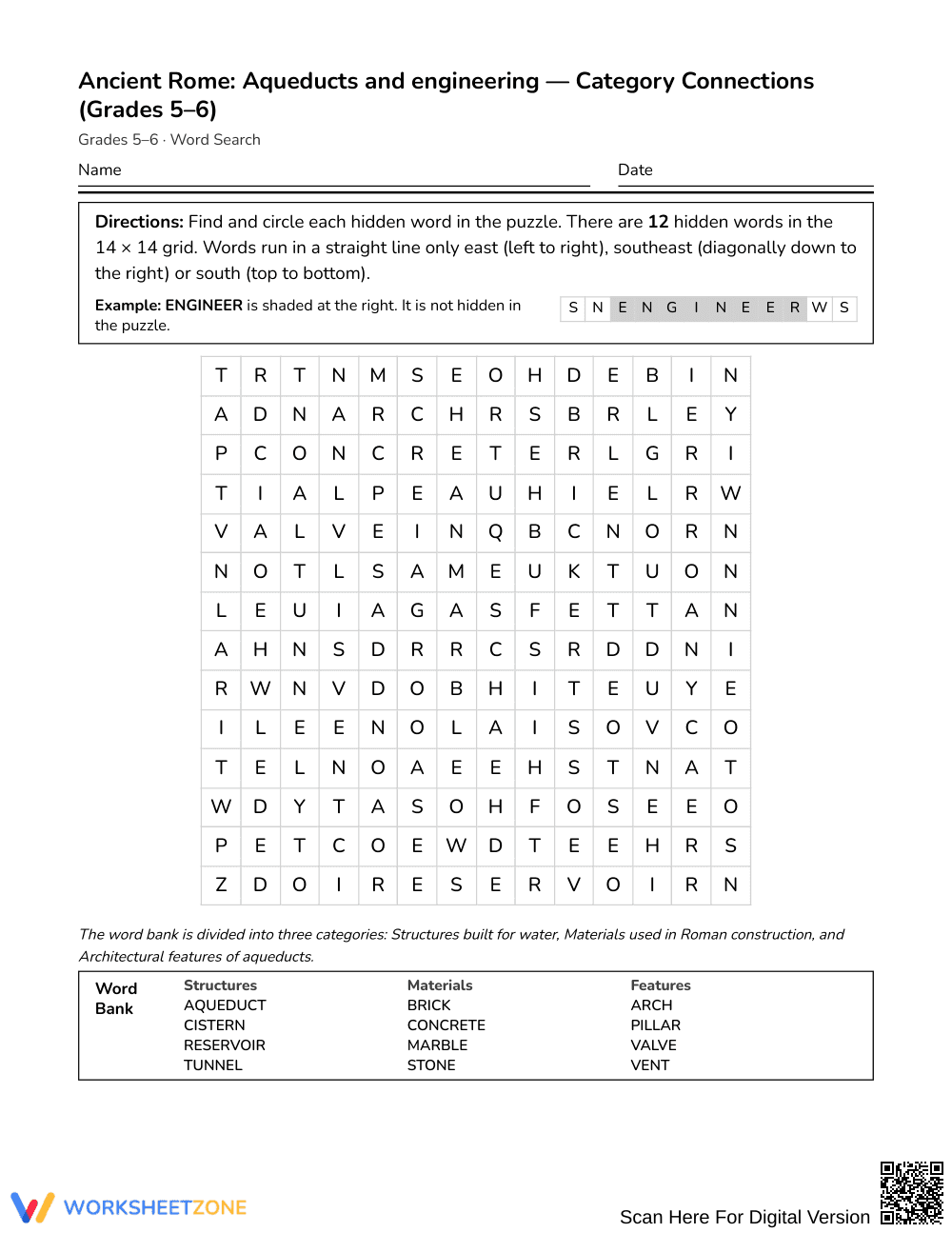

Printable Aqueducts Word Search | Grades 5–6 Social Studies

Paste this activity's link or code into your existing LMS (Google Classroom, Canvas, Teams, Schoology, Moodle, etc.).
Students can open and work on the activity right away, with no student login required.
You'll still be able to track student progress and results from your teacher account.
This ancient Rome word search reinforces key vocabulary regarding Roman aqueducts and civil engineering for Grades 5–6 students. Learners locate 12 specialized terms categorized by structures, materials, and architectural features. The activity builds foundational historical terminology, helping students recognize how Roman builders transported fresh water across vast distances to support growing urban populations.
At a Glance
- Grade: Grades 5–6 · Subject: Social Studies
- Standard: Not standards-assessed — vocabulary enrichment
- Skill Focus: Roman aqueducts and engineering vocabulary
- Format: 1 page · 12 words · Answer key included · PDF
- Best For: Vocabulary warm-up, early finishers, sub plans
- Time: 15–25 minutes
This single-page printable activity features a clean 14-by-14 letter grid containing 12 historical vocabulary terms. Rather than an unorganized alphabetical list, the word bank is organized into three conceptual categories: structures built for water, materials used in Roman construction, and architectural features of aqueducts. The resource also includes a clear, full-page answer key showing exact letter coordinates and word placements for efficient grading or student self-checking.
The word search employs a 14-by-14 letter grid designed specifically for intermediate learners. All 12 hidden words run in three forward-facing orientations: East (horizontal left-to-right), Southeast (diagonal downward), and South (vertical downward). By avoiding backward or upward letter placements, the puzzle maintains an accessible yet engaging challenge level. Students locate four structures (such as cistern and reservoir), four building materials (including concrete and brick), and four engineering features (such as arch and pillar).
This resource serves as targeted vocabulary enrichment for world history units and is not aligned to a formal academic standard. It supports domain-specific language acquisition by connecting engineering terms directly to classical Roman civilization studies.
Introduce this word search at the beginning of an ancient Rome unit as an introductory hook to build familiarity with specialized architectural terms before direct instruction on Roman technology. Alternatively, deploy it after a lesson on urban infrastructure to consolidate domain knowledge as an independent closing task. While students search the grid, circulate to observe whether they can explain the historical function of structural elements like arches and cisterns. Most learners complete the activity in 15 to 25 minutes.
This word search is designed for Grades 5–6 social studies students studying ancient Mediterranean civilizations and classical engineering. For English language learners or students needing additional support, teachers can pair the categorized word bank with visual flashcards illustrating arches, aqueduct channels, and concrete construction. The puzzle pairs naturally with direct instruction lessons on Roman infrastructure or primary-source readings examining how Roman cities managed daily water supplies.
Explicit exposure to categorized domain-specific vocabulary strengthens conceptual retention and reading comprehension in upper elementary and middle school social studies. Research synthesized by Fisher & Frey (2014) highlights that intentional word study and relational grouping enable learners to build robust mental schemata for complex historical systems. When fifth and sixth grade students engage with specialized terminology such as concrete, cistern, and arch through thematic classification, they transition from passive memorization to relational understanding of Roman engineering achievements. Incorporating 12 focused terms across structural, material, and functional categories provides structured language support without overwhelming working memory. The 14-by-14 puzzle design directs student attention to word spelling and orthographic patterns through forward orientations, establishing lexical familiarity that directly enhances subsequent informational text comprehension. Systematic vocabulary practice thus equips learners with the disciplinary literacy necessary to evaluate how historical infrastructure projects transformed ancient urban society.


