































Printable ake & ate Word Family Word Search | Grade 2 ELA

Paste this activity's link or code into your existing LMS (Google Classroom, Canvas, Teams, Schoology, Moodle, etc.).
Students can open and work on the activity right away, with no student login required.
You'll still be able to track student progress and results from your teacher account.
This Grade 2 phonics word search strengthens recognition of the common -ake and -ate word families through an engaging listening challenge. Second-grade learners practice identifying rhyming patterns and spelling structures as they locate target phonics words. The activity promotes active listening, phonemic awareness, and orthographic mapping without requiring any advance preparation.
At a Glance
- Grade: Grade 2 · Subject: English Language Arts (ELA)
- Standard: Not standards-assessed — vocabulary enrichment
- Skill Focus: the ake and ate word families
- Format: 2 pages · 8 words · Answer key included · PDF
- Best For: Phonics warm-up and morning work
- Time: 15–20 minutes
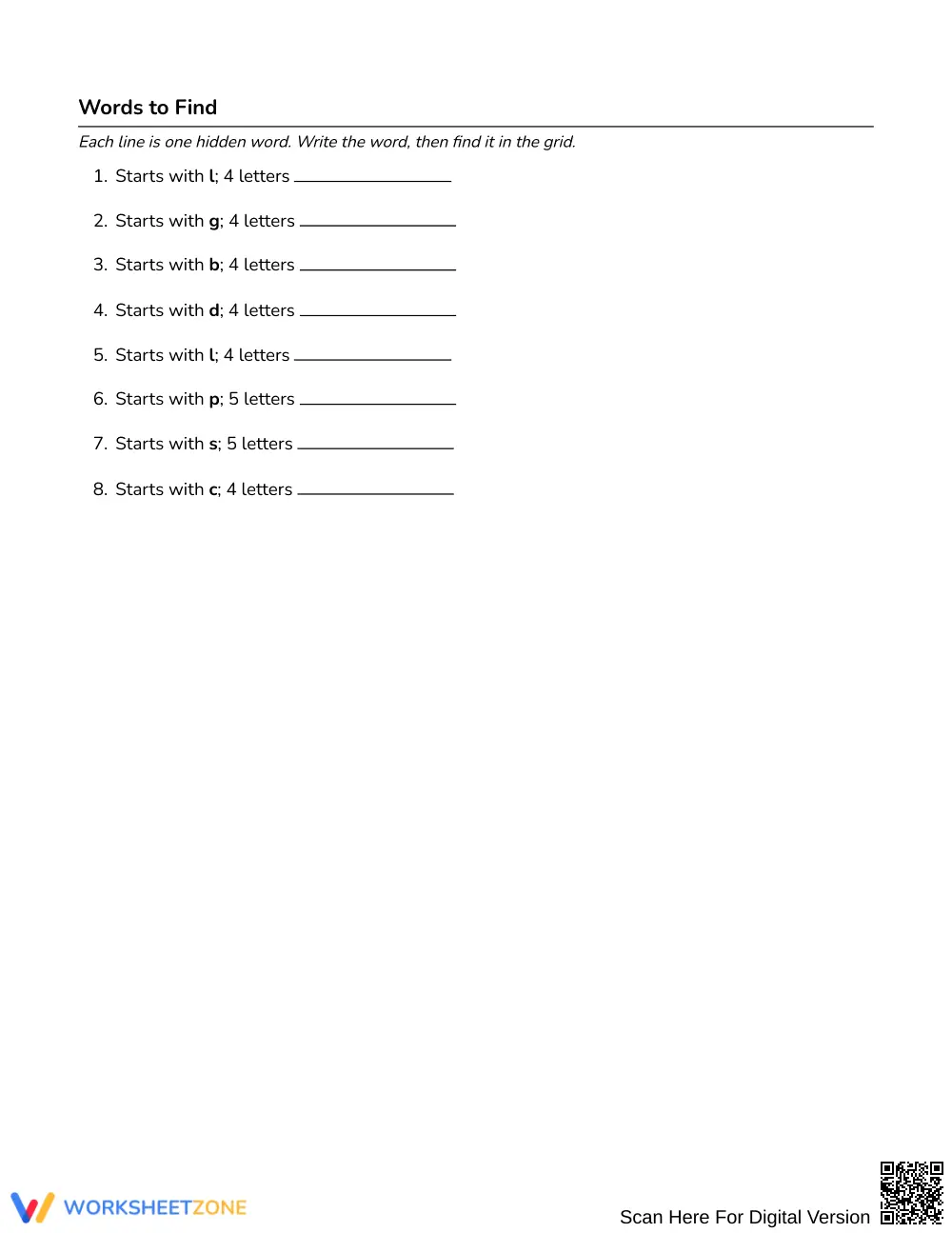
What's Inside: A 2-page print-and-go PDF containing a clean letter grid alongside teacher-led rhyming definitions. Because this challenge features no printed word bank, students listen to auditory clues to determine each target word before searching. A complete 2-page answer key highlighting all letter coordinates is included for rapid visual checking.
Puzzle Mechanics and Design
This puzzle presents 8 target vocabulary words arranged inside a clear 10 x 10 letter grid. Hidden words run strictly east (left-to-right) and south (top-to-bottom), ensuring developmental appropriateness for early elementary readers. Because there is no visible word bank, learners rely on auditory clues read by the teacher, challenging students to deduce each rhyming word before locating it in the puzzle.
Standards Alignment
This resource serves as supplemental vocabulary enrichment and is not aligned to a specific academic standard. It provides foundational reinforcement of long vowel phonogram patterns to support ongoing early literacy instruction.
How to Use It
Deploy this activity during small-group phonics rotations or as an interactive whole-class warm-up after direct instruction on silent-e patterns. Read the definition aloud, allow students to identify the rhyming word, and give them two minutes to scan the grid. Formatively observe whether students scan sequentially across rows and down columns or search randomly. Expect completion within 15 to 20 minutes.
Who It's For
This printable activity is designed for Grade 2 students practicing long vowel phonics patterns and rime analogies. It works smoothly for general education classes, speech-language listening sessions, and English language learners needing auditory vocabulary reinforcement. Pair this puzzle with a decodable rhyming text or an anchor chart displaying common silent-e phonograms.
Orthographic pattern recognition plays a foundational role in early elementary reading fluency. According to Fisher & Frey (2014), purposeful word-study activities that combine auditory processing with visual pattern identification help young readers consolidate phoneme-grapheme correspondences into long-term memory. This 8-word puzzle reinforces high-frequency rimes through focused listening rather than passive letter copying, helping Grade 2 students build systematic orthographic maps. The deliberate constraint of horizontal and vertical search paths respects developmental scanning capacities while encouraging methodical visual search routines. When educators pair verbal context clues with orthographic searches, emerging readers form stronger semantic and phonological representations for recurring spelling families like -ake and -ate.


