


























Views
Downloads
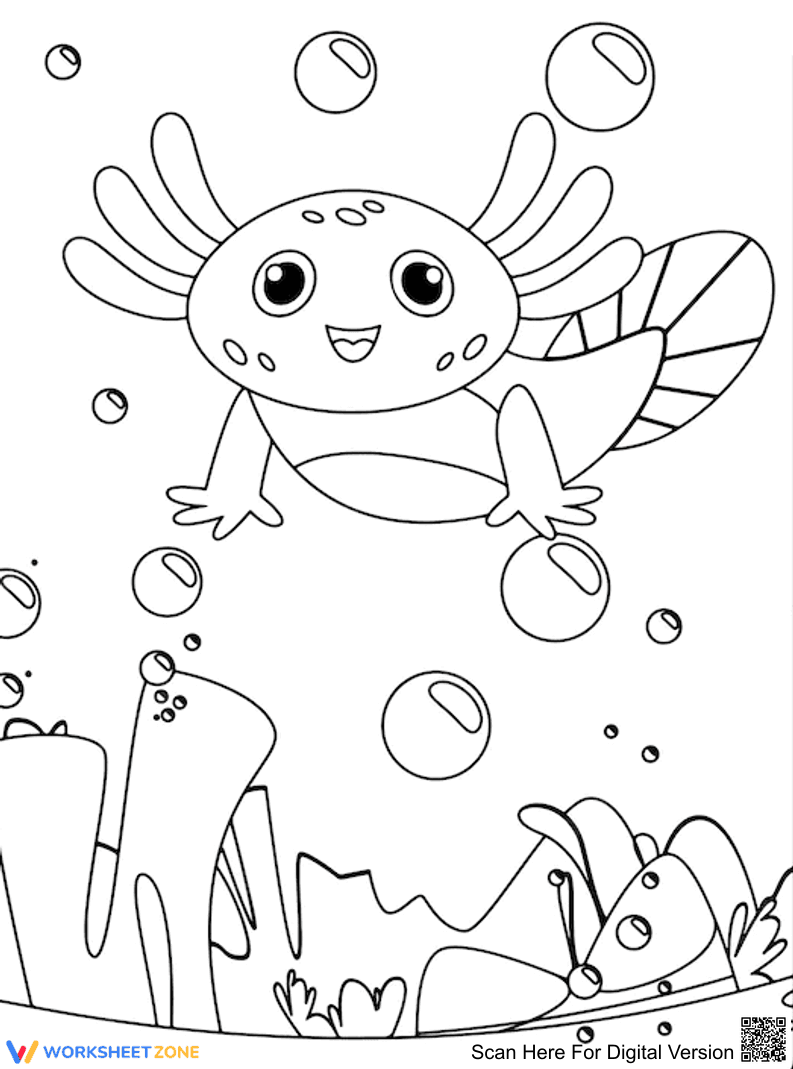

Pretty Axolotl Coloring Page | Essential Grade 1-5
Paste this activity's link or code into your existing LMS (Google Classroom, Canvas, Teams, Schoology, Moodle, etc.).
Students can open and work on the activity right away, with no student login required.
You'll still be able to track student progress and results from your teacher account.
This printable axolotl coloring page provides elementary students with a creative outlet to develop fine motor control and artistic expression. By focusing on the unique features of this aquatic salamander, learners engage with biological themes while practicing precision. It serves as a high-interest activity for early finishers or as a thematic supplement to science lessons.
At a Glance
At a Glance
- Grade: 1-5 · Subject: Arts & Crafts
- Standard:
VA:Cr1.2.1a— Use observation and investigation in making a work of art- Skill Focus: Fine motor precision
- Format: 1 page · 1 task · No answer key · PDF
- Best For: Early finishers and thematic art
- Time: 15–20 minutes
What's Inside
Inside this resource, you will find a single-page, high-resolution PDF featuring a "Pretty Axolotl" in its natural-style underwater habitat. The illustration includes the axolotl, bubbles, and coral elements, providing various textures for students to color. There are no complex instructions, making it immediately accessible for students across multiple elementary grade levels without teacher intervention.
Zero-Prep Workflow
The zero-prep workflow for this worksheet is designed for maximum efficiency. First, print the single-page PDF (30 seconds). Second, distribute the sheets to students along with crayons, markers, or colored pencils (1 minute). Third, allow students to work independently while you transition between lessons or manage small groups. Total teacher preparation time is under two minutes, making it an ideal sub-plan addition.
Standards Alignment
This activity aligns with `VA:Cr1.2.1a`, which encourages students to use observation and investigation in making art. While primarily an artistic endeavor, it also supports `1-LS1-2` by allowing students to observe and color the specific physical patterns of an animal. Both standard codes can be copied directly into lesson plans, IEP goals, or district curriculum mapping tools.
How to Use It
Use this worksheet during a "Science and Art" integration block after a lesson on amphibians. It works exceptionally well as a formative assessment tool; observe how students handle small details like the axolotl's gills to gauge fine motor development. Expected completion time ranges from 15 to 20 minutes depending on the medium used.
Who It's For
This resource is designed for students in Grades 1 through 5, particularly those who benefit from tactile, creative tasks to reduce anxiety or transition between subjects. It pairs naturally with an informational text about Mexican water monsters or an anchor chart detailing the parts of an amphibian during a biology unit.
Research from the RAND AIRS 2024 report emphasizes that integrating creative arts into the primary curriculum significantly improves student engagement and retention of thematic content. This worksheet, aligned to the VA:Cr1.2.1a standard, focuses on the plain-English skill of using observation to create art. By engaging with the "Pretty Axolotl" illustration, students practice the fine motor precision necessary for handwriting and detailed scientific drawing. Studies by Fisher & Frey (2014) suggest that such low-stakes creative tasks provide essential cognitive breaks that allow for better processing of complex academic information. This 1-page PDF is a high-utility tool for educators seeking to balance rigorous standards with student well-being. The inclusion of specific biological subjects like the axolotl also supports cross-curricular literacy by providing a visual anchor for vocabulary acquisition in the life sciences, ensuring that artistic time contributes to overall academic growth and developmental milestones.


